Arndt-Michael Meyer
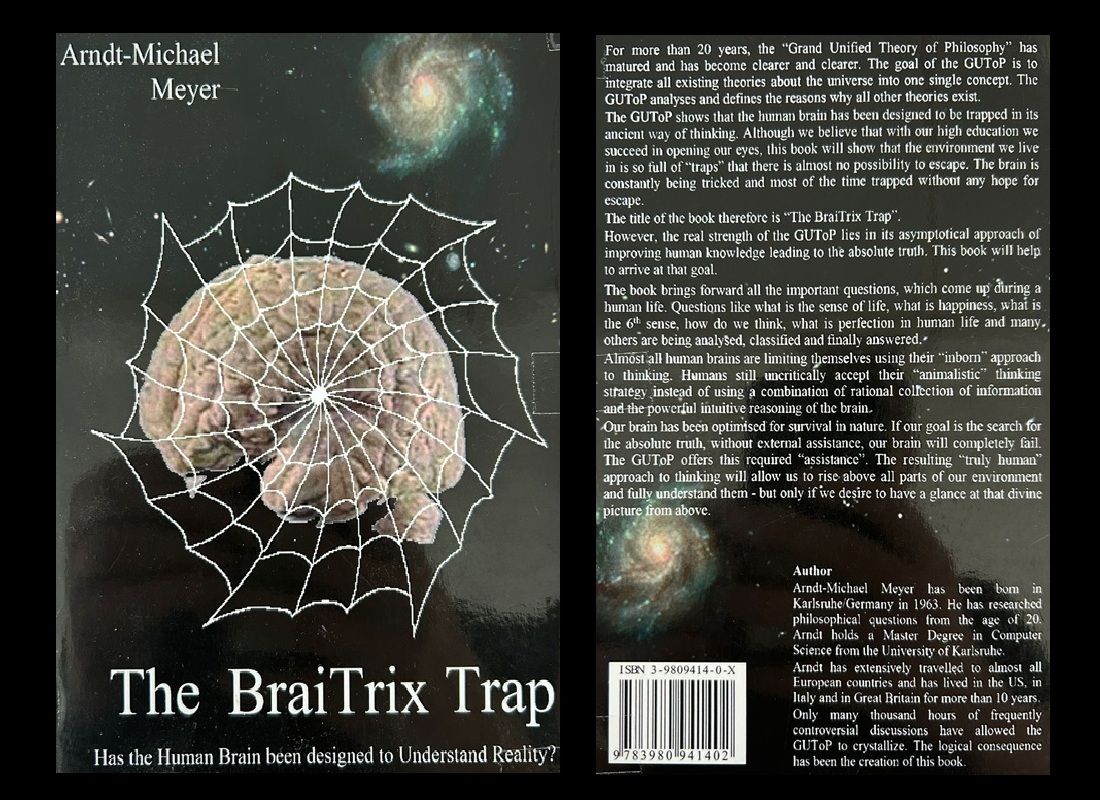
The BraiTrix Trap
Has the Human Brain
been designed to
Understand Reality?
Updated 2026
Cover: Arndt-Michael Meyer
Author: Arndt-Michael Meyer
Production: MAk-Tec GmbH
Made in Germany
Copyright© 2026 All Rights Reserved
Licensing: CC-BY 4.0
The text will soon be available as an audio book.
Content
1 Preface 8
2 Preparation 10
2.1 Reading Instructions 10
2.2 A Letter to Friends 12
2.3 Motivation 13
2.4 Some Definitions of Words 15
2.5 What you will know after having read the Book 16
3 Nature 18
3.1 Darwinism 18
3.2 The Concept of Darwinism 19
3.3 The Speed of Darwinism 21
3.4 Some Conclusions from Darwinism 22
3.5 Darwinism in Action 28
Partnership 28
The Mating Game for Males 31
The Mating Game for Females 32
3.6 The Implications of Darwinism on our own Lives 34
3.7 A new Word is required 35
3.8 Difficulties with Darwinism 36
4 Brain 38
4.1 The Matrix 39
4.2 Some Sensors some Connections and a Brain 41
4.3 The Form and Function of a Brain 44
4.4 Train your Brain 46
4.5 What is the Use of our Brain? 50
The Driving Force for Humans 50
4.6 How do we think? 51
The Learning Process 51
How does a Neutral Network work? 52
The Coffee Expert 53
The Rubber-Band Strategy 54
4.7 How clever is the Brain? 56
The Turbo in our Brains 57
The Self-Organisation of Thoughts 58
4.8 The Reality Quotient (RQ) 60
4.9 Complexity of Problems 62
Limits of the Human Brain 65
4.10 Different Types of Brains 66
Supernatural Brains 66
Natural Brains 68
4.11 Differences between the two Types of Brains 68
4.12 Education and Predisposition 70
4.13 Rebuilding the Human Brain 71
4.14 Some Examples of the Brain in Action 74
Giving Estimates 74
Differences between Languages 75
4.15 Are we able to Change the Way our Brain works? 76
5 Truth 77
5.1 The Absolute Truth 77
5.2 Doubt 80
5.3 The Model of the World of Philosophy 80
5.4 Are we prepared to find the Truth? 83
5.5 The History of Truth 84
5.6 The Question of our Existence 87
5.7 All possible Systems 90
5.8 The Database of Human Knowledge 93
5.9 The Development of the GUToP 94
1st approach (not successful) 94
2nd approach (not successful) 95
3rd approach (not successful) 95
4th approach (partially successful) 96
5th approach (partially successful) 98
6th approach (partially successful) 99
7th approach (successful) 99
5.10 Proofs for the non-existence of Supernatural Forces 102
5.11 Evidence clashes with Reality 103
5.12 What is Truth and what is true? 104
5.13 What is Rational Thinking? 106
Destroying the Brains Logical Thinking 106
Curing the Brains Logical Thinking 107
5.14 Being Critical 107
Handling Probabilities 109
5.15 Prerequisites for the Search for Truth 111
5.16 Do we want Truth? 113
5.17 The Wishful Thinker 115
5.18 The Realistic Thinker 116
5.19 Approaching Truth 117
5.20 Universal Truth 119
5.21 The GUToP 121
5.22 The Pattern of a Philosophical Discussion 122
6 Philosophy and Physics 124
6.1 How it all begun 124
6.2 The Creation of the Universe on one Page 125
6.3 Applying the “the most likely will happen” Rule 126
6.4 What could be the Future Results of Physics 128
6.5 Limits and Shortfalls of the One Rule System 130
7 Religion 132
7.1 Can Religions be Critical? 133
7.2 Is Religion made by Humans? 134
7.3 The two Models: “God” or “No God” 138
7.4 Seeking Relieve in Religion 140
7.5 The Logical Chain leading to the Belief in God 141
7.6 Questioning the God Model 144
7.7 An Example of Religious Belief 150
7.8 A World without Religion 151
8 Thinking 154
8.1 The different Methods of Thinking 154
Biased Thinking 154
Critical Thinking 154
Egoistic Thinking 155
8.2 Does Critical Thinking depend on Intelligence? 155
8.3 Thinking Traps created by the Brain 156
8.4 Discussions between the two Tribes 157
8.5 Challenging the Unknown 158
9 Life 159
9.1 What is Life? 159
9.2 Other Forms of Life 160
9.3 Life in alternative environments 162
9.4 Characteristics of a natural intelligent being 162
10 Culture, Ethics and Society 164
10.1 Ethics 164
10.2 What is the Reason for Ethics? 165
10.3 Culture can make Life very hard 166
10.4 How to Organise a Society 169
10.5 The Ethics Spread Sheet 171
10.6 The best Economic or Social System 173
10.7 When did Culture Start? 175
10.8 Difficulties in Groups 176
10.9 Is Orwell’s “Big Brother” the Replacement of Religion? 177
11 Interesting Questions 178
11.1 The 6th Sense 178
11.2 Free Will 179
11.3 What are Emotions like Love and Hate? 183
11.4 Human Perfection 184
Perfect Love 184
The perfect Interpersonal Relationship 185
Can a Human be perfect? 185
Happiness 186
11.5 Why do we need Economic Growth? 186
11.6 How to discuss avoiding Conflict 189
11.7 The Solution to the Smoker Problem 192
11.8 Philosophy 193
11.9 Our own Death 195
11.10 Sense of Life 198
11.11 Why do we need Fortune Tellers? 201
11.12 What will the Future bring 202
Rebuild a Human 202
Problems in Society 203
Intellect becoming a new Trend 205
12 Comments on Philosophic Statements 206
13 Comments on Famous Quotes 221
14 Brainstorming 230
14.1 The Limits of Rational Thinking 230
14.2 Could the World be run by a Computer Program 230
14.3 Economy and the Happiness of People 231
14.4 Logic and Life are completely related 233
14.5 Designing an Alternative Nature 233
14.6 What will the Future bring? 234
14.7 At what Age should a Child learn that Santa Claus is a Fairy Tale? 234
14.8 The Death Penalty 236
14.9 Collection of miscellaneous Thoughts 239
15 Conclusion 244
16 Main Statements 246
17 Bibliography 248
Warning:
The only goal of this book is the search for truth. Anybody in search for truth will arrive at the exact same conclusions. The Great Unified Theory of Everything (GUToP) is being presented in this book. The GUToP is the only realistic and truthful way to approach the subject of philosophy. There is no partial solution. If the goal is the truth there can only be a global solution, i.e. the GUToP.
Truth is fully independent from emotional human desires.
The GUToP (Great Unified Theory of Everything) may be your wakeup call.
If you like what you see, once your brain has woken up, life will suddenly become quite easy.
If you do not like what you see, it will be better to sleep through the alarm.
A “wishful thinker” will not have the search for the truth being his or his brains emotional desire. He therefore will not be able to join us on our journey towards the truth.
1 Preface
This book sums up all the important things a human wants to know about the universe, nature and his own life. Initially this task seems impossible to be done, in particular not in such a short book. However, we will see that it is perfectly possible
The reason for this success lies in the nature of human thinking and the way in which complex systems like any system in our close or far environment need to be described.
Nobody will ever be able to describe even the simplest complex system in all its details. However, what a human brain intuitively and perfectly does is to build a picture of every system its encounters. No matter how hard we try, when building a picture, we will always seek for more details. However, all we need to know to build a “valid” picture inside our brain is the accuracy of each single piece of information we keep in our brain.
Initially our picture will be based on vague information. Important is that we know that we build our picture based on vague information. To improve the clarity of our picture we just add more and more information together with the awareness of the level of accuracy of this additional information
This book allows everybody to “see” a perfectly clear initial picture. Once this picture will be visible, we will be able to increase its accuracy "step by step". Even an insignificant increase in quality of a piece of information could however require hundreds of additional hours of reading and studying.
Therefore, going into such detail does only make sense for specific pieces of information in which the single reader is particularly interested. An important fact is that none of these specific pieces of information will ever be known beyond certain accuracy. Knowing this, the reader should rather try to get the whole picture right, than trying in vain to reach perfection in a few single pieces of information.
The GUToP (Great Unified Theory of Philosophy) will show how everything humans experience in their lives fits together. On the theoretical side, it will show the questions, which are still open, and the questions, which will remain forever unsolved. On the practical side, the GUToP will allow humans to improve the accuracy attached to knowledge in a continuous way. For the first time in history, philosophy will not be running in circles, but is able to improve continuously, in order to reach the maximum level of accuracy possible for each question. We are able to make this achievement independently from a definite knowledge about the composition of the universe.
An important part of the GUToP is to show, how humans work or better how our brains work, why our brains work the way they work and what consequences this has for our human life.
However, please watch out. The truth could hurt!
In most cases, our brain will protect us from getting hurt. The fulfilment of emotional desires dictated by our brain will filter any information accordingly.
From experience, I would predict that less than 10% of educated people would be able to understand and accept the theory described in this book. This number will obviously strongly depend on the type of person and their associated state of the brain. The likelihood is quite high that most people will remain caught inside their BraiTrix.
The natural behavior caused by our brains is that we will only partially accept a new theory. The parts we accept just happen to fit our current understanding of the world. We have no problem integrating matching pieces of information into our own personal view of the world. If the information does not match, the brain will alter or discard it.
Human thinking roughly follows the following scheme:
• “Universe” is about dead matter
• “Nature” is about living matter
• “Human” is about spiritual matters
I will show that the three subjects: “universe, nature and human” are very much interrelated and that all three subjects follow the same mechanism.
One of the most important questions is why different people see things differently. Therefore, this question will be a large part of this theory. The GUToP will allow analyzing, classifying and understanding all our questions.
During our journey towards the universal truth, a new word is needed and is being defined. Questions like whether we have a free will, what the concept of dying means, what the sense of life is and many others are being answered.
The GUToP will change the way we see ethical questions. Therefore, it will eventually have quite some impact on society. This impact however will be very slow. If ever, it will take several generations for the masses to understand and accept the GUToP.
Max Planck already said, “A new theory never triumphs. Only the people sticking to the old theory will eventually die”.
Arndt-Michael Meyer
January 2004
2 Preparation
The GUToP is a revolution to thinking. It is much more than the introduction of critical thinking. It is the introduction of a complete theory, which allows understanding the behavior of every person as well as every other object in the universe.
Please be aware that when dealing with complex systems, there is no possibility to provide a hard proof of a statement. The only feasible way to “prove” a complex system is to “understand” its components and then allow your brain to simulate it “automatically”. If you are not experiencing any contradictions, when using your unbiased intuition, you have “proved” the correctness of your view of the system.
2.1 Reading Instructions
The most important method to read this book is adding you own personal probability number in percent to each section. The printed probability is the probability with which the author rated the section at the time he wrote the statement.
[90%] [ ] [ ]
When re-reading a section of the book a second time, you might want to adjust the probabilities you had put in the time you read it before.
When your probabilities do not change anymore between the times you re-read the section, you have arrived at your own personal opinion. This opinion could change with time. The likelihood that your opinion will change increases with every different opinion you hear. The most powerful means to challenge your own opinion is the “controversial and emotional discussion”. Obviously changing your opinion will greatly depend on the openness or “softness” of your brain.
Different “truth seekers” will attach different probabilities to the single sections. For complex systems, this is quite normal. However, if most probabilities differ by much from the printed probabilities, we can assume that this reader is a “wishful thinker”.
The complexity and the quantity of things humans have found out are too big to keep in a single brain. Therefore, each human will only keep a subset of human knowledge in his brain. We need to make sure that we know with what accuracy and probability the different pieces of information are stored in our brains.
To demonstrate this, I will use the following example.
In the chapter “Some Conclusions from Darwinism”, I will explain how a couple is able to choose with quite a high probability to conceive a baby-boy or baby-girl. I will also explain why this characteristic has been introduced by nature and how nature implemented this characteristic.
During the research for this “baby-boy or baby-girl” subject, I had found many additional pieces of information. Sometimes the information had not been in accordance with my statement. Sometimes new details were added.
Therefore, the conclusion of the “baby-boy or baby-girl” subject for the GUToP is that it is very likely nature invented this feature, because it served for the success of the human species. However, the details are not yet very accurate.
If humans wish to increase the accuracy of this specific statement, they will be able to research further and consequently bring the probability that this “feature” is really a genetic feature, as well as how it is implemented, to 99% or even to 99.9%, but we will never arrive at 100% accuracy, because there are no 100% facts in nature.
Currently I would rate the probability that the “baby-boy or baby-girl” feature, in the way I describe it, is a true statement with a probability of 95%. In the text, you will therefore see:
[95%] [ ] [ ]
Throughout the book, feel free to put in your own probability percentage. It will encourage discussing with yourself or with friends. It will also allow verifying whether your way of thinking changes over time.
It is interesting that humans accept to write down exact instructions on how to build complex machines and describe these building processes very accurately. However, whenever we approach human feelings and other soft sciences, humans completely oppose to accept that we are able to write down any instructions.
We do not doubt that an engineer is able to give exact descriptions how to design a new material, a new machine or a new computer. We accept that he, his team or anybody else constantly improves new components or redesign the whole thing.
However, when we touch feelings, we say, “Stop! This cannot be described! You have no right to analyze me! I do not work like a machine! You will not be able to find out who I am! There is more to me than what you see! There is a secret behind nature!”
The GUToP completely breaks with this human centric view. Anything will be analyzed and described without emotions, but still the GUToP allows each person to have whatever view he wants. The GUToP only analyses and tries to understand why humans have so many different views of this same world we all share.
The GUToP is not different to what “normal people” have been doing during all their lives with the toaster in the kitchen and most scientists have been doing in their contained field of research. The GUToP is the globalization of that “cold”, “analytic” and “scientific” spirit.
2.2 A Letter to Friends
To begin with, I want to show my way of thinking and communicating. Therefore, I decided to print a letter I had written to two friends in April 2003.
I have partially read Telmo’s book – “Homo sapiens e altre catastrofi” , chapter 1 & 2, some parts in the center and the final chapter. Unluckily I am too slow reading Italian. This disturbs me, as I cannot go my pace.
I agree with almost all the things I read. The important thing about evolution is that you cannot predict; you can only interpret the result and find a reason why it is as it is. If we would have 100 different types of humans on earth, from 30 cm to 3 meters and from an IQ of 20 to 200, which have specialized on different things, well, then it would be like that and we would find (or try to find) an explanation why “humans” are like that.
For some time, I thought that, it would be important to search for “the impact of industrialized life on natural selection”, but this will not give any important result. Because we need just some 100 to 1,000 years until we will have full control over the human DNA. Even if we fu** it up big time, there will still be some humans with “good” DNA - whatever that means -, which can survive.
Even in case, that there will not be any human DNA to survive it will not matter. The universe will just move on - and there is no plan in that. Nature has no plan; the result of what is happening is “nature”.
Interesting is the fact (I think it is a fact?) that, when there is water plus some elements and some heat, after some long time (millions to billions of years) some kind of life forms. Life for me means that there is this mechanism, which transforms matter into “something else”. So, the heat and the water could be replaced by different entities. Important is that they “move” or automatically transform themselves.
This new “something else” will be mainly composed of things that form more easily or quicker, are more resistant, etc. This leads to the matter being transformed to this “better matter”. However, inside this better matter the process of "life” (evolution/selection) will make sure that the matter will be transformed again into something better. In the end, this leads to nature, as we know it.
We can look at it as a game the universe plays, because if the living conditions become impossible "life" stops.
However, when the right conditions are met again this whole process will start again. By the way, it will start at zero! Maybe its result will be different, or it will not finalize at all in some form of life that can think, but that does not matter. Nothing matters.
A good question here is "Are there other ways that life can form? Could there be a different "nature", which is based on a different rule?"
Ad-hoc I would deny this. Life, as we know it, is an automatic process that starts when the conditions are right. The rule is “The better matter multiplies” and by the way, there is no end to this. Nobody wins! We cannot say “And the winner of Universe XXX is the earth”. Everything flows; nothing is fixed - except for the rule.
I am currently researching in the field of designing a model to classify information. Well, I should put it more lightly: “I am thinking about...”
The IC research (Information Classification) seems a challenge to me. Most people do not understand what I try to find out. Maybe they are right, but I think that information can be classified. Therefore, if we would have a system to classify information, we can ask different people to put the information into the appropriate “boxes”. We would get a statistical distribution of what “real” people think and derive from that what makes sense now and then improve the derived knowledge with every new cognition (idea) humans or machines are developing.
The result - if there should be one - would be a collection of “things” which are true.
These true things will obviously be “seen” by humans in different ways. This “different view” can be imagined as filters in front of the truth. These filters can be defined. That means we know why a certain person “interprets” the truth in his way. However, that does not make the truth false, it just means that the human is “human”, that means not realistic.
Well, that is what I do at the moment besides studying Russian, going out, working too much, doing some sports and travelling a bit.
2.3 Motivation
Every month many new books on supernatural subjects appear. Most of those authors write about humans and their feelings, even though the scientific positioning of the book suggests that it must be independent from personal feelings.
This emotional type of writing is excellent when the goal is to give the reader something that is of emotional interest. However, it is bad if we want to discover scientifically what is true and therefore must be independent from personal interest.
The human brain likes to hear things that allow the brain to continue to live in its own reality. Forcing the brain to give up an old belief is maybe the most difficult thing for a brain to do. Unluckily this is also true for many brains of scientists.
In a computer, you are able to load a new program within seconds. Contrary to that, the human brain requires years to “supplant” an old program or belief with a new program. This is already true for the brain of a young person. For the brain of an adult re-programming might become impossible. After the re-programming, the old belief may still be around, as there is no easy and secure way to remove completely the original belief .
From philosophy, I have not received a consistent and universal view of the world, but only disconnected bits of useful information in an ocean of idiotic, useless and false statements and ideas.
There is nothing difficult inside this book. Every single statement and concept in this book is understandable. There are no formulas at all. Formulas would need physical and mathematical knowledge to understand. This knowledge is not required, although a well-trained brain helps to understand the GUToP.
The only difficulty for the reader will be to understand the implications of one simple rule applied to a starting condition. The rest is normal human thinking or human intelligence applied to the world we experience every day.
This book could be 2 pages (see the Chapter: Main Statements) or 2,000 pages, the basic concept behind the book will be the same. If the length of the book would be two pages, it would take many years for the reader to find out all the implications and often there would be errors in his conclusions. A book of 2,000 pages I could not write because of lack of time and such a long book would likely not be read by many readers.
Therefore, I decided to keep the book to about 200 pages. This length allows explaining the main ideas in sufficient detail and giving enough examples to make the concept clear. The examples will help the reader to think about real life situations onto which he can apply the new GUToP theory. The examples allow having anchor points and they offer a base to build upon.
Another reason for this book was that, to my knowledge, there are only biased publications about this kind of subject. The believers are biased towards supernatural things and the critical thinkers are biased against supernatural things. In the dispute between the two currently there is no concept that allows building up a consensus.
The idea is to create a theory or concept that allows building up the knowledge of the universe. This knowledge of the universe is human knowledge, but only because humans discovered it and wrote it down. I expect that any other intelligent being would come up with the exact same view when confronted with our world.
The GUToP crystallized during a 20-year period of research. It has not been designed, because there has never been a goal to design it. The GUToP is the result of a nature-like design process. During the whole 20 years, any result was possible.
Some people live according to the rule that the “way along the middle” is the best. When looking for an answer to a problem, they usually combine parts of different theories. They intuitively feel that the “way along the middle” concept is the best answer.
They are right. Actually, it is the best answer!
However, it is the best answer only if you want to create harmony for you and your environment. The “way along the middle” concept will completely fail when your goal is to arrive at the truth.
2.4 Some Definitions of Words
In the GUToP, we separate between logical reasons and emotional reasons. As always in nature, the two types of reasons cannot be fully separated. In every decision, there will always be some emotional reasons as well as some logical reasons.
When the emotional level is dominating, the following words will be used:
• Wishful thinker, believer
• SNF, supernatural force
• Faith, belief
When the rational level is dominating, the following words will be used respectively:
• Realist, non-believer, scientist
• Physical laws
• Probabilities
“Emotion”
The driving-force for humans is the emotion. The brain’s desire is to experience positive emotions. All information in our brain is linked to emotions. The genetic predisposition will have created an initial strategy how to link information to emotions. During the active and passive education of the human brain, the links will be altered, but usually only to a very small extend. These emotional links decide what we are going to think, not the logical relationship of the information itself.
“Pragmatic approach”
The “pragmatic approach” is the key to success. To use a “pragmatic approach” means that we will search for the optimal solution using our available resources . For an optimal solution, we will have used our resources correctly weighted. We must not spend many of our resources for unlikely solutions .
It is interesting but perfectly true that the brain understands complex systems only after having understood them almost perfectly already. The understanding of a complex system does not arrive during one session. The understanding arrives over a period of many days, weeks, months or even years. When we finally shout “eureka”, our brain has adjusted the last association required for the understanding of our problem. All the other required associations our brain had “silently” adjusted before. In general, humans wrongly assume that only the last association was important and that the learning was done in one split second. This is completely wrong.
Important to know is that we always give an answer independent from whether we use a “pragmatic approach” or any other approach. Problems concerning complex systems are however not solvable if no “pragmatic approach” is being used.
Examples of answers are:
• Think nothing or say nothing
• Say: “I do not know”
• Say: “It does not matter to me”
• Say: “Put into one sentence, the answer is the following:”
• Say: “Having just one day, the answer is the following:”
• Etc.
The best answer for complex systems will always be “I do not exactly know, but the chances are X% for solution1, Y% for solution2, etc.”
2.5 What you will know after having read the Book
The content of this book has been researched over a period of two decades. This required implementing billions of associations inside my brain. Depending on the starting condition of the reader’s brain, it will take weeks, months or even years to implement similar associations.
Reading a book on such a global theory like the GUToP will require touching almost every piece of information the brain has ever learned. Touching any piece of information inside the brain will always result in changed associations concerning this piece of information with other related pieces of information.
Each piece of information inside the brain will “defend” its many existing associations. This makes it a hard struggle for a new theory to “take possession of a brain”.
The general difficulty of philosophy comes from three independent reasons:
1) We will never be able to prove that the universe or the system in which we live is the whole system.
2) The complexity of the universe or the system in which we live is so high that the calculation of probabilities of certain sub-systems often leads to completely different results stretching from 0% to 100% excluding 0% and 100%. The different results often derive from just slightly different probabilities for the base facts we use for our calculation. To formulate it better, I need to say for our simulation of the model of the system inside our brain.
3) The person is not interested in searching for the truth. He is only interested in proving that what he feels or thinks is true.
3 Nature
Nature has no goal
This sentence has been commonly understood, however the interpretation of the implications of this sentence is still quite difficult.
Although this chapter is entirely on Darwinism, I will not explain the concept of Darwinism. There are many excellent books on Darwinist evolution.
What I will do is to give some examples of applied Darwinism. None of the examples describes a 100% fact, because 100% facts do not exist in nature. Reflecting about the examples should help the reader to develop his own feeling for Darwinism and to notice what evolution means to human life. This is the only possible approach to handle the complex systems of evolution.
3.1 Darwinism
To me “The blind Watchmaker ” still is the best book on Darwinism. The concept of Darwinism is very simple, but it is impossible to describe, understand and predict all the implications of Darwinism. There are too many constraints and they are too complex to fully describe. Therefore, although the concept is clear, it does only allow estimates of what has happened (in the past) and what will happen (in the future).
The GUToP is using the concept of Darwinism, but this concept will be put into a more global picture to create a full theory that spans from physics to ethics. It will go further, going into subjects like “Why is there religion?” and “Why does the brain work like it works?”
The homo sapiens has proved to be successful, but might be extinct in a thousand years and then it might take millions of years on the earth until other animals will find the right balance between genetic capability and the environment to develop intelligence again. This development might be in vain, as “developing intelligence” is not nature’s goal. To be “successful” is the only importance for the species. For nature, nothing matters. For the single species success matters, and simply by the fact that this species exists, it has proven that it has been successful and most probably will be successful in the near future.
There is no end to evolution. Even if humans continue to be successful for quite some time, in a billion years the human species might have died. The only thing that lives on is matter and as long as there is matter, evolution will continue.
[95%] [ ] [ ]
A brain caught in the BraiTrix trap from a Darwinist point of view is not a bad thing. If the species is more successful with a BraiTrix instead of a rational thinking brain, so it will be. To express the concept of our brain being tricked all the time, I invented the word “BraiTrix”
Saying: “Nature’s goal is to find a way to be more successful.” is misleading. Unluckily the human language does not have the right word to express nature’s “no goal” design concept. Later in this chapter, I will define a new word to express nature’s evolutionary concept.
It is difficult for a human to understand that during a design process there is no goal. However, we all know that nature’s design concept leads to fascinating results, for example the lovely girl next door ;-)
Nature’s design process however is unbelievably slow! It took several billion years to design life for which it will take humans about 100 years to understand and maybe a thousand years to copy.
It cannot be ruled out, that in the future humans will be able to design a better system for nature as we currently know it from nature. More on this subject will be covered in the chapter on Life.
[95%] [ ] [ ]
The goal of nature when designing the human or the human brain has been completely different from the goal to find the truth. Therefore, a search for the truth using the “natural” brain approach cannot be successful. Only a logical and rational search can finally make humans rise above themselves and allow them to analyze who they are and why and where they live. To rise above ourselves is something humans wrongly believe that they have achieved already!
[99%] [ ] [ ]
3.2 The Concept of Darwinism
At school, they teach us Darwinism. However, after we leave school, do we really have the correct model in our heads? We all think to understand Darwinism, but in reality, this is not true. It is even worse! Because everybody wrongly assumes to understand Darwinism, nobody sees the necessity to study and reflect further.
It gets even worse when people have to understand and accept that they themselves have been genetically programmed by evolution. I have not met many people that like the idea that they are genetically programmed. Therefore, their brains rule out this possibility and the owner of the brain sits in the BraiTrix trap.
I catch myself every occasionally with a conclusion involving Darwinism, which does not hold true when challenged further. A common error is to think that when we behave in a certain way we have the backing of the evolution that what we are doing is good. Only time and many generations will show whether a characteristic has allowed the species to be “successful” in a (changing) environment.
[95%] [ ] [ ]
To be successful in nature, there are just two choices:
1) you survive and the others get killed
2) you propagate more successfully than the others
3) a combination of 1) and 2)
Characteristics that are only in the culture or education will not persist. The genetic programming will be dominant. Genetic programming can be overruled by learning. However, the moment you take culture away the old genetic programming will bounce back. We see that only genetic programming will persist in the different societies.
The human child goes through a 20-year training period, so the human is the living being that is most dominated by its culture.
There is a big difference between genetic programming and learning, although there might be some indirect interconnections between the two. That means that a better learner will most probably be more successful . Therefore, in the next generation more members will have better “learning capabilities”.
[95%] [ ] [ ]
Darwinism does not necessarily mean that the stronger will survive. We only think that, because we see the stronger animal winning against the weaker. However, this is not a general rule. What is true is that when we look at the gene pool, we will see the status of what has been successful. Looking at fossils, we might discover what has not been successful in the past.
The more successful does not have to be the stronger. Inside a species, it usually is the stronger, but this is not necessary. It could be the smaller, the faster, the more intelligent as well as many more characteristics.
It could be that a “successful” branch, after some time, dies out and a formerly less successful branch will win. It could even be that the living being with certain characteristics does not itself have descendants, but the ones that produce descendants, will make sure that the right distribution of genetic programming is inside the genes, which are being passed on. In that way, the genes make sure that the different types inside the species are fulfilling all tasks in the community. This is especially true for animals that live closely together and can only survive as a group, for example ants.
[95%] [ ] [ ]
3.3 The Speed of Darwinism
The speed of evolution depends on many things. If the necessary genetic characteristics are essential for survival and only the ones with those same characteristics mate, then it has a “turbo effect” on selection. Some few generations will be enough to change completely the distribution of genetic characteristics. Normally the characteristics will not have this turbo effect. For them it might take thousands of generations to increase significantly their weight inside the gene pool.
As an example of a turbo effect, we can take a dog propagator. He will succeed within 20 generations to change the race of a dog into quite funny looking animals. If nature finds the right environment that forces this strong and exact selection, then the change will be quite fast as well. However, the change in nature usually is quite slow. The benefit of this slowness seems to be that life is more robust if having been “designed” slowly.
[90%] [ ] [ ]
Nature tries out many different examples where the result can only be seen after many years. This is just a game, everything flows, and nothing has persistence, except for the mechanism itself.
There is a difference in extrusion based on time and extrusion based on space. If a tribe is better than another tribe is, then they could kill the others, or they just propagate more, so that after some generations the more successful species will be more numerous. Any mechanism that helps the species to be successful could have been considered by nature, as nature does not have many limits regarding its creativity.
The killing of other tribes would be a faster strategy to short-term success, but if killing of members of the same species persists in the genes, then this will most probably prove unsuccessful for the species as a whole.
In nature, we do not see many species that kill each other. The killing each other concept does not seem to be a successful concept. The concept of chasing others away is much more successful. It allows the species to expand into all territories that meet the requirements for that species. Only in case that there is no room, then the fight inside the species will get harder and often the weaker will be less successful, by having less descendants.
The conclusion from this is that animals do not spare each other because they have an ethic, but because it has proved to be a more successful characteristic.
[95%] [ ] [ ]
A very strong factor in the quality and speed of the selection process and the creation of new species is the “almost extinct” factor. Whenever a species has to go to its limits and beyond, when only few survive, then the new species will have exactly the characteristics that made it survive. This can happen when the environmental conditions change or members of the species migrate. Only those that survive the new environment or survive the long journey through the desert or the sea will contribute to the new gene pool. The survivors have the genes that make them survive during those critical situations.
The few, which do multiply, might alter the genetic multitude even more. They might be subject to inbreeding. We think that inbreeding is something bad, but remember that we are looking at nature where beings that are disabled because of inbreeding will not survive. So, inbreeding although dangerous to the single member might not be dangerous to the whole species. If 9 out of 10 mutated members die before they can propagate, it does not matter to the species if the 1 out of 10, which survives, has the new characteristics, which allow the species to be more successful.
[90%] [ ] [ ]
The conclusion is that when there is constancy and a lot of food that the selection process is slower compared to the situation when there is change, little food or other extreme situations.
3.4 Some Conclusions from Darwinism
This section contains some examples of characteristics of the human race that seem obvious. However, they do not seem to be accepted generally. Have a read, reflect and then decide yourself.
What counts is not your personal characteristic or your personal belief, what your own personal characteristic is. The chapter is about the statistical distribution of certain characteristics in the human gene pool. Some members have that characteristic other do not. Some members have genetic characteristics. However, culture and education have covered the genetic characteristic.
If the human species would die, “nature” would just “notice” that the species “human” was not a successful one. The Neanderthal was successful for some thousand years, but then disappeared. Lucky for us was that the Homo sapiens survived. However, nature does not care. The reader would not care either, as he would not be reading this book ;-)
[99%] [ ] [ ]
Fire is quite easy to make. With lightning, the ancient humans saw fire and they will have used it and will have understood how it worked. However, they did not have a scientific approach. They “learned” that wood burns and that fire hurts, but also gives warmth. Try rubbing your hands for 10 seconds. That produces already enough heat to burn your hands. Therefore, it will have been possible to make the link even for “unscientific” ancient humans. The important step was not to make fire, but to copy what you see, improve what you did in the past and make conclusions based on former experience. In a very basic form, many animals do that already. The human species was lucky to have all the requirements so that its selection process was based on growing intelligence. That was the key for the development into a species with such a powerful brain.
Humans have developed into a race that based education not only on the parents, but also on the whole tribe and even developed the characteristics to be able to “copy from other humans”. They lived close to other tribes, so they had regular contact and learned from others. This allowed distributing new technologies within some hundred years over a distance of several thousand kilometers.
Inventions will have been lost or altered. Some will have been distributed fast, others slowly others not at all. However, the human tribes that had contact with other tribes and learned from them will have been the more successful tribes.
[90%] [ ] [ ]
One of the reasons for the gigantic success of the human race could be that the human babies did not stay silent anymore. That meant that the humans were not able to hide anymore. They needed to become stronger than any other animal.
Therefore, there were human babies, which were silent, and ones that cried. Some tribes with the noisy babies might have killed those noisy babies, some tribes did not kill the noisy babies and hence they were killed by their enemies or they were not able to find food easily, because the noise chased their pray away.
Some tribes, the successful ones, allowed their babies to live and to be noisy. Those tribes found a way to build up a defense system against their enemies and to hunt with a better technology. After many generations, the ones with the noisy babies had developed a defense and a successful hunting system. They were using arms, fences and more tools. They were the ones that had become more successful than the others had because they had developed brains that are more inventive.
[70%] [ ] [ ]
There has been a predisposition in humans to accept a leader. Accepting a leader makes animals living in groups more successful, as they are united and they follow the leader, which often has the best ideas for the tribe.
This characteristic combined with the “fear of something unknown” which is like a blank spot in the brain, which is being filled with the big unknown “leader of the leader”, developed into the belief that supernatural things are a real thing. The “leader of the leader” did not exist, however the tribe that developed brains that favored such a belief were the more successful, because they had more respect for their leader. Therefore, humans have the “ideal brain” for believing in supernatural things. We see this even today, in a time when everything can be scientifically explained, almost every human believes in some form of supernatural power. See the chapter “Brain” for reasons and details.
[90%] [ ] [ ]
The human has many body-internal drugs. Those drugs have been used to control the behavior of humans before reasoning has been “invented”. Music and Religion can be drugs for humans as well. Music is one of the forces allowing unifying humans. Therefore, members with the genetic programming to like music or rhythm were more successful.
[90%] [ ] [ ]
The world could be a cruel world if the society, which did not support the old and weak members, would have made it through evolution. We can be lucky that the “caring for the weak members” society made it.
However, is this true?
I think not.
I think that the “caring for the old” society did not take the lead.
The society that developed the “best compromise” made it! Our society is violent, cruel and at the same time caring. That was the best approach to defend against the “too cruel” societies as well as win in terms of efficiency over the “too caring” societies. Therefore, humans show a compromise between both behaviors inside their genes.
[90%] [ ] [ ]
The human race in the industrialized countries does not follow anymore the traditional selection process. This is not bad itself. However, we have to consider that during the past 10,000 years we have changed a selection mechanism based on natural selection without any help of medicine to a selection mechanism, where we allow almost anybody to survive. People that could not have babies can now have babies. Therefore, these babies will have that “defective” gene which in real nature would not have survived. Those babies once they are old enough might wish to have babies themselves. This is not “good” or “bad”. This is just a different selection process that will lead to a different human gene pool. How long it will take to show in our genes I do not know. Currently only 30% of humans i.e. the ones living in industrialized countries have actually altered their selection mechanism. The others still more or less follow the traditional selection process.
[95%] [ ] [ ]
In the ancient human tribes, when there was a lot of food (good times), more female babies are being born, when there was little food (bad times), more male babies are being born. This was beneficial to the species, because during a time where there is much food the species has to increase in number. This can be done best if there are many female members. If there is little food, many males are required to hunt and defend the tribe. Even if the gene that introduced this characteristic is only a bit more successful, after some million years with various periods of rich and poor supply of food, most of the members of the species will have those genes.
How has that characteristic been implemented by nature?
The male sperm is faster than the female sperm whereas the female sperm lives longer.
How does that influence the quantities of male and female that are being born?
If there is a lot of food, then the members will have more sex, so the likelihood that sperm is already in the female when she becomes fertile is higher. Because the male sperms die faster, the likelihood that the sperm, which meets the egg, will be female will be higher.
On the other hand, if there is little food, then the male will be quite exhausted from going to hunt and have little to eat. Therefore, the male will not take much initiative to have sex. As we know, the female is sexually active when she is fertile, so she will ask for intercourse when she is fertile. The male sperm being faster will then lead to more males.
This is simple but efficient.
[95%] [ ] [ ]
There are many discussions going on about the fact that there are many gay people. The reason for this behavior could be a natural reason. In times when there are no people of the opposite sex in the tribe, the male and the female will still need to be sexually active.
Once the members of the opposite sex are available again, the normal behavior will be re-established.
Especially today, there is so much cultural influence so that many humans have problems with the opposite sex. The brain automatically excludes the people of the opposite sex. The owner of that brain then “virtually” lives in the same condition as if there would be no partner of the opposite sex in his or her environment. Therefore, they follow their genetic programming and become gay or lesbian.
[60%] [ ] [ ]
Have you ever reflected about why humans have pubic hair?
Well, it could be just by chance. Although nature does extensive use of lucky experiments, after many thousand generations, luck has been supplanted by the characteristics that where more successful. Therefore, it was not luck.
Maybe the pubic hair served as a protection against heat, cold and sun. This is a valid possibility. It could be that the ones survived better which did not show their genitals too openly in public.
If you think about the spots where skin rubs other skin, you will notice, that there are just two locations on the human body where skin rubs other skin. These are between the arms and the body and between the legs. If you shave those spots, the likelihood that it will become sore and infected is higher than when leaving the hair unshaved. We have to consider that the ancient humans did not have medicine and they had to work quite hard to survive. Therefore, any infection will have resulted in less success. The pubic hair remained in those spots where it made infections less probable.
[70%] [ ] [ ]
Why do we have not that much body hair as many other animals? Why is it that the male usually has more body hair?
The reason for this is the mating process. The male will spot the female much better and will recognize that it is a female the less hair she has on her body. That could be why after many generations the hairless female dominated.
However, why does the male have more hair than the female? The reason for this is that the male is the more active when mating. Therefore, it is less important for the female to notice him. By the way, the “important part” of him - in case he likes her - can be seen even if surrounded by some fur.
We see that the amount of body hair of the male and the female is an indication on how active the male or female are in the mating game.
There could be other factors. For example, that the male spends more time outside so he needs more protection against the cold and the sun, or that when hunting he cannot be seen easily, or that the female needs to be protected by a house or a male to stay warm. Those factors could have also been very important.
Will we ever know how important those factors have been?
We will only know up to a certain level of accuracy.
[85%] [ ] [ ]
Male and female in the mating game always try to get the best deal. The male is a bit more interested to get the best deal than the female. The female is able to accept compromises much better than the male.
We see that behavior in our everyday lives. Imagine somebody gets famous and rich. If it is a man, which gets famous and rich, he will usually try to meet a new woman. It is very likely that he will succeed. The man will find a young and beautiful “lady”. He will be happy with her. She does not need, or even, she should not be more intelligent compared to him, because the man wants to feel important, especially in his woman’s eyes. Even in the case that she should be more intelligent than he should, if she is clever, she will not demonstrate her supremacy to him ;-)
On the other hand, if the woman gets famous and rich, she will usually try to keep her partner. However, he will not be happy in that situation and the partnership will most likely end, because he does not like the situation.
[80%] [ ] [ ]
A big problem humans face, especially the humans in industrialized countries face, is information overload. There are too many things to consider when taking a decision. The brain automatically tries to reduce this complexity to a level that it can handle.
In the ancient times, the problem of caring about too many people was much less of a problem. Today we receive phone calls, emails, letters and other messages. This reminds us all the time of those remote people.
Reading books, watching TV and watching movies makes us participate in many other lives or environments.
Keeping pictures, films, letters and other memories in our close proximity will remind us for many years of the people we miss or we once knew.
This is a new challenge to our brain. Some handle it well others not. The traditional approach of the brain used to be “Out of sight is out of mind”. Our modern life will allow us to “keep everybody in sight”.
[90%] [ ] [ ]
Another interesting observation in nature is about spiders. The fact that in some species of spiders the female spider might eat the male could be caused by a disastrous period the spiders went through. When they had extremely little food, eating the male after intercourse, will allow the female to get the baby spiders up and running. Instead of surviving without eating for a year, eating the male spider will increase this period to maybe 18 months while digesting daddy. The little ones will thank their daddy ;-)
[80%] [ ] [ ]
3.5 Darwinism in Action
The following chapter contains some conclusions based on different studies, reports and own experiences. Some priorities might not be perfectly right and will be adjusted based on further research.
Partnership
There is one main driving force in humans. It is a bit different for men than it is for women:
• Men will look for a female and try to stay in her close environment. The man will choose the best female that he is able to stay close to.
• Women will pick from the different males, which stay in her close environment. The woman will choose the best of the males that stay close to her.
We see that the decision maker usually is the female. She will pick from the males that have presented themselves to her. She will make it easier for a suitable partner to have sex with her and afterwards when the female feels that it is the right one, she will make everything that he will stay with her and the kids she will be expecting. To make him stay with her she will give him as much sex and coziness as needed. Sexually spoken it is difficult for the female. However, it is very likely that she will have used sexual favors to keep him with her.
This explanation is oversimplifying and it neglects cultural constraints, but it shows the concept of human instincts or genetic programming. It holds true if we like it or not.
[90%] [ ] [ ]
In the old days of evolution, sex did not provide humans with very much “pleasure”. When “animals” fight for survival, they must not waste energy. Therefore, sex served simply to propagate. When food became no problem anymore, sex started to be used as a reinforcing “activity” which you do with your partner(s). This characteristic was needed because the bringing up time of a human child was very long and the group needed to stay united.
Looking at it a bit closer, with all those modern divorce laws in industrialized countries women are actually the winners now. However, in nature the life of a female was not too pleasant. Her luck in those ancient days was that she just got on with her life without reflecting about it. The genes of the ones that did not accept the rude behavior of the male will not be around today. On the other hand, males, which were too rude, would not be around either.
[80%] [ ] [ ]
Why do women think less rational and more emotional?
The female had to take care of the male, the kids and the members of the tribe. This requires advanced emotional skills. Obviously, the female also interacted with nature and physical laws. Therefore, some rational thinking was needed as well.
The male had to hunt for food and females. He had to solve technical problems. This required advanced rational skills. Obviously, the male also interacted with members of the tribe. Therefore, some emotional skills were needed as well.
The conclusion from the fact that the male and the female were facing different environments is that they needed to specialize on different skills. My informed guess is that on average the female uses 40% of her brain for rational things and 60% for emotional things. The male on the other hand uses 60% for rational things and 40% for emotional things.
[80%] [ ] [ ]
The genetic programming of woman and the definition of the word “prostitute” makes women be prostitutes. There is nothing bad with that. Some women have this behavior a bit more and some a bit less . Some take money, some take security, some prestige, some prostitute themselves to just one man, others to many, etc. However, bottom line is she gives sex and tenderness for her and her kids benefit.
That behavior is what nature invented to make humans be successful. Humans define the words. In nature, the normal mechanism is that the male is active and offers something to convince the female. She decides whether she accepts the deal. What does he offer and what does she have to give in return. A human word with a bad tag for this behavior is “prostitute”. However, the concept is not bad itself. Human’s culture defined some situations in which this behavior is considered a bad behavior.
We just should accept this, live with it, and find a way to live happily and with dignity, whatever dignity means to each one of us.
[70%] [ ] [ ]
We might ask what men do in nature. They do much less than women do. We all know that. They hunted for food and fought for women. They were very efficient and effective in that respect.
Now a male reader will say, excellent, in the old days I was walking through the woods and I was able to have sex with all the women I wanted. Stop! No! Wrong!
There were other men around that wanted sex as well. Therefore, there was quite some competition. Therefore, sex was not easy to get. Maybe the man got a kick into his soft parts instead. Maybe even by a woman. Therefore, the male often preferred to stay with his woman, in case he was lucky to have found one. We always have to keep in mind that there will have been equilibrium most of the time.
The female was however more dependent on the male than the male was dependent on the female. That is why she had more tasks to do than he has to do.
[90%] [ ] [ ]
The female and the male will usually look for the best option. If leaving your partner meant that you died of hunger, then this genetic characteristic will not have made it far! Maybe one generation ;-)
However, leaving your partner under certain circumstances can be a successful characteristic. It allows coping with the death of the partner. It allows leaving your partner if he should be too violent and threatens to kill you. It allows going to a better partner that makes you have more kids with a higher survival probability.
Now we have to do the step into the current society. The equal rights idea between woman and men together with a society that supports the concept of divorce formerly unknown to nature or at least very unlikely, will be the driving force that will make it quite likely for women to leave their husbands. The male with his ancient genetic programming assumes that the female will stay even if he is not behaving well. Instead of coping with the deficiency of the male, in a modern society the female will leave the male.
[90%] [ ] [ ]
Humans after some time of staying alone become desperate and start to look for a partner. This feeling of desperation staying alone combined with the nice feeling of staying close and having sex, will make partners stay together for some time. Until they get the chance to live somewhere else in a nicer environment. When we still were living in tribes, the woman better stayed with someone that brought home meat and protected her, even if that required her to give in to violence, injustice and sexual demands.
[90%] [ ] [ ]
It is interesting to see that an old husband, who has lost his wife, usually dies within a short time frame, whereas an old wife that loses her husband usually lives on for quite some time and can even prosper. The genetic reason for this could be that there is no usage for old men in an ancient society, however there is quite some usage for an old woman. The old man will not serve the tribe a lot, as the only things that he knows to do is hunt and intercourse. For both he will be quite useless. The old woman will be able to serve the tribe and bring up the kids without disturbing much.
[90%] [ ] [ ]
As always, there are different ways for nature to implement successful behavior. We can only watch and try to interpret the behavior we have in front of us.
I think that nature invented the different levels of relationships from having intercourse with no matter whom up to infinite love. All the different levels are needed, because then the species will be much stronger. If you do not meet the perfect partner, you still need to have kids. However, the person that meets the perfect partner will be much more motivated to defend that partner. That will make sure that the two will have more kids.
[70%] [ ] [ ]
The Mating Game for Males
In the very early days of humanity, men usually were violent and aggressive. Women had the task to calm down the men. The best way to calm down a man is to have sex with him. Women needed a partner and had to find a way to keep him calm and supportive. This was done by building a nest and providing sexual pleasure. This model is not working very well anymore in our modern world – at least for the men, as the women will be able to leave them even for small disturbances of their happiness.
[90%] [ ] [ ]
An often-criticized behavior of men is that they always try with all women. The corresponding side of this behavior is that women have no rule that they will not have sex even with the most stupid, ugly, stinky man . There will be situations where she falls for him. And then “bingo”, he is “in”. This comes from her genetic programming. If there should be just stupid, ugly, stinky men around, then she will have babies with those men.
Let us put it this way, the absence of schools, hairdressers and deodorant has never led to the extinction of the human race!
The modern society overrates the “badness” of men and his sexual desires. Sexual desire is the most natural thing. The man does it because his genes or his instinct in the genes tells him to do so. On a cultural level, he should use neither force nor violence to get sex. Only if we start to accept that sexual desires are natural and normal we have a possibility to find the maximum harmony in an environment created by culture, which is not in harmony with our genetic programming.
[90%] [ ] [ ]
Men usually want sex much more often than women do. However, when looking at the total sex-time, we see that there is not that much difference. Woman will want to spend much more time while having sex. A male orgasm if not kept under control , on average will happen after 3 minutes, the female orgasm after an average of about 12 minutes. That gives a ratio of 1 to 4. This is approximately the ratio for how more frequently the male wants to have intercourse. Maybe that ratio in reality is 1:5. This relationship still leaves some competition between males in the fight for females.
The conclusion must be that usually several males had intercourse with a female. Will we ever know what happened in those ancient times?
[70%] [ ] [ ]
The Mating Game for Females
Women are able to start to love somebody based on disliking the person. Initially they think that the man is stupid and insisting. Then when they have them - although in a negative way – in their brain, they start to “see” that he - in reality - is not that bad a person and if he still insists, they will even start to think that he is an attractive person. This genetic behavior proved successful in the past. In general, men do not “work” like this.
[80%] [ ] [ ]
The woman has a different natural behavior. She will say “no” during the first few times she meets the male. She instinctively behaves in this manner, so that she can be relatively sure of two things:
• He is interested.
• He is strong.
If he is able to hang around near her for a long time, he must be stronger than the other “competitors” are. She starts to pay attention to him after he has been around for a long time. That happens often at work or it happens when people of opposite sex are forced to stay together for many weeks by an activity they do together.
It is usually the woman that needs this time. If the man is attracted to her, he will be interested to have sex with her from the first moment he noticed her. Sometimes he will even want to have sex with her, if he is not attracted to her.
We see that spreading genes for a man is much easier than for a woman!
[90%] [ ] [ ]
The fact that most women fall in love only when they had intercourse and stay for some hours with their partner, is necessary to make sure that daddy will stay with the new family. If the male stays with her after they had intercourse, we can assume that he likes her closeness and smell. If dad likes to stay close to their mother, the children have a better chance to survive.
How have these characteristics been implemented by evolution? Mainly by using a hormone that is being produced when a female stays with a male for some hours after intercourse. Therefore, a good advice is to send the “one night stand” home before the female starts to produce the “fall in love” hormone.
The genetic programming of a woman needs to be reluctant to have immediate intercourse with a male, as she will have a big problem if he is not the right one. Therefore, she hides and only when he insists, she will finally accept.
Once she accepted the male, she will be in competition with other females, with which her male tries to have intercourse. The woman that makes sure that he takes care of her and her kids will bring children that are more successful into the next generation.
[80%] [ ] [ ]
Some women feel the desire to have sporadically sex with a beautiful and strong male. Although they like him, they do not intend to stay with him. This behavior could be explained by genetic programming. The advantage of this characteristic will be that the lower end of the gene pool will take profit of the “good” genes. The kids will be brought up by the “bad” gene mother and “bad” gene stepfather, but the “good” genes will live on and make the species stronger.
[70%] [ ] [ ]
The normal genetic programming of the female is that she wants a strong and “good” male. If she cannot find that type of male in her surrounding, she will lower more and more her search criterion to make sure to have kids and often implicitly a family. Very interesting is that she still will accept almost any situation and she will be happy and caring.
[90%] [ ] [ ]
It is very difficult for a woman to accept that her genetic programming is to live even with a violent husband. To implement that behavior, the genetic programming of a woman is that she always feels guilty, even if the male is wrong. If he beats her up, she feels or thinks that it is her fault. In the past, this helped, but nowadays this feeling is not needed anymore and will create some confusion between, her cultural feeling to leave him, and her genetic programming to stay with him.
[90%] [ ] [ ]
The genetic injustice that the woman has to do 60% of the work and the male has to do just 40% of the work has been matched with the old male-centric systems. Until less than 50 years ago, the industrialized societies have reflected that “60:40” distribution of rights in society between men and women. Therefore, the divorce rate has been relatively low. With the advent of the equal rights (“50:50”), society accepted women to ask for divorce. Together with the current divorce laws, the natural equilibrium, which was at “60:40”, has now been destroyed.
Nature created the "60:40" work-distribution between male and female. That has been the “natural equilibrium”. This genetic “60:40” work-distribution would also need a corresponding “60:40” ratio when it comes to culture and society. As male and female are now equal (“50:50”) this is not possible anymore, therefore we see the high divorce rate as well and many conflicts.
[90%] [ ] [ ]
Women do not like harmony as a starting condition. They like to create harmony. If the man brings harmony, they have nothing to do. Therefore, intuitively, they will not be interested in such a harmonic male. The genetic programming tells women that they have to solve tension and convert tension to harmony. That is one of the tasks women look for.
In the case, that this task is not needed women usually will feel unsatisfied.
[80%] [ ] [ ]
3.6 The Implications of Darwinism on our own Lives
The person itself will usually not notice that he behaves according to his genetic programming and when confronted with his behavior, he will deny it. We do not like the idea to behave instinctively. Obviously, there are many cultural and other constraints, which can temporary, overrule the genetic programming. As always, nature in its single experiments plays with probabilities and not with 100% rules.
When thinking about the reason for our human behaviors like feelings and emotions, we always should think back some thousand, ten-thousand, hundred-thousand and million years and try to understand why certain behavior has been programmed into our brain. Usually, the behavior is present because it helped to make our species more successful. The results we get out of this research will always be discussable and the results will never be 100% facts.
Although we have some thousand years of culture, there is very little “non animalistic” behavior in us. We usually obey to the rules given by society, but we still very much behave in an intuitive and emotional way.
[90%] [ ] [ ]
3.7 A new Word is required
None of the human languages has a word for the concept of Darwinism. To show the difficulty that humans have with Darwinism check the following examples:
We are being asked to explain Darwinism. We answer by saying that the strongest survives. We will say that when there are different characteristics in a living being, then only the one that it best adapted will make it. Etc.
We see that it is quite difficult to explain the concept.
How did nature succeed in coming up with this tasteful apple? We will start saying that nature has invented the tasteful apple because animals liked to eat it. However, in reality the better the apple was, the more animals ate it and carried the seamen further. Therefore, the more tasteful apple made it further. Maybe an animal tasted a not so good or sweet apple, but threw it away. This apple also grew, but it grew very close to the parent tree, so the tasteful apple was carried further and became the more successful apple. This relationship is actually even more complex, as the apple developed together with its environment. The whole environment was part of this design process.
Nature always starts a big number of experiments. They all are a bit different from each other. Some prove more successful than others do and in the end some of the experiments populate the environment others not.
To make this concept of design simpler to imagine, I will use the term “to natinv” whenever we want to express “nature invented”. The word expresses the concept of Darwinism, which designs with neither goal nor plan.
In human languages, there is no term to express the concept of nature’s blind as well as unsolicited search for the most successful solution to a non-existing problem. This scenario is one of the reasons why humans have so much difficulty to understand Darwinism. Please do not underestimate the use of language for humans to think.
to natinv, natinved, natinved
Using the word “to design” in conjunction with nature is even more misleading than the use of “to invent”. When hearing “to design” we imagine that someone sits down, thinks about the design goal, and then designs the desired object. Therefore, the use of the verb design should never be used when talking about nature.
[95%] [ ] [ ]
3.8 Difficulties with Darwinism
Many people dislike the idea that some dead and cold mechanism created all that what we call nature. In opposition to that, I actually think that there are only very few things that are more fascinating than discovering the different designs nature invented.
People that wish to belief, but still try to keep some form of scientific touch often try to come up with explanations like the intelligent design (ID). There are many other alternative theories to Darwinism. For example, the ones that say that, extra-terrestrial beings have brought culture to the earth. There are even those that still today say that the earth is flat! There are those that say that the age of the earth is some thousand years. All those people are trapped inside their BraiTrix. Sadly enough, I do not belief that there is an escape from the trap for them. Therefore, they have to continue to live in their world of belief.
I will only briefly comment on the belief in intelligent design.
Where does the intelligent design come into nature? Was it some billion years ago? Was it once the human appeared? Was it when religion appeared? Was it when intelligence appeared? Was it when culture appeared? Who controls the intelligent design process? Who created the controller of the intelligent design process? Was he created through some form of evolution?
Believing in ID gives so much more questions and non-matching information, that we can rule it out, if our interest is in the search for truth. If we look for something that makes us look important, the ID theory proves to be a handy solution.
[95%] [ ] [ ]
Often it will be difficult to separate the learned from the instinctive knowledge. For example, when rats learn a labyrinth, and then their brain is being fed to other rats. Those rats seem to develop a greater likelihood to go through this same labyrinth. Therefore, there must be a reason why this happens. There are multiple possibilities and combinations of those. It could be that the experiment was conducted wrongly. Alternatively, it could be that the eaten substances go to the brain and put it into a labyrinth solving state, or the brain cells are being re-programmed using the eaten cells, and therefore the learned patterns are part of the new brain. Or it could be that they just follow the scent of the killed rats that ran earlier through the labyrinth. However, bottom line is that there will be an explanation. As always, nature is not a miracle.
Miracles only exist in fairytales. In the GUToP fairytales are not accepted as explanations. Fairytales are only accepted as human belief.
[70%] [ ] [ ]
Humans think that they think logically and correctly. However, just imagine how a mother reacts, if their child is ill. In that situation, her thought “my child is ill” will dominate all other thoughts.
Therefore, I ask the question again:
“Do humans think logically?”
“No”
“Do they think correctly?”
“Yes”
Correctly means that they will follow their genetic programming which in the past has led to a successful species.
It is important to notice that the last sentence is not the same as this wrong one:
Correctly means that they will make sure that the species survives.
The difference is that we are talking about nature. We are always an experiment of nature. Only the future will tell us, or the scientists that look at the earth in thousands of years, whether certain behavior has been successful.
[90%] [ ] [ ]
4 Brain
The brain has not been designed to think about itself.
The brain of any living being acts in its natural environment, which for the brain is the center of everything. The brain’s vision of the world is human centric, however in most cases not realistic.
Nature has created the brain not to understand the world, but to be more successful. If it does understand the world, then this is a lucky or not so lucky side effect. The human brain, up to let us say some thousand years ago, needed to put its owner into the condition to multiply more frequently than others did as well as to survive in hostile situations. Our brains are the result of this selection process. Critical thinking or the capability to find the truth was no design goal.
If all the critical thinkers would have more children than the wishful thinkers, in some generations’ time the human species would have pre-dominantly a “critical thinking” brain. This could prove disastrous or beneficial. We do not know, as predicting the future is quite complex.
[90%] [ ] [ ]
Humans, intelligent or not, have a certain opinion. The brain defends this opinion independent from the quality of this opinion. This chapter will explain this behavior.
Throughout this book, the brain is the only information-processing unit I will talk about. There are decentralized activities like the heartbeat and muscle reflexes. There are also some pre-processing units connected to the eye, the ear and other senses. However, these can be seen as part of the brain or its sensors.
[95%] [ ] [ ]
There is nothing else than the brain that controls the human. The brain can allow other humans, music, smell, or even its own imagination to take control over the activities of the owner of the brain.
Fact is that there is no external force, which influences neither us, neither our brain nor anything else via supernatural means. All the senses a human brain is able to detect, can be detected by instruments as well and all the signals the human organs are able to send can be detected by instruments.
[90%] [ ] [ ]
When humans remember something or someone, the brain activates that part of the brain, which is associated with the picture, voice, smell, etc. of that entity. In this moment, the brain is the condition to feel how this entity will influence his situation.
Having this feeling might suggest that there is a physical relationship between the two entities. However, the feeling is only generated by our brain, which integrates the entity into his view of the situation. The brain is usually able to predict how that entity will behave based on former experience.
This is the perfect method of thinking! This method allows “thinking” without any effort. Humans have inherited this type of brain from their primitive ancestors.
A nice example of genetically programmed behavior is the fact that women like nice underwear for themselves. Their emotion tells them to try to look attractive. The intended “side-effect” is that this behavior usually results in women being attractive to men.
Almost all our emotional desires are genetically programmed. We can be lucky that we usually do not notice our genetic programming.
[90%] [ ] [ ]
4.1 The Matrix
We know that there are people, which still today think that the earth is flat. And they or their brains will not accept any proof that what they believe is wrong. Those people are severely trapped inside their BraiTrix.
Knowing this, I have concluded that we live in some form of “Matrix”. However, it is not the “Matrix” we know from the movie, but it is everyone’s own “Matrix”. There are different levels depending on the characteristics of the individual brain. The brain will change the signals that arrive from the environment to make those signals fit the model the brain has already developed over time.
[90%] [ ] [ ]
The original statement from the film “Matrix” is:
This is your last chance, after this, there is no going back.
You take the blue pill and the story ends.
You wake in your bed and believe whatever you want to believe
You take the red pill and you stay in Wonderland and I show you how deep the rabbit-hole goes.
Remember that all I am offering is the truth.
I would change the statement to the following wording:
This is your chance, after this, there is no going back.
You close the book and you believe whatever you want to believe
You understand the book and you enter a world without contradictions
As all I am offering is the truth.
Everybody is impressed by the film “The Matrix “. However, when reality is presented, for example through this book, many will think, “No, we do not want to hear! This is evil! This must be wrong!”
This happens because when the brain is being asked to throw away a lot of old beliefs, each one of those old beliefs will “oppose”. Therefore, the brain will refuse to accept. The brain would need many hours to re-organize or re-evaluate the different associations through which old contradictory information is being stored.
In the film, “Matrix” the leader says something like “Use your imagination”. This is a great line to hear in a movie. However, if it requires throwing away old beliefs, then the human brain is not willing to do so. During the film, the phrase sounds great, but only because you will be allowed to fall back into your old belief when getting out of the theatre. Giving up old beliefs hurts. My statement therefore is:
Real thinking hurts
This statement needs some explanation. When we apply our knowledge or if we hear something that fits perfectly into what we already know, we get a positive feeling back from the brain. It feels good. All the sections where this information is being stored signal that the information fits perfectly. Therefore, no additional reorganization needs to be done by the brain.
However, if we notice that there is some inconsistency in our brain, then the necessary re-programming process is difficult, costs energy and the parts of the brain that sense an inconsistency will defend their knowledge against the newly arrived contradictory facts. This hurts!
The brain will try to put it right. The brain usually does that when we sleep. To do so, the brain needs to activate the involved parts of the brain and then re-program them. That is why we sometimes “see” things. We usually call this activity “dreaming”.
[95%] [ ] [ ]
Usually there is no benefit in changing opinion and start to “see” reality. It would take the brain many years to change and, in the end, there will be no reward.
In the film “Matrix” there was the bad person that wanted to re-enter the “Matrix” and live there happily. He knowingly chooses to live in a fake world. However, he liked that fake world. Most humans do the same by choosing to belief in their own imaginary world. If it makes them happy, this is the right thing to do.
However, it is bad news for the truth.
[95%] [ ] [ ]
4.2 Some Sensors some Connections and a Brain
The brain is perfectly suited for the world it operates in. In ancient times, this has been a relatively limited world. Compared to our modern world, this ancient world is composed of few beings, few objects and few rules. The brain has not been created to handle many “objects” as well as it is not perfect for handling precise and deterministic problems.
Obviously, the brain “thinks”. However, our brain is quite a “bastard”. It does not allow us to think freely. It tells us what to think!
This mechanism lies in the history of our brain. The brain stores quite a lot of information over the many years we live. When we need to apply that knowledge or experience to a situation the brain just retrieves the answer in one go. That answer is what we would immediately do. The brain has automatically decided – considering all the things we ever learned – that this is the best answer.
The brain just reacts intuitively onto signals that come from its sensors or from its own inside. The human is trapped by his own brain. The brain gives you the answer, which you have to execute. You have no choice to see the reality, if not by luck and the investment of a lot of time.
You need luck, because your brain needs to find a reason why it should search for unbiased thoughts.
You need a lot of time, because your brain will need to rebuild completely its view of the world.
[90%] [ ] [ ]
Deterministic problems are not present in nature. In nature, there is always probability and no certainty.
An example would be a bird that breeds. The bird might not notice that the egg has been taken away or it does not notice if one of the eggs is missing. The decision of the bird to sit on the nest will most probably be caused by the combination of different inputs, for example the season, by the fact that it has a partner, by the fact there is a nest, etc. and also because there are eggs.
The decision to breed is not based on the capability of the bird to count and take a deterministic decision according to the result of his counting. The bird’s decision will be a decision based on multiple “fuzzy” inputs.
[90%] [ ] [ ]
Let us suppose you are afraid of heights, of flying, of walking across big places, etc. If that is the case then it is difficult to do something against it, because you do not know the sensors and ideas that make you have this reaction of fear. If you can locate the reasons for your fear, you could try to re-program your brain to overcome this fear. In order to execute the re-programming, you need to put yourself or your brain into the situation that created the fear. This is being done by activating the correct brain locations. In that state, you can do the forgetting or altering process in your brain. This might require several “sessions” as the original programming might be quite fix. It might even be “hard wired”, then there will be very little possibility to fix it.
If you do not know such kind of fear or phobia, you can try to put yourself into such a situation yourself. Try, when sitting on a plane to imagine that you sit thirty thousand feet above the ground in a metal thing, where the engines could easily break. Read some articles about airplane crashes, etc. Then your brain might activate all the logical connections to create a fear against flying. I have successfully emulated this on several flights. However, after a while it is not possible anymore, as my brain did not believe “me” anymore.
[90%] [ ] [ ]
Questions whether humans have an instinctive drive for grammar are misleading questions. They also prove that the person that asks have not understood Darwinism. First, we need to understand what the use of the brain is. Then we need to understand how the brain evolved. As always when it comes to evolution, we need to find the path to perfection. Or expressed less dramatically and actually more correctly: “We need to understand why the brain has arrived at its current state”.
When the first forms of life natinved, those living beings did not have a big repertoire of reactions to the environment. They just transformed substances and multiplied. However, this was not as successful as slight mutations, which were able to detect conditions of the environment and react to those conditions. For example, the cell did “eat” faster when there was light and slower if there was dark. So, the cell with that characteristic had a sensor for light or heat that controlled the “eating”. Let us suppose that those cells proved to be more successful. After many generations, these more successful cells had taken over great parts of the environment. Then the cells natinved additional sensors. The cells, which were able to combine several sensors proved to be the more successful ones.
To combine the signals from several sensors some form of “arbiter” is needed. The mutation of the cell, which had this “arbiter”, was the inventor of the brain. The brain was nothing more than an elaborator of signals. It needed to put those signals into relationship and take informed decisions. The better these decisions had been the more successful the owner of the brain was. The feature to store information and to adapt to changing environments proved successful.
Some billion years later the human brain when natinving language was looking for a way to identify things and situations and to describe their relationship. The invention of grammar came only quite recently into human lives. To me during school ;-)
The current state of a human brain is that the brain will accept anything that the environment presents and puts it into some relationship. The grammar is used to explain different relationships between entities the brain handles. Grammar was needed to express complex relationships.
Initially there were sounds or words for things and feelings. These words then had to be used to explain complex situations to members of the tribe. It was not possible to stick to substantives only. Verbs were needed. Adjectives were needed as well. When the things that needed to be expressed became even more complex, grammar was invented. Usually at a certain stage “specialists” tried to put the language into a system and the grammar was being defined. Different languages use different systems, because each population had different constraints and each population had different “specialists” or leaders.
[90%] [ ] [ ]
The fact that we have vocal strings is not necessary. Humans could have developed without vocal strings, especially if we would not have a sensor that picks up sound! The reason why we have the ear is that it helps to hear enemies and pray. It is possible to communicate using a language that is based on humming or squeaking. The organ just needs to use the air to transmit sound, as the air is the medium we have in our environment that allows for easy midrange communication. Even mental transfer of information over a long distance would be an option. Nature natinved the mechanism of voice, using vocal strings, because it proved to be the most successful communication mechanism.
Some animals natinved different and more “technical” forms of communication and detection. Fishes, for example, use electromagnetic sensors to find pray. Fishes in the depth of the sea use lights to transmit information, as do some light-bugs. Others use ultra sounds (bats), other use heat (snakes). There are many more options to communicate. Nature found most of them, trying almost every possible option and if there is a path leading to a new “technology”, it will be used until the species will not be successful anymore.
[90%] [ ] [ ]
Was the ancient human brain as powerful as the brain of today? I think yes, as the selection dominator of the past thousand years has not been intelligence. The old Egyptians, Greeks and Romans were very skilled and it is very likely that they could have understood all modern things, if they would have grown up in our world. Just their environment did not allow independent thought. It was too much dominated by fixed beliefs. In addition, we see that members of all human races have similar if not equal intelligence. All human races have the same capability to learn when they are being educated.
[90%] [ ] [ ]
4.3 The Form and Function of a Brain
The human brain is mainly a reacting brain. In our modern life, we often force our brain to do something, which it initially has not been designed for: “to reason using a thinking strategy”.
The human brain has not been created to allow its owner to think about himself in an objective way. Being able to think about himself is a “nice” side effect. The principal design goal, as for any living being, has always been to be more successful. The brain supported the human to be successful.
In the ancient times, the brain was activated mainly by inputs from the outside. There is not a lot of difference in the mechanism between the thinking of a dog and a human. A dog will also “think” based on different information, which its brain elaborates.
Just after having taken a decision, the feeling of hunger or fear could make the dog change its initial decision it the same way a human would.
Therefore, the concept is the same. The difference is that a normal human, that means where the brain is neither that of a baby, nor temporally malfunctioning nor disabled, will consider maybe 1,000 times more pieces of information. Very important is that this increase of brainpower does not just result in the potential to make the same things the dog can do 1,000 times faster or do 1,000 things in parallel.
The increase of brainpower allows the brain to develop an extreme level of intelligence. There has been enough “capacity” inside the human brain to develop the use of tools, language and other complex forms of behavior.
If we would take a monkey and train it, we can make it learn some thousand words and maybe make it realize that its reflection in the mirror is "him". However, it is very likely that even if we would train a group of monkeys for several years and then leave them alone, they would not continue to pass those learned behaviors onto their descendants.
The difficult task the human race mastered was that it had to discover all the human knowledge by themselves. The genetic desire to experiment and to improve made this development possible. This genetic desire was maybe the most important selection criterion.
Other animals currently lack this feature. In millions of years, other animals could natinv intelligence as well. Obviously, scientists could “help” nature to develop “intelligence” in animals. It might take just 100 generations using a perfect selection mechanism for intelligence to make some suited animals intelligent.
[90%] [ ] [ ]
The development of the intellectual capabilities of the brain has to happen synchronous with the need for these capabilities by the environment. An increase of these capabilities needs to make this member and its descendants more successful in its current environment or situation.
Humans developed this natural desire of the brain to be better than others, especially when those persons are in direct competition.
People are usually happy when a human wins against a computer. Maybe they are afraid to be less important or less intelligent than a computer. Therefore, the intuitive desire when dealing with a machine or a person, which is considered a competitor, is to beat him.
These competitors could be people believing in other religions, women, black people, non-believers, disabled, people from other nationalities, etc. Winning against competitors makes us automatically happy. We derive happiness from events that play in our close environment. This “close environment” today includes TV and other mass media.
[90%] [ ] [ ]
Schizophrenic behavior is quite a normal state for our brain. It results directly from the way the brain works. All brains use the concept of mapping the system of another entity inside the brain when it “thinks” of that other entity. The brain uses this system to be able to understand and predict the behavior of the other entity. The brain does this for everything it has to handle.
When the brain is malfunctioning, it could result in the brain to believe that it is the imagined entity. Normal people know who they are, but we are still able to simulate another person. Therefore, there is a gradual transition between the different forms of schizophrenic behavior.
• There are people that cannot imagine anybody else. They usually are very self-centered and they have problems to predict how another person will behave.
• There are the normal people, which can feel more or less, what another person thinks.
• There are the schizophrenic people which, when imagining another person, cannot distinguish between “the other” and themselves.
The gut feeling, the feelings from inside our heart, the 6th sense, are all locally inside the brain. Often the information, which the decision has been based on, cannot be easily pinpointed. Therefore, many people think that those feelings arrive from a supernatural force.
Even today, humans still act very much like tribe members and like animals. They react intuitively without applying neither cultural nor critical thinking. Football hooligans are extreme examples, however everywhere we still are able to see this tribal behavior. These humans do not see an objective reality, but they perceive the system of the world as their ancient way of thinking tells them.
There is little objective reasoning in the world. This fact is not bad in itself. The design goal for nature has been the survival of the species, but not “defining” and “understanding” reality.
[90%] [ ] [ ]
4.4 Train your Brain
The reason why logical thinking is difficult is that the training of our brain is quite complex and mainly controlled by emotions.
The brain is a Neural Network. To achieve a high-quality function, we need to program the brain for years with the right inputs. However, the brain is lazy. It will try to think in a way that is easy for it. Easy for a brain is collecting information that fits perfectly into the predefined structure without being forced to break up those existing structures.
Another very important point for a person, which works in a complex environment, is that he will need to train his brain all the time. This is comparable with a sports athlete that exercises several hours per day. The brain can be trained as well. It can be trained in terms of speed, quantities of information and the duration of staying concentrated.
What does this mean for a person who did not invest a lot of time into the training of his brain?
We could call such a person lazy or just a person, which is not a “brain athlete”. There is nothing this person is able to do to quickly become a “brain athlete”. If the person still has some years to live, he could try to start training, but progress will be very slow and often not even rewarding.
[90%] [ ] [ ]
What can you do with a brain that is wrongly programmed? Is there a cure? I think that there is little cure. It will already take a long time to re-program the accessible pieces of information and their associated probabilities. However, it will be almost impossible to localize the hidden “programming errors” and then re-train them. This is comparable to the debugging of a neural network.
Note: The reprogramming of the brain is difficult. Adding a piece of information to an existing structure is very simple compared to altering the logical dependencies of the system in the brain. Changing internal or unknown pieces of information is almost impossible. For example, if someone is afraid of height, he often does not know why this happens, so he will have problems to control the re-programming process.
Many people will not have the intellectual potential to understand complex systems. This might have to do with limited neural networks implementing the brain. It could however also have to do with that person not having trained his brain well enough. There are many different reasons for this: not the right motivation, not enough time, fight for food, fight for a partner, fight for love, fight for recognition, etc.
[90%] [ ] [ ]
Whenever the brain comes up with an answer to a complex question or problem it cannot easily verify whether the answer is right or wrong. When this happens, the brain is not able to give the required feedback to its neural network. This will result in a “stale” entry. The brain will automatically take care of that entry, but we have little control how the brain will create the associations.
Even if we are being told that we came up with a wrong answer, the brain will still have difficulties to correct its reasoning. It does not exactly know what parts of information have been used to come up with the answer and therefore it cannot easily correct their relationship.
Now imagine what happens if we provide the brain with the wrong feedback for many years. We will see that the brain will be completely confused and the information will hardly be stored in a logical combination representing the truth or the reality.
What often happens in this situation of insecurity or inconsistency is that the brain thankfully accepts external sources giving the answer. The people that think alike reinforce themselves. This reinforcement is independent of the actual truth of the statement.
[90%] [ ] [ ]
Most people will only work innovatively for some minutes per day. Those few minutes of concentrated work will already make those people tired. Some people will not even arrive at minutes of innovative work per day. Working innovatively does not mean to do standard work in the office, go shopping or watching TV, etc. These activities are most often repetitive, where our brain just applies what it already knows.
With the term “innovative work”, I intend the re-programming of our brain when many associations are being re-considered and re-evaluated. This happens when the brain learns a new concept, modifies an old belief, and learns a language or any other activity where the brain has to break existing structures.
When learning new concepts, it is very hard for the brain to do the re-programming. Many connections need to be re-valuated and adjusted. The brain then needs a lot of sleep for the re-organization. I would assume the brain needs about 15 minutes of additional sleep for every hour it actively learns. During sleep, the brain automatically arranges the information in a consistent way, which is not necessarily the correct way.
[90%] [ ] [ ]
People tend to run around blindly. They have their eyes open, but their reasoning mechanism is switched off. When people decide to learn something, they will go to a school or they will buy a book. Then they try to open their brain and put some information into the brain. However, the other 23 or more hours of the day, the brain is usually switched off and just insists on being right.
Why do we not use the remaining 15 hours in which we are awake to keep the brain busy?
[90%] [ ] [ ]
The characteristic of the brain to keep its own belief often makes people think or say the sentence: “Beam me up Scotty. There is no intelligent life on this plant”
However, be careful using that sentence. It might be you are the person, which does not act intelligently!
The brain is hardening its structure every day. Instead of using every new piece of information to reorganize the information, the brain alters the information to cement its old belief.
Learning and the resulting reorganization of associated information will often just require an adjustment of the probabilities in which old pieces of information are related to each other.
[90%] [ ] [ ]
To become a genius in a complex subject it takes many years. During all those years, the brain will need to constantly “live and act” inside that complex subject. This allows the brain to create associations of the complex subject with billions of new or already known pieces of information.
After many years, the subject will be almost completely mapped inside the brain. The brain is then able to produce all the things regarding the subject without effort as well as very quickly. However, to be powerful, we need to make sure that the complex subject you have in your brain and the real system, which you want to emulate, are “in-synch”. That is very difficult to achieve.
To achieve that goal you need constant feedback, so that the neural network can be programmed properly. The brain like any other neural network needs constant verification and re-programming.
Such a fully trained brain for example allowed Mozart to produce music of a certain type without much thinking. His brain did it automatically for him. In that case, the brain automatically produces beautiful compositions according to a very complex mechanism.
In most cases, however the brain will not have received enough correct feedback to make the programming good enough to come up automatically with excellent results.
[90%] [ ] [ ]
Important is to get feedback from other people, because our own brain will usually not give correct feedback. If the person giving the feedback is critical, it will result in a better programming. Too much critical feedback will however discourage the person. On the other hand, just trying to please the person by saying what he wants to hear will not result in a correctly programmed brain.
This happens for example when people adopt the ideas of sects, because they want to change something in their lives. Maybe they are not being loved enough or they have other problems and the new belief helps them to feel better. This will cause them to run blindly into that new religion.
From an “animalistic” view, this is a correct behavior. The animal’s genetic programming is that if someone gives you good feelings, he should be trusted and his ideas should be followed.
[90%] [ ] [ ]
To reach heights in any field, like intellectual, physical, sports, etc. it helps to have external “encouragement”. This can be the love for money, for being loved, for behaving as people expect from you, etc. Without this external “encouragement”, we usually will stay below our possibilities.
[90%] [ ] [ ]
Important to know is that not every brain has the same genetic characteristics it will start with. Some examples of such brain characteristics:
• Can speak well
• Does not move very well
• Thinks very fast
• Thinks illogically
• Does not feel rhythm
• Is able to think well in parallel
We are able to train our brain quite a bit. However, it might take one brain a very long time to achieve the same result, which a different brain will achieve in very little time. Qualities are not evenly distributed in nature and there is no universal justice.
[90%] [ ] [ ]
4.5 What is the Use of our Brain?
This is the most important question we have to ask ourselves. A protein does not have a brain because it does not need a brain. The protein controls its actions or reactions differently. The mono cell does not have a brain. The cell “eats”, i.e. it metabolizes, and when it is big enough it divides. The simplest brain will just have a few neurons and just reacts on input from very few sensors. In addition, its learning capabilities will be limited. Take the example of a certain snail brain, which only has six cells. Such a brain can be fully simulated by a computer already today.
The brain’s function is about helping us to survive better in our environment. The brain has not been built to think about ourselves, about the ultimate truth, etc. The brain knows states that we recently have started to put into words. With recently I mean some thousand years ago. The brain is well suited to manage that kind of information. However, it is not specialized to elaborate information about new complex systems.
The status of the brain at each single point in time is the combination of all things that it has experienced during the past. Some things are hidden, so the brain often does not even remember what experiences it uses to take decisions.
[90%] [ ] [ ]
The Driving Force for Humans
We might think that the driving force for humans is to be happy. However, this is not true. Humans do instinctive actions caused by the situation they face. Their actions depend on the state their brains are in. This state has been caused by education over a long time, but it also depends on their health, hunger, etc. The lower the priority of instinctive actions inside the brain is, the more other influence factors, often triggered by culture, take the lead in our brains.
The more educational and cultural constraints we have, the more our brain internally evaluates its actions. In the ancient times humans just did things that they “had to do”, which were relatively “hard wired”. The more rules we put in “soft wiring” via education and culture and in some cases via critical thinking the more we control our actions.
To put it more generally, we can say, “The more information we correctly elaborate in our brain, the closer we can get to reality.”
This is not however not “good” or “bad”.
[80%] [ ] [ ]
4.6 How do we think?
We usually do not think about the solution, but about how to make the desired result valid. When trying to give an answer, the predominant piece of information inside the brain is the desired result itself.
The brain intuitively gives an answer and only afterwards, we are able to ask the brain to give us the reasons why we think in that way.
Obviously, the critical thinker will do the same, but before giving an answer, he will iterate the reasons the brain pulls out by inputting those reasons into the brain repeatedly until the solution is the best possible solution. This way of reasoning will allow coming up with quite good answers in the short run, but its real strength lies in the “long run”. The brain will get used to iterate automatically though its answers. Therefore, after some years the critical thinker will have put his brain into a clean and logical state without many contradictions.
The difficulty is that every brain, even that of a critical thinker, will believe that it thinks correctly.
[90%] [ ] [ ]
The Learning Process
I have listed the main steps the brain goes through when it learns.
1st Step: Learning: Info 1 to Info N --> Brain
2nd Step: Retrieving Info: Question --> Brain (in one cycle, approx. 0.1 seconds) --> Answer
3rd Step (optional): Challenging or questioning the answer: When we apply the answer to the brain, the brain might foresee the implications. When we do not accept those implications, we re-think. This might result in a different (alternative) answer, because modified priorities have been used for the re-thinking. It will also result in a learning process, as the brain during the thinking process is “open” for learning.
4th Step (optional): Extracting the reasons for giving this answer: Brain --> searches for reasons
Note: Some reasons stay unknown to the person itself. Those reasons cannot be retrieved easily or not retrieved at all.
[95%] [ ] [ ]
The brain always tries to think in systems. That has nothing to do with education or intelligence. It is just the concept how the brain works.
The football supporter for example will use his own system about football. This system will allow his brain to give intuitively answers to situations concerning football. It is not necessary that his system is correct. A football supporter is “lucky”, because in football it is difficult to prove that an opinion is wrong or right. For that reason, the learning or better the possibility to give feedback is difficult. A wrongly programmed “football supporter” brain will make it through life undiscovered.
[90%] [ ] [ ]
Philosophy has muddled through undiscovered for the past decades. In the name of clarity and truth, this has to stop as soon as possible.
When the problem is too complex, the brain cannot grasp it and cannot get the feedback for the learning phase right. To solve this, the problem has to be broken into smaller pieces and learned separately. The smaller pieces can then be put together to build the bigger view. This then allows grasping the problem as a whole. The difficulty lies in discovering the “big view” for the first time!
[90%] [ ] [ ]
How does a Neutral Network work?
A neural network may be too complex or too simple to handle a certain kind of system. Such an “unsuited” neural network, even when extending the learning process infinitely, will never be able to improve the success rate above a certain level. This behavior of a neutral network is very similar to that of a human brain.
In reality for the human brain, it will be even more difficult. We will not be able to continue the learning process for a long time, as the brain will get tired and refuse to continue its learning phase. This could be for example because this brain does not like to be constantly re-programmed based on new facts.
It is not important to understand the smallest relationships and details. However, it is important to get the whole picture right. This is what the GUToP is trying to do. It avoids overloading the reader with, for the moment, unimportant details in order to make the concept clear. Each part can then be looked at in more detail once required.
[95%] [ ] [ ]
When introducing a new theory, people usually will not be able to understand immediately. The brain will need minutes, hours, days, weeks, months, years to understand the new theory. Some brains will never understand certain systems. In that case when designing neural networks, we would need to use a new neural network that can handle the required complexity. In the case of a human, we do not have that option. We could try to make the re-programming more efficient. We can achieve that by offering some benefit to the brain that will make it invest more time or “try harder” to change the wrong probabilities in the brain into new ones.
[95%] [ ] [ ]
There are different levels of understanding. They reach from a complete mapping of the system into the brain, which will allow to answer most (all) questions quickly without much “thinking”, over partial mapping of the system, to not mapping the system into the brain.
Some people learn facts by heart, but tend not to map the system. They are very fast when it comes to answering known questions. However, they fail when it comes to answering new questions where only the understanding of the system can provide a reliable answer.
[90%] [ ] [ ]
The Coffee Expert
The brain builds up a system representing reality. It does this for all kind of systems. The systems can be simple or very complex.
Let us take the example of how to prepare a cup of coffee. The level of “rebuilding” this system inside the brain can stretch from just following a list of steps required to make coffee, up to the possibility to answer any question concerning the process of making coffee using all different possibilities to make coffee.
The knowledgeable coffee expert will be able to ask the guest what type of coffee he desires. Based on the answer he will be able to prepare the different types of coffee. For instant coffee he will just put the instant coffee into the cup, add boiling water, steer and serve. For filtered coffee, he will fill the coffee machine, wait some minutes and then pour the coffee into the cup. The more expert you are, the more types of coffee you know to prepare.
If you are an even better expert, you will also know the taste of the different types of coffee and maybe you will be able to improvise in case ingredients should be missing.
If you use a systematic approach, you can increase and refine your knowledge further and further.
The brain thinks in a limited space as it only considers the information that it has available. If the available information describes a limited space, then the outcome of the “thinking process” will just be about that space.
A famous quote regarding this scenario is “We might be in a Nutshell and we do not notice”
[90%] [ ] [ ]
The Rubber-Band Strategy
To decrease complexity the brain has invented the “rubber-band” strategy. Although the brain knows that there are hundreds of implications and reasons, it will just follow one idea or very few ideas.
All the thoughts are being aligned to prove the correctness of an idea that the brain wants to confirm. In order to implement this strategy, the brain will alter any piece of information it possesses to make the desired result valid.
This has nothing to do with correctly and logically arguing humans. This “natural logic” is subject to as much subjectivity as our brain has decided to apply. Most importantly, the owner of that brain will not notice!
[90%] [ ] [ ]
Love is the strongest emotion in human life, as it controls the propagation of the species. Therefore, love will extremely condition the way the human brain thinks. Other feelings like hunger, anger, hate, fear, being tired, etc. influence the brain as well, but love is the strongest of all. For example, when two people want to get married, they often are looking into the same direction. This means they have the same goals. Those same goals are their “rubber band”.
The “rubber band” to bring up the kids is a very efficient method for a couple to stay together. Once the kids leave their parents’ home the couple will need other “rubber bands” to stay together.
In case they should not have the independence to leave each other, they will stay together even if there should be no “rubber band”. Therefore, a habit or force from the environment can act as a “rubber bands” as well.
Money is a “rubber band” that pulls people into a certain direction. It does not force anybody to do certain actions, but it increases the likelihood that a person does a certain action. Money is a perfect “rubber band”, because it has a similar positive effect on most people and usually persists over time.
[90%] [ ] [ ]
The brain prioritizes and forgets, so information will be rated based on importance. What the brain does is to combine the information in a way it likes to store that information. This is the important point. The brain stores information in a way it likes to store it. The implicit and automatic result is that humans do not think in a logical way.
Now you could say that the brain will learn and will correct its errors. This usually is not true. The brain introduces filters which will only allow “non contradictory” information to make it into the “central storage”.
All other pieces of information even clear facts are being either altered or weighted wrongly compared to their “real importance”. Some pieces of information will be completely blocked.
You could say that the brain knows the importance, so the term “real importance” does not make sense. However, the brain decides itself according to its liking. This liking is not logical and not necessarily correct. Unluckily it is only partially true for “this brain’s reality”, but it definitely is not true for the “absolute truth”.
We are able to fight against this behavior of our brain, however that is difficult and it often even hurts, so most people do not even attempt to do it. It hurts feelings, but it will also hurt physically (headache, desperation, fear, etc.). The brain surrenders and escapes to some safe ground.
The consequence is that we cannot expect a logical answer on a complex question from the brain. What we can expect is an answer, which the brain feels comfortable with.
[95%] [ ] [ ]
A human is able to see everything in a “correct” or logical way. However, that would require fighting the automatic filters every minute several times. There is no brain, which will be able to handle this. If the brain has not been trained to set up its filters in a “logical way” or it signals at least that a filter is active to allow correcting that filter, and to store the information using the appropriate probability, then the brain will end up with a “wrong” picture of the environmental system. This is what is happening to people all the time.
[90%] [ ] [ ]
Most of the people like winners. As always in nature not all people like winners, but most of them do. We also like to see ourselves as the winner. What can we do if only one out of 100 can be the winner? We could have competitions with less participants, but still with 10 participants, 90% will not be a winner. The brain is the solution. It will allow us to see ourselves as winners, or it will find reasons why we did not win, but why we should have won.
[90%] [ ] [ ]
4.7 How clever is the Brain?
The brain is perfectly suited for the world it operates in. It has not been created to handle deterministic problems.
A brain which is used to live with inconsistencies gets used to them and is than able to come up with any kind of thought without understanding that the thought is not correct. Such a brain will not have a problem adding additional illogical pieces of information.
The brain of a critical thinker or a real scientist will have received a training to avoid this. Therefore, it will usually be better at detecting inconsistencies in new information or in its own reasoning.
[90%] [ ] [ ]
The brain needs to simplify systems to understand them. Once understood the basic concept, the brain is able to refine the rough information into more detailed information. If we feed the brain with wrong probabilities, maybe because we just supply filtered information, then the brain will build up a wrong representation of the world. It will be difficult to fix this error at a later stage.
The ideal teaching process, if the teacher knows the details and the solution is to use correct but rough groupings with correct probabilities. Once the student understands the concept it can be refined.
The best model for this is the “open drawer concept”. Whenever you get information, you will put it into a drawer. When new information arrives, you need to be able to divide the drawer into smaller sections and attach probabilities to the different sections or to take the piece of information out of the drawer and move it into another drawer. This seams easy, but as “thinking” is an automatic process by the brain, it is difficult to “supervise” well.
[90%] [ ] [ ]
If pride and self-belief is too strong, then the brain can neither detect nor accept possible errors. We start committing such errors when we are still young. At that time, the brain could still be reprogrammed. However, when we are adult this way of thinking will have become our natural way of thinking. We will not be able to detect what we are doing wrong and more importantly if we are doing something wrong.
[95%] [ ] [ ]
Many people will not have the intellectual potential to understand complex systems. One reason is a limited neural network (brain). The main reason however is that, the person does not have trained his brain well enough. There are many different reasons for a lack of good training. Examples of reasons are not having enough motivation, time, food, etc.
[95%] [ ] [ ]
The following joke from
Karl Valentin (1882 - 1948), an old German comedian & philosopher, shows how the human brain often fools itself:
During the night, a person on the street is looking for something on the ground next to a lamp. Another person arrives.
Q: What are you looking for?
A: My keys
Q: Where did you lose them?
A: Over there in the dark.
Q: But why are you looking for them here?
A: Well, over there it is dark. Here there is at least some light.
[90%] [ ] [ ]
The Turbo in our Brains
People use only 5% of their brain’s potential. The very common interpretation that trance, spiritual and supernatural effects will stimulate the remaining potential of the brain is not correct.
Fact is that the brain is able to collect information almost all the time. There is a limit to the brain’s capabilities, but most people will stop at the 1% mark. Some might go to 10 or 20%, but reaching 50% and above might cause you to lose your freedom of thoughts, because working and researching will become your obsession.
Key to a powerful and balanced brain is to have a good mix of intellectual challenges mixed with mostly positive social contacts.
In most occasions, people will not live in a situation where they are able to reach above 5% of their brain’s potential. Family, friends, work, psychological, sexual and instinctive constraints will not permit an unbiased and extensive programming of their brain.
[90%] [ ] [ ]
The “turbo” in our brain is active when we have succeeded to map the system into our brain, because then the brain can work at maybe 1,000 times the speed compared to reasoning by procedural thinking. This can be seen when artists, musicians, programmers, scientists, etc. are at work. Once they have the system in place, they are just unbeatable. To set up the system usually takes many years for complex things like the composition of music, poetry, literature, scientific subjects, etc.
For simple systems, it will take less time. However, key for the “turbo” to work is not to learn facts by heart, but to set up (or program) the brain so that it has those facts linked in the correct way in terms of probability as well as logical relationship.
In that way the brain can anticipate an answer that is similar or very close to the real system. This answer will be ready within a few brain clock-cycles, and it will not require stepping sequentially through the single facts. A nice side effect is that such thinking will not be tiring for the brain.
[90%] [ ] [ ]
The Self-Organization of Thoughts
Even atheists can report about so-called wonders. Assume you have committed an error. After you evaluated the error, after you spoke with an imaginary person or after you spoke with a real person about your error, you will usually feel relieved.
The explanation behind this is very easy. You give the brain the possibility to make modifications to the “zone” of the brain containing the error causing a bad emotion.
Cleaning up only works when that particular part of the brain has been activated. Cleaning up thoughts removes tensions or contradictions. This makes you feel good. The brain loves to have everything in order. This is not necessarily the correct order. The brain is happy with his type of order, and it will do the adjustments by itself.
[90%] [ ] [ ]
One of the natural characteristics of the human brain is self-fraud. Maybe I should use the Darwinist version: “From ancient times on the brain has never opposed to any illogical thought if that thought proved to be successful for the species.”
The brain automatically invents many “stories” or as I prefer to call them “lies”, to make the situation look good for it.
For example, if an unmarried man goes to see a prostitute, his brain might invent the story of the film “Pretty Woman”. When a married man has an affair or goes to a prostitute, he will blame his wife for not giving him enough love. We see that the brain always succeeds to find a way to look good. In most cases, the owner of the brain will not notice.
[90%] [ ] [ ]
The brain needs to have all the sections containing the relevant information “open” or “re-programmable” while thinking. In addition to that, it will need to train itself while thinking. The training or learning will have to be done by the brain itself. If the brain does not understand the pieces of information, it will not be able to finalize the learning. This will result in the brain not improving itself, although new information arrived. The advent of new pieces of information could even decrease the quality of the contents of the brain.
[90%] [ ] [ ]
During a normal life, even if a person works very hard, there will be very few occasions when the brain needs to re-program its structure. There are facts that we learn. That means we put pieces of information in pre-allocated spaces. However, that is not real “thinking”. It is not a re-programming of brain structures. Knowing this mechanism, I am certain that most people are unable to learn truly new things. When the brain needs to re-program itself, it has to do hard work. The brain does not like to do hard work. It rather sticks to its old structure.
[90%] [ ] [ ]
Interesting is that in 1986 I had almost the same basic beliefs than today. For me such behavior always rings an alarm bell, because such behavior can be dangerous for the truth. It shows that a brain does not change its opinion. If you have the right opinion, then it is fine to keep it, but what if you do not have the right opinion? How do you know that you are right?
[90%] [ ] [ ]
Two people could have the same feelings and “see” the same things, but they interpret the concept of “feelings” in a completely different way.
I had similar capabilities and senses as had a friend of mine. She thought that her feelings as well as her sixth sense must be based on something supernatural whereas I thought that they lie inside our senses, sensors and brain.
Once I told her how I think, she was very surprised that someone that does not have “the universe behind him” can pick up such “hidden” secrets. Once she knew that I do not believe in supernatural things, she started to question all my capabilities as well as all my feelings.
This is interesting to know. Only if you believe in the same things, people will trust your senses.
[90%] [ ] [ ]
The brain usually blocks the use of information, if it does not like the information. If you are not personally involved, you will have fewer problems with “blocked thoughts” or “altered reality”.
Not being involved means that the piece of information is just information. It is not linked to feelings! Feelings hurt. Information itself does never hurt! Feelings are human’s only driving force.
[90%] [ ] [ ]
4.8 The Reality Quotient (RQ)
It will be necessary to develop a new test for the brain. This is not a new test of intelligence, but a test on how well the brain is able to switch off the automatic filters the brain introduces.
The RQ test will be something like a “no filter test”, a “clear view test” a “being unbiased test” or a “neutral information processing test”. Such a test will answer the question: “To what degree is the brain able to remove feelings and emotions from information?”
There are people that have developed such strong filters, that they are not able anymore to understand reality. From a certain level on this is being considered being a mental illness.
[70%] [ ] [ ]
This test needs to include the possibility to test the current state of the brain. Some tests need to be found which can test how well the brain maps reality. These tests will initially be quite difficult to define. We will need to start such definitions so that we have the possibility to improve these tests.
The best results for such an RQ test will be achieved by brains that are able to keep information and emotions separate or by brains that are able to control their emotions.
[80%] [ ] [ ]
(1) If someone asks us, “How many apples are on the table?” we will count them and answer: “There are 4 apples on the table”.
Such types of questions usually do not raise any emotions nor do they create a conflict with our belief. Therefore, the answer is neutral and simple.
(2) Let us suppose we do not see very well, but we do not want to admit that we have this “defect”. A person asks us, “How many apples are hanging on that little apple tree some hundred meters distant?” Our brain will have a problem with the honest or correct answer: “Sorry, but my eye-sight is poor, therefore I do not even see the tree”. To avoid our problem, we will invent an answer or try not to answer at all. If we give an honest answer, we will feel badly. Initially we will also feel badly when inventing the answer.
The answer of the question will cause a problem with the image we want others to have from us. What we have here is that the simple information: “I do not see very well” is directly linked to our emotional desire: “I have perfect eye-sight”. Information and emotion do not match. Therefore, we feel uncomfortable giving the correct answer. The brain will eventually help us to solve this problem by inventing a parallel world just for us!
(3) Let us suppose someone tells us: “The way you look and from what all your friends told me, you are a complete idiot”.
Why is this statement difficult to handle for a person (or brain)?
This statement triggers information that is very closely linked to emotions. The information we believe in is that we look ok and that our friends like us. This information is now being questioned. This causes strong emotions. For a human it will be almost impossible to reply to such a statement in an un-emotional from.
What we see from the three different examples is that information, which is neutral to us, can easily be processed un-emotionally. With the advent of emotions, which are linked to the information, we start to get into trouble.
[95%] [ ] [ ]
Our brain develops its emotional links over time.
Here are the five main steps during this process:
(1) -9 months : The genetic predisposition of the new being is a combination of the DNA inside the egg and the sperm.
(2) -9 months --> birth: The food, stress, illness, movement, sound and many other influence factors will be passed by the mother to the fetus. This will start to define the characteristic of the brain of the newborn.
(3) Birth --> approx. 7 years: The challenge the environment puts on the child influences the basic thinking capabilities of the brain.
(4) approx. 7 years --> adulthood: The almost finished brain meets the educational system, friends and environment.
(5) Adulthood --> death: The brain is now almost hard programmed. It can hardly be changed anymore. The brain will “execute” his programming when dealing with job, friends, family, etc.
Question for further research: Which are the critical periods when the brain is being most influenced for the development of the basic emotional links, which control our human desires?
[80%] [ ] [ ]
A person with a brain whose main interested is not the plain information but the desire to prove a certain predominant view will usually not intend to have a career in “hard sciences”. He will move into a field where he can keep his view of the world. The opposite is true for a person with a brain, which gets its positive emotions from the consistency of information. We will find such a person usually in “hard sciences”. He desires a world that is understandable and predictable.
The reason for this behavior is that a person will be unhappy or unsatisfied if he chooses the wrong profession.
In a precise science, we usually have clear answers and clear judgement. We are often able prove the correctness of an answer. Only a brain that gets its positive emotions from the consistency of information will feel happy.
In a vague and imprecise science, we are able to use fuzzy argumentation and claim that anything is possible. An answer usually cannot be verified. Therefore, the brain will be able to keep its view of the world.
One of the worst examples for being a “fuzzy” science is philosophy. Up to now philosophy has been one of the sciences that hid so well behind millions of words that very little progress has been made.
The GUToP finally attempts to show that most philosophers are either not able to understand the required complexity or their emotional desire is not to find the solution.
[95%] [ ] [ ]
4.9 Complexity of Problems
This leads to a general question. Could it be possible that a certain problem is too difficult to understand? Could it be too difficult to understand for a certain IQ? Could it be too difficult to understand even for the most intelligent person? Could it be that even the most intelligent person needs help of a computer to understand the problem?
We see this kind of problem in real life all the time. Certain problems are too complex for people to understand.
We need to distinguish between two types of problems.
• The first class of problems are “natural problems”, like the understanding of Darwinism, understanding human behavior, understanding an ecosystem, understanding an economic system and many others. These problems have no clear and defined solution. They are probabilistic problems. There is for example no hard proof that a certain influence factor even if it is very small, will not be the dominant factor in a particular situation. Therefore, it is quite difficult to judge if a person understands the system correctly or not.
• The second class of problems are “human defined” problems. These problems can be mathematical problems or any other closed system where everything has been defined by the inventor of the system. In the case of a fully defined system the verification, whether a person has understood the system is quite simple. It is quite easy to judge if a person understands the system correctly or not.
The “human defined” problems are sometimes also very difficult, but they all have an answer. For example, we do not know and we will never know whether the solution of chess is that white wins, black wins or whether it is a tie.
However, the “natural problems” are the real challenging problems. The most difficult of all seems to be the question what the universe consists of. This question has two sub-problems.
• Is there something outside of the currently known universe and can we include that outside part into the universe once we found out what it is? Will this question have an answer or will there always be something outside of our perception? My short and intuitive answer is “Theoretically there will always be the possibility that there is something unknown to us, but practically in the future we will arrive at the conclusion that there is nothing outside our universe which influences our universe.”
• The second sub-problem comes from the complexity itself. When we look at chess, which is a “human defined” and much smaller problem, we see that 64 fields, 32 figures and some rules make every possible computer surrender. If we are not even able to calculate the future of 32 figures moving according to 100% defined rules in a limited space, we understand why we will never be able to calculate the future of “natural problems”.
Note: With the term surrender to chess, I do not mean that a computer plays against a human and loses. I mean that a computer solves the problem of chess. Chess can theoretically be solved in the same way as tic-tac-toe. However, chess is too complex to calculate. There will never be a computer, which will be able to calculate all the required moves to calculate all possible chess positions. Only if we calculate all possible chess positions, we could decide whether the game will end with one of the three options: white wins, black wins or always a tie.
Therefore, the correct answer to chess is “We will never know! You want to play?” ;-)
Interesting is the fact that no “solvable game” will have a world championship, because it would be quite boring to watch every game to have the same result!
[99%] [ ] [ ]
Scientists currently search for a physical theory (Great Unified Theory – GUT, also called TOE – Theory of Everything) of the composition of the universe. However, this discovery will not bring us much further in terms of philosophical questions.
The problems of philosophy will remain the same. The reason for this is that philosophers ask the right questions, but they do not accept the correct answer. They ask for “sense of life”, “prediction of the future”, “our destiny”, “God and other religions”. The GUToP answers all those questions. The problem of most philosophers is that their brains neither want to hear nor do they want to understand the answer.
A perfect prediction of events in human lives will never be possible.
[90%] [ ] [ ]
What scientists look for is the solution of a small controlled system for a small amount of time. They only want to understand how some few elements interact. They are not interested to understand how many elements interact over a long time, because they know that we will never be able to do it.
Once physicists will have found this so-called GUT (Great Unified Theory, now called TOE, Theory of Everything), we will be able to describe our universe a bit better.
Will it be the final theory?
No, we will never know, whether we have arrived at the final theory.
[90%] [ ] [ ]
Will it be possible for a single human brain to understand the GUT (Great Unified Theory, now called TOE, Theory of Everything)?
Although it is a nice thing to understand this system without the help of a computer, this is not a requirement for the solution of a problem. If the understanding of the problem requires the help of a computer to describe the different implications of the GUT (TOE) this will be acceptable. Computers will allow to collect and to maintain all the details found by different research teams.
Important is that there is just one consistent answer to every question we ask about that system. Even if the answer is just a probability and even if the answer is that, we will never know!
[95%] [ ] [ ]
Limits of the Human Brain
The human brain cannot easily handle probabilities that have not been necessary to survive in his natural habitat. If there are many 0.001% probabilities, a human brain will not be able to use those probabilities with the appropriate weight or importance.
The logical answer will be to support the human brain in those circumstances by the help of a computer.
An approach to define the complexity of problems could be the following:
1st: Pour hot water over the hand of a person
99.9% of humans will withdraw the arm and shout. That means they manage to solve the problem. It is an automated behavior, but still, we will need our brain for solving the problem. By the way, most monkeys will solve the problem as well!
2nd: Ask a person how much is 1+1
About 99% of humans will manage to solve this. By the way, “2” is the answer ;-)
3rd: Ask a person to calculate x when 4x=3
About 80% of the humans might be able to do that. Some will only solve it after some time and struggle.
4th: Ask a person to tell you whether there is some supernatural force
Most of the people will say that there is some supernatural force.
Why is this?
The people feel something inside. There is nothing, which can be done to remove that feeling because for the brain these feelings are real. Why should the brain doubt them? It will defend them, especially if those feelings are “good” feelings like “There is someone protecting and helping me even if I am all alone and have a lot of problems.”
5th: ask a person to combine all the information he has received during his life to build a view of the universe.
Will he be able to combine millions of pieces of information and put them together in the right way? I doubt it. Each form of information stored in his brain is tagged with some form of probability and uncertainty. We base most of the things we decide on vague information. The decision is then taken by our “gut-feeling”. Our decision is usually not verifiable.
[90%] [ ] [ ]
The complexity of the theory behind this book is quite challenging. There will never be one single person that knows everything regarding the GUToP in all its details. A good approximation of the GUToP in our brain could be that we are able to come up with logical answers to most questions. The answer should include an approximation of the probability that newly heard, so called “facts”, are real facts as well as putting a probability from 0% to 100% to everything you think and say before you link that information to other associated pieces of information inside your brain.
[90%] [ ] [ ]
4.10 Different Types of Brains
The natural approach to truth is that the brain has no predisposition to distinguish between two or more different types of truth. Therefore, each brain feels that it and only it knows the truth. This is part of the BraiTrix trap.
How can I avoid to be trapped inside the BraiTrix myself?
It seems that the basic programming of a brain cannot be altered. However, I am not sure about this. I assume that there is a genetic predisposition to think in a certain way. It seems that this has been a characteristic, which helped the human species to be successful.
[90%] [ ] [ ]
Could it be that there are certain brains that do not pick up supernatural powers or parallel spiritual entities, which manage the supernatural things? Then the question must be whether there is a link between the two? Will I move from “a believer” in the one universe to the other when I lose my belief and vice versa? What does change in my brain? Do I get a soul once I believe, or will my soul just have to go to hell when I do not believe, but it has always lived inside me? Will I lose sensors that then will not allow me to participate anymore in the spiritual world?
It seems that there are two different types of brains: the supernatural (illogical) and the natural (logical) brain. As always, the demarcation point, between the two types of brains, is impossible to set. As a rough approximation, we could define something like the following sentence. The person who believes that there is some form of force, which deliberately influences our lives for the scope of some form of plan, has a “supernatural” brain. The others have a “natural” brain.
[90%] [ ] [ ]
Supernatural Brains
I would go so far to say that a person with a supernatural brain sees so many inconsistencies in his experienced world, which do not correspond to his imagined world, that he will always feel insecure. His brain will never be able to give him clear answers to things that happen in his experienced world. This is the reason why such a brain needs much more support and comfort from outside entities.
The “supernatural” theory is based on false reports caused by feelings inside the brain, deliberately false reports, social constraints, etc. However, it is impossible to bring this fake building down, as there will always remain reports by people combined with the urge to believe in something, which makes us feel more important than we are. This urge to belief will always drag the thoughts and the belief into the direction of supernatural belief.
[95%] [ ] [ ]
I have met many people that are the perfect persons to read and believe in Paolo Coelho’s books and ideas. They are the perfect wishful thinkers. They are the perfect people when asked to choose between two options to choose the one that they like more, not the one that is more likely. For me it is fascinating and scary at the same time to watch such people reason.
Wishful thinking is one of the reasons why humans believe in supernatural things. There is a turbo effect once you have had the feeling, that there is someone close to you. If during that moment you believe in “god”, you will be 100% certain that there really is something or someone. The brain just fools you.
Objectively judged nothing has ever been modified by something supernatural.
The following effects make the brain insist to believe in supernatural forces:
• positive thoughts
• knowing that you can rely on some form of “god”
• knowing that you have a future
• knowing that someone cares for you
• self-fulfilling prophecy
• many others
Supernatural thoughts are a trap. It is a nice trap, which is not even dangerous, as there are nice rewards for the believer coming from supernatural belief.
[90%] [ ] [ ]
Most people are afraid to be realists. When opening their eyes, they will see a huge gap between reality and their own imagined world.
We all need to see us in a very positive light. Therefore, the brain does the required adjustments automatically for us. Many people with “supernatural brains” would become depressed if they could “see” reality.
[95%] [ ] [ ]
Supernaturally thinking brains will always associate feelings and emotions with anything they experience. They are not able to accept that feeling and emotions can be just electrochemical reactions inside the brain.
[95%] [ ] [ ]
Natural Brains
The perfect “natural brain” will try to come as close to the truth in everything it experiences and elaborates. The type of brain that is needed to find out about the truth must not have any form of bias.
The “natural brain” sees everything with the correct probability. For obvious reasons these probabilities can never be exact, however the “natural brain” will try to arrive as close to the reality as possible.
This type of brain combined with a high education has a very easy life. It hardly ever experiences contradictions. If it should find a contradiction, it will soon find a perfect way to solve it. This type of brain is not interested to confirm that what it thinks is right, but to modify its model of reality every time it “sees” something that does not fit its current understanding.
[95%] [ ] [ ]
Although I think that nature is super, I do not believe in supernatural things ;-)
4.11 Differences between the two Types of Brains
To ask for a prediction of human related things is something quite stupid, if you do not believe in supernatural forces. However, if your view of the world is that you are important, that you are in the center of the attention, that there is a bigger goal for you to achieve, and that the supernatural forces will help you to reach your goal, then asking for prediction makes perfect sense.
If you do not believe in supernatural forces, asking for prediction of human related things is something that can never happen. The level at which a non-believer thinks is the natural level. A non-believer does not think at the spiritual level. Because he assumes that, the driving force of the universe is nature, which is based on the physical parts and laws, as we know them. This model is sufficient to explain everything we know. Adding a supernatural force would require some unknown entity to change the physical laws locally in order to influence life on earth or in the universe.
[95%] [ ] [ ]
Only the brain of a believer is able to believe that a pendulum can “tell” you the number 3 and that the number means that you will have three kids. Therefore, the force influencing the pendulum “knows" that 3 distortions to the pendulum mean 3 times intercourse while both male and female are fertile during the next few years. While writing this I cannot help, but to be astonished by the incapability of some human brains to find explanations, which make sense.
[95%] [ ] [ ]
During a discussion have you ever thought: “Why doesn’t he understand what I say, it is so easy”?
This is because the system in the other person’s brain is not in synch with your brain. It could be that you are right, or he is right, or that both of you are wrong.
Or maybe both of you are right, but you both talk about something else. That could happen if you do not have the same goal or you do not answer the same question. The “supernatural believer” has the goal to be protected by “god”. The “non believer” is interested in the truth. Both brains get what they are looking for.
Initially I believed that there are many reasons why someone does not “see” reality. Some examples of reasons were “the brain is not powerful enough”, “the brain’s structure is not compatible with reality” or “the different types of information inside the brain are not linked correctly”.
However, this is not true. Those reasons are only the result of the brain’s desire to satisfy his emotional happiness. As described above, the main reason for the difference in human reasoning is that each brain “requests” specific answers from the theories, which the brain will accept.
[95%] [ ] [ ]
Topic for further research: Is there a genetically or environmentally programmed structure of the brain, which is responsible for a predisposition determining what humans are going to become and what our concept of thinking will be?
The natural human logic assumes that if you like me you need to think the same way as I think. A logical person knows that there are feelings, but they have nothing to do with the truth. Feelings are human, but not right or wrong. They have been developed by nature to make humans more successful. Maybe they prove not to be successful in the modern world, but only future will tell.
[90%] [ ] [ ]
4.12 Education and Predisposition
When will we need to tell children that Santa Claus is not real? At what age do we need to tell children that there is no God to comforts us in case we are afraid? When will we need to tell Children that after death there is nothing?
Will children understand? Will they have problems with the concepts of loneliness and death?
Could it be that the brain of a child does not like the better and more consistent non-believer model? Could it be that a brain needs the believer model?
A non-critical brain will most probably live better using the believer model. Does that mean that we will need to have two types of schools? Does it mean that the people, which went to different types of schools, will have less and less things in common?
[90%] [ ] [ ]
One of the problems in the education of a child and then the adult is that the brain, when being taught the believer model, will learn that it is quite normal to have inconsistencies in the brain. The brain will not only contain blank spots, but spots that contain pieces of information which does not make sense and which cannot be logically resolved.
The brain goes mad on such sections in the brain. It will try to elaborate these things and it will not succeed to make sense of the stored information. As the brain will not be able to put the information in a logical way, it will link the information in some uncontrolled and illogical relationship together. This will eventually result in a brain that does not reason logically.
[90%] [ ] [ ]
As always in nature, there are small but important differences in the different members of a species. This difference is used for multiple scopes. One of which is that in a group of people (tribe) there must be some followers and some leaders. The leaders will need to obtain leadership and then defend their position. The brain of the follower needs to accept the leader.
[70%] [ ] [ ]
There is a difference between the female and the male brain. Because these differences are obvious and can be experienced during our everyday life, this subject has been covered in many books. I will only name the main difference:
• The male brain follows one activity.
• The female brain can handle several parallel tasks.
The reason was that the male needed to hunt for one thing at a time, for food or for females.
The female had to cope with multiple kids, coordinate multiple other activities and she had to cope with different males.
This brain difference proved useful for the human species. Nowadays in a world, which has a growing number of equal rights societies, sometimes this difference is not beneficial and not easy to live with.
Will we need to consider this difference when deciding how and what to teach to boys and girls? Boys have different needs than girls. Should our educational system consider this difference? Should our equal rights system consider the difference between male and female?
[90%] [ ] [ ]
4.13 Rebuilding the Human Brain
Maybe the greatest development or technical revolution mankind will make will be the reconstruction of a human brain. I believe we are still more than 50 years from that event. Once we have rebuilt the brain, we will be able to shorten the time it takes to train this brain and we will be able to increase its clock rate. What such a brain could do I do not dare to imagine. It could become quite dangerous.
[90%] [ ] [ ]
Rebuilding a human brain could show that emotions, feelings and fantasy develop inside a dead machine. At first, we should not be too critical to this machine. Most humans are also quite limited in what they come up with. To be more precise: “It is not a whole lot of new things an average person comes up during his life. “
Most of the human activities are animalistic behavior, recalling learned things, applying learned things to new situations and intuitive reactions. The remaining brain activity is to trot with the flock.
[90%] [ ] [ ]
Rebuilding the brain will be very difficult. The brain of a mentally ill person looks the same as the brain of a normal person however there are huge differences. Take for example a serial killer, a rapist or a schizophrenic person. We see that the difference between a serial killer and a “normal” person can be just some small percentage of chemicals or different neural connections.
It is possible to find hundreds of examples where emotions block the brain or emotions make the brain reason in a “strange” way. For example, if the conditions are right and you see a person you like (usually men do that at first sight (seconds), women are a bit slower (weeks, months or even years)) the brain goes nuts. You cannot think of anything else than just one phrase, or no phrase at all. During that critical phase, the brain seems to forget everything culture and education have ever taught. I just described the feeling we call “love”. However, the same mechanism, just a bit weaker, is true for the feeling of hunger, tension and other feelings. The conclusion is that only feelings have influence on our behavior.
All these types of behavior are just natural, as they have helped the human species to prosper. Or to put it right in terms of Darwinism, the members of the species that had these characteristics in the right combination and weight had some more descendants , so that after thousands of generations these characteristics became an essential part of the genes.
In general, the more basic these characteristics are the longer they have been part of the genes. That means we can find many characteristics in living beings even before the human species appeared.
The driving-forces of the human brain are feelings. It will be quite difficult to implement this concept inside an artificial brain.
Note: Most people do not like that type of analysis.
[90%] [ ] [ ]
When rebuilding the human brain, we need to consider the different characteristics of the brain:
• Human species predisposition
• Genetic predisposition
• It can learn new things actively and subconsciously
• It can start to think about things itself
This will be quite a challenge for the next few decades.
[90%] [ ] [ ]
If we try to re-build or simulate the function of a brain (e.g. the brain of an insect) using a computer, it might work, but it is not the ideal task for a computer and it will require a lot of processing power to simulate even the easiest brain. The same applies to the opposite, which means to ask a brain to do emulate a computer. Even the most powerful brain will not do the task of a small and slow computer well.
It might prove impossible still for quite some time to rebuild the human brain. I think that it will be possible to understand how the brain works and what the electro-chemical reactions are which allow us to think. However, it will be very difficult to fine-tune the brain. It will take at least some decades if not centuries. Let us hope that human race will still have that many years. If we consider how sensitive the human brain is to even the smallest internal or external changes, we can imagine how complex the rebuilding of a brain will be.
[90%] [ ] [ ]
Building a human brain might require a new type of chips, as the current design of chips is based on strictly deterministic designs, where every calculation is reproducible. The human brain does not at all work like that. It comes up with some different view, although usually only slightly different views, every time we ask it the same question.
[90%] [ ] [ ]
Once we have succeeded to rebuild the brain, we can run this artificial brain at a much higher speed that a human brain. Once it has learned in a few weeks as much as a human learns until the age of 50 it could go on and on. It might however prove that such a brain will only be able to handle complexity of a certain degree. This is at least true for the human brain.
The challenge could then be to design a brain, that can cope with higher complexity. It will be interesting, whether it is possible to build a high-power brain based on the design nature came up with. Maybe a new design concept will be needed.
[80%] [ ] [ ]
Once we have such an artificial brain, we would like to copy the fully trained brain. This would improve the efficiency, because even if you clone a person, the contents of the brain will develop differently. The structure of the brain will be similar, if not equal, however due to slightly different environmental conditions these equal brains will soon differ. If we could store the contents of a trained neural network, then we could copy it. However, this might be not possible because every brain cell will need to be described quite detailed. Such a description might be a good start, but it will not simulate the real electro chemical picture of the different areas in a single brain. In addition, even if it would be possible to copy that brain, from the moment of duplication, the different brains will develop differently.
[80%] [ ] [ ]
Another challenge could be to design a hybrid brain that has components from both types of processing units. Such a hybrid brain will have a high CPU power plus a large memory taking care of calculations and information and highly parallel human brain capabilities, which will deal with probabilistic decisions.
The things like emotions, touching, skin contact, etc., are difficult to simulate in terms of input and output but will eventually be mastered.
Maybe the whole problem of rebuilding the human brain could be divided into different partial problems, which can be solved by different teams. In addition, maybe the amount of input and output devices could be limited. For example, we could make this electronic brain independent from sensors like touch, smell, heat, taste, etc. and just leave hearing, speech and view. This will need to be solved during many years of experimentation.
[70%] [ ] [ ]
Would it be possible to imagine a world that is based on a different approach to design a brain? How would a deterministic brain model work in a living being? Would a living being with such a brain be successful in the environment we live in? Would such a brain actually work, when based on natural elements and evolution? How would such a deterministic brain have made it through evolution? Evolution has no goal. Therefore, the improvement of characteristics is not being selected by the complexity and power of the new design, but just by its capability to generate more descendants that have this new characteristic.
[70%] [ ] [ ]
4.14 Some Examples of the Brain in Action
This chapter is about interesting observations we can make whenever the human brain is involved.
Giving Estimates
If a person can give you a quick estimate, he has understood the system and has quite some experience in that system.
In some situations, you will ask a person to give you an estimate. Maybe you need to know how much something costs, or how long it will take to get there, etc. However, the person you ask will not be able to give you an estimate.
Why is this?
The reason for this is quite easy. When this happens, the brain is not able to grasp the whole problem in one go. Therefore, the person will have to sequentially add up the details, and then come up with the exact result.
To give you an ad-hoc estimate, the brain would need to have some experience or anchor points that will help to find quickly a good or not so good estimate. The problem with the estimate is that the brain needs to give an answer to a complex problem, but is not allowed to consider all the parameters in a sequential way.
An example of this could be that you ask someone how many kilometers he will need for his round trip through the whole of Germany. Considering that Germany is about 1,000 km in length and about 600 km in width, I would immediately come up with an estimate of 3,000 km, assuming that the round trip will be just a week or two. The precise answer could be to ask what cities you want to visit and then add up the distances and come up with an exact number like 3232 km.
The brains natural answer would be “Yes, let’s go. I like the idea of a trip”.
[80%] [ ] [ ]
Differences between Languages
When you ask an Italian whether he thinks that French is similar to Italian, in most cases he will tell you that this is not true. They two languages are perceived as being completely different. This is because Italians know their language so well, that they see their own language very detailed and will pick up even small differences.
A German on the other hand will not have the detailed knowledge of either the languages. He will therefore notice that the Italian and the French words are similar. Therefore, he assumes that an Italian must be able to learn French much easier than a German.
Most Italians perceive English being similar to German. However, English historically is a mix between French (nobles) and German (normal population). So, the truth is somewhere in the middle. Basic English is close to German whereas the sophisticated English will be close to French (Latin).
Germans will usually agree that English is closer to German than it is to French. The reason is that the German person will usually use just simple words of the English language. The simple English words are close to German. For example, “I go home = Ich gehe heim” or “The ship sails = Das Schiff segelt”. The sophisticated English words are usually based on French or Latin.
Spanish is quite similar to Italian, but still far from being the same. The two languages are so similar that an Italian could understand a Spanish speaker when he speaks slowly, because the brain is able to cope with the slight difference between Spanish and Italian, however it could not cope with the bigger difference between Italian and French.
When learning Italian, I discovered that French is quite similar to Italian because my brain initially had problems switching between French and Italian. After some years of practice my brain had become firm in the two languages, so that it was able to automatically distinguish and therefore switch between the two languages.
[70%] [ ] [ ]
4.15 Are we able to Change the Way our Brain works?
It is difficult to find a migration strategy into the GUToP theory. Let us imagine someone wants to change from a believer into a supporter of the GUToP.
There are different steps required to change a brain:
(1) We need to be very carefully when starting to analyze our current way of thinking, because the brain tries to fool us all the time.
The quote from Friedrich Bodenstedt fits perfectly: “If you want to move cleverly through life, verify the opinions of others, but also verify the opinions of yourself! Everybody loves to fool others, but the most we love fool ourselves.”
(2) As the brain always looks for a loophole to stay with its old belief, it needs a reason to change the way it thinks. There might be some reasons to change, however I am actually not sure. This needs further analysis. „It is not enough to prove an idea; you still need to incentive people to adapt to the idea. “, Friedrich Nietzsche
(3) During the day, we have some influence on our brain in order to make it store the information applying the new and desired system.
(4) During the night, the brain stores the information in the way it likes. This usually will still be the old system. We have no control.
[90%] [ ] [ ]
The conclusion – a very sad one for a logical thinker – is that the brain usually continues to think in its learned way, independent from any logical reasoning.
5 Truth
No matter how stupid an idea or thought may be, it is very likely that someone will think and defend that idea or thought. This is not an encouraging starting condition for the search for truth.
However, considering that we ask ourselves and not the general population of the world to look for the truth, it will be an easy task. Only the people that have the desire to find the truth are involved in the search.
The brain of people whose goal it is to defend a certain view will unconsciously make the desired goal appear true. We have little influence against this behavior
[100%] [ ] [ ]
5.1 The Absolute Truth
Will it be easy to define the absolute truth?
The answer is "Yes and No"
The result of the search for the truth will most probably not be satisfying to most of the people. However, in this book we are neither looking for our own nor for someone else’s satisfaction, but only for the truth.
The result will end those never-ending discussions, about what is wrong and what is right.
How can a human come up with the absolute truth?
To search for the absolute truth, we must try to stop to be human. That means we have to make sure that our brain always remembers the following constraints.
• The truth must be independent from the way we think
• The truth must be independent from who thinks
• The truth must be independent from the point of time we think
• The truth must be independent from the location where we think
• The truth must be independent from the human point of view
To help in removing the human view from our brain for some time, we need to ask ourselves if this ‘truth’ is still true when we remove all humans from the world, or even remove all life from earth, or we completely move ourselves into space.
Just imagine the following scenarios:
• It cannot be ruled out that a huge meteorite hits the earth during the next thousand years and all humans will die
• It is a fact that the sun will get colder and that this fact will extinct life on earth during the next billion years.
• During the time of the cold war, humans were quite close to the extinction of the human race
Even without humans, the truth still holds true. The truth is independent from humans. Therefore, we need to separate science from human feelings.
We can also demand that we need to be able to take the absolute truth to any place in the universe and it still will hold true there. Reality exists even when there would be no humans. Fears, emotions, subjective feelings of the brain are of no primary interest to the absolute truth.
Some people might point out, if you do not consider supernatural things, you do not get the whole picture. However, the so-called supernatural things are just inside every single brain. They are an essential part of human thinking, but not physically existent outside the brain. They are just local imaginations inside the brain.
[95%] [ ] [ ]
Now we can start to define the truth:
There will always be the question whether the system as we know it is the whole system. This applies to any system we decide to choose. What are the options of systems that we can choose?
There are just two.
• The system where there is no supernatural force. That means that there is nothing, which influences in some form the development of the universe. Let us call this system the “no” system.
• The system where there is a supernatural force. That means that there is something, which we might not know what it is, that influences in some form the development of the universe. Let us call this system the “yes” system.
Even between these very clearly different systems, the demarcation point is not clear. Not being able to define precisely a demarcation point is a characteristic of the real world. There is a theoretical possibility that some force started the creation of the universe, but does not interfere anymore. This scenario would be in-between the “yes” system and the “no” system.
Suppose we choose the “no” system. Then there will always be the possibility that someday we discover that the system is bigger than we thought. It could have an additional element. This element could be something supernatural or it could be some new discovery. Maybe we find that there are more universes around, or we find that the composition of the universe is not as we used to experience it. However, even if we then change our view of the system, we can never be sure that the new model of the system is the final one.
Suppose we choose the “yes” system. What does it mean to choose the “yes” system? It does not mean to believe that the “yes” system is the right system. It means the supernatural force comes to the earth and shows everybody that it really is a supernatural force. In addition, it will have sufficient time to convince every single person. After that, the total human population will know that there is this supernatural force.
However, will we be sure that this “yes” system is now the whole system? Do we know that there is nothing more than this system as it was shown to us? We do not know. We can never be sure, because there might always appear something outside our known system or something new inside our known system.
This whole section shows very well that the absolute truth is that we will never know what keeps the universe together.
Never ever!
This makes all the efforts of people, which try to discuss this subject, repeatedly quite a useless task.
The conclusion of this fact is that in our search for the knowledge we only need to consider the known facts and try to find new facts. This is exactly what scientists are doing. The theoretical possibility of the existence of a supernatural force must be neglected.
The GUToP shows that there is no possibility to arrive at a final conclusion. We have to accept this answer and we have to live with this answer.
[100%] [ ] [ ]
5.2 Doubt
During many discussions, I have come across the argument that the SNF (super natural force) will introduce a system that makes all other systems or theories completely useless.
This argument usually is being introduced when the logical thinker destroys any argument the believer has. When the believer asks: “Does God know that there is not more to the system? How can God be sure that he knows everything?” this point has been reached.
Usually at that point, the believer will say that God will introduce a system that makes all questions obsolete. There is no doubt anymore. Questions like whether chess is a win, a tie or a loss for the white figures is then either answerable or not of interest anymore. God knows everything. Logic and mathematics do not work anymore or they do not make sense.
I have to admit, if that system existed, I would not be able to continue to argue anymore. The logical and scientific reasoning does not exist in that system anymore. Not even the proof that such a system would not have anything to do with the world as we know it and therefore would be useless does not lead to success.
The believer will just say. There is "something" we do not know. You stupid “non believer” are not able to prove that this system, which I am not able to explain to you, does not exist.
[100%] [ ] [ ]
The next chapter will put that “mythical” system the believers, wishful thinkers and dreamers have invented into relationship with reality.
5.3 The Model of the World of Philosophy
During the design phase of the model of philosophy, many approaches have been evaluated, modified and deleted. The following is the final model. It is quite simple and therefore easy to understand. Coming to this final model, has taken a long time. As the different approaches show how I have arrived at the final model, I have explained those different models in the chapter “5.9 The Development of the GUToP”.
Figure to be added
Figure 1 – KNO1, KNO2 and SYS3
We have three possible levels of knowledge of the system (universe) we live in. Currently we are in KNO1 and try to increase KNO1, so that KNO2 gets smaller and smaller. We know that KNO1 and KNO2 exist. SYS3 are all supernatural forces. We do not know whether SYS3 exists, because we have not proof of its existence.
KNO1
KNO1 is the knowledge, which we have of the system in which we live at the moment. Everything is explainable and things that are still unknown to us will be discovered or solved in the future (KNO2).
KNO2
KNO2 includes all the knowledge we can possibly achieve of the system in which we live. We do not know if we can arrive to understand fully KNO2. KNO2 may be limited or it may be unlimited. Even if KNO2 would be limited, it could be that we will never arrive at a full knowledge of it. The reason is that progress might be slowing down, the closer we get to the full knowledge.
Even if we make huge progress in our research and increase KNO1. We will never know if we will ever know everything, we are able to know. Symbolically this means we will never know if KNO1 is equal to KNO2.
SYS3a
SYS3a is a system with limited supernatural forces, which shares space with KNO1. Sometimes the rules from KNO1 apply and sometimes some supernatural things happen. When those supernatural things happen, everything is possible, because logic does not work in SYS3a. Reasoning does not work either.
However, when SYS3a exists we are able to ask questions and we are able to have doubts regarding the existence of those supernatural forces. Being able to challenge the supernatural forces in SYS3a proves that SYS3a cannot be the perfect system. We need to define the perfect system in a different way.
Note: There are many people, which believe that SYS3a is already currently present. However, up to now all the “facts” that such a system, which does not obey to physical rules, exists have been proved wrong. Due to a genetic and educational desire of the brain towards supernatural belief, the wrong belief that SYS3a currently conditions our lives and our environment is still strong amongst the “wishful thinkers”.
SYS3b
SYS3b is a special system. In SYS3b like in SYS3a, traditional logic does not work anymore. However, in some way we need to make sure that doubt and nasty questions are not possible in SYS3b. Remember that in SYS3a we are able to question the supernatural things. This must not be possible in the perfect system SYS3b.
Once SYS3b is established, there is no escape. There is no outside of SYS3b. There is no going back into other systems. SYS3b is the perfect system. Otherwise, there would be space for doubt.
[100%] [ ] [ ]
An interesting point is that SYS3a can be used anytime to prove even the most obscure or illogical reasoning. Whenever we are in a discussion where our reasoning is in trouble, we can call SYS3a. SYS3a allows saying anything you want. Nothing we say can be proved wrong. We know that SYS3a does not follow logical rules. Therefore, it can be applied to the most obscure reasoning.
Inside KNO1 and KNO2, reasoning works in the way we know it. Logic can be used to arrive at conclusions. In SYS3a or SYS3b, anything works and anything is possible.
Some samples for calling SYS3a:
Statement 1: “The whales commit suicide by swimming onto the beach, because they are against humans committing terrible crimes.”
Reply: “But no, there must be something wrong with the whales’ sense of orientation. Maybe the cause for their confusion is a viral infection of their inner ear?”
The escape into SYS3a: “I call SYS3a. In SYS3a, the whales are in contact with the universe and show to us humans that we do something wrong. The whales fulfil a bigger plan.”
Statement 2: “I saw a black cat this morning. I will stay at home, because otherwise I will have bad luck.”
Reply: “But no, this is neighbors’ cat. They used to have a white cat, but now they bought a black one.”
The escape into SYS3a: “I call SYS3a. In SYS3a the black cats try to communicate to “non blind humans” that they should be careful.”
Statement 3: “During an exam a student answers the question for 4x=3 with x=1.”
Reply of the teacher: “This is wrong, the correct answer is x=0.75. You failed!”
The escape into SYS3a: “I call SYS3a. In SYS3a X is always 1 .”
There are unlimited amounts of such statements. They cannot be proven wrong. The person that makes even the most obscure statement will always be able to call SYS3a.
[100%] [ ] [ ]
Why do people call SYS3a?
There are two reasons to call SYS3a.
• The complexity of the experienced world is too high
• The options available in the experienced or real world (KNO1 or KNO2) are not nice enough
There are two reasons to call SYS3b
• I am afraid of dying
• I have a miserable life and I want to have hope that there is a brighter life waiting for me
Calling SYS3a or SYS3b can be done whenever you want. You can always claim that what you say is right, because there is a higher plan that makes your statement right. It is the best anti-depressive medicine mankind has available.
It has however nothing to do with truth.
[100%] [ ] [ ]
5.4 Are we prepared to find the Truth?
In a normal human life, there is no need to bring up discussions about the universe. Even less important is to say reasonable and logical things about the universe. Therefore, when we are adult, we might have spent only some few hours to think about the universe. Even more important is that we also did not have a lot of good feedback during the long training period of our brain. In this situation, how can we expect to be a population of experts regarding questions about the universe?
To develop a unified theory of the universe, the exact right combination of circumstances needs to be present for a person to develop a brain that can come up with the required characteristics. There are only very few humans that had the possibility to grow up totally unbiased. Even a brain with the right balance between social contacts, intellectual education, pre-disposition, brain structure and others will still need some decades to come up with such a theory.
Any unbiased thinker, whose desire is the search for the truth, when thinking about the theory of the universe must come up with just one result. That result will be the GUToP.
[100%] [ ] [ ]
5.5 The History of Truth
Historically we tend to think that everything concerning the universe is very complicated. However, the basic facts of the universe are actually very easy.
It is the implications, which are not easy and large-scale predictions, are not possible and will never be possible.
A human bases his experience on the fact that it worked for him. Suppose he is very ill and prays to recover. In case he does not die, he will be convinced that the prayer has helped and he will loudly announce that his prayer has been heard by God or whatever he believes in. The person that prayed and died will not tell anybody about his misfortune.
[99%] [ ] [ ]
The idea behind the GUToP is to take one book as the reference and improve the precision of the statements in a continuous way. This strategy will lead to a perfect model of the universe. This model will be subject to modifications due to new experiences. The model will however change very slowly because humans during their long history experienced almost everything already.
If philosophers continue to write books about single separate subjects, which they persistently try to prove, progress will be very slow; if there will be progress at all . Any type of hard proof in the field of philosophy will fail because of the complexity of the system. Only a practical approach will lead to success – the GUToP.
The GUToP should be seen as the framework, which allows approaching the perfect model. The GUToP will include all human views of the universe together with explanations why people and animals have the observed views and behaviors.
For a long time, philosophy has been accepted by humans to be a science that is based on human feelings and emotions. We need to change this science into two parts, a part, which is true and a part how people interpret their world and why.
The philosophers seem to have worked in a way, where they traded to be allowed to have some “emotional” thoughts against allowing other philosophers to have some “emotional” thoughts as well. In the name of the truth, this has to stop!
We need to separate human feelings from philosophy. Only then, we can arrive at some form of truth that is independent from the condition humans live in.
Once arrived at the independent truth we will be able to address the emotional parts.
[99%] [ ] [ ]
I understand that there are people who have brains that require an illogical world. Some of them are very well aware of the fact that they create their own world. When those people research, they have some problems in doing analytical research, as they are always emotionally tempted to question the rational and logical approach of research.
Besides those people that are aware that they need an illogical world, there are people that must not be aware of the fact that they create their own illogical world. Those people as well need to be able to satisfy their brain’s demand. Those people need to live in their illogical world and they need to continue to “research” in their own world.
Both groups of people have severe problems to separate information from emotion. Therefore, their goal will never be to find the truth.
[90%] [ ] [ ]
We seem to have three types of humans:
• Scientists - mainly being logical thinkers
• Part-time Dreamers – people that separate between their own illogical world and the real world
• Dreamers - mainly illogical thinkers
As always in nature, there is no clear demarcation point between these three types. If we look at the above definitions, we will notice that the first and the last type-groups will be quite empty, depending on how we define the word “mainly”. Most of us will be in the “Part-Time Dreamer” group, because everybody dreams sometimes and everybody reasons in a logical way sometimes.
As we saw already in the chapter about the brain, the conclusion is that most people live in their own individually created world.
Science in an environment of external freedom of thought has existed only for a very short time. Still now, churches, religions, beliefs and cultures force humans not to think in an independent way.
We can state that there is very little space for independent reasoning in our world even in our modern world. We are caught in a system that is similar, in its impact on human reasoning, to the computer simulation in the film The Matrix.
We are able to think rationally inside limited and well-defined partial systems. Such a system can be seen as an island of unbiased information inside an ocean full of emotions. Once humans have to leave their few known islands, they move into high sea and they are totally lost inside their emotional constraints.
The unbiased thought is neither part of our “natural” nor of our “cultural” world. Most information is associated to emotions. Therefore, there is no wonder that we are only at the beginning when it comes to thinking in and understanding of complex systems.
An interesting observation is that we do not seem to need an external force, like a government, ideology or religion to keep us from unbiased thinking. We seem to do it ourselves. Our cage is wide open, but we still stay inside.
[95%] [ ] [ ]
The intellectuals of the world have started to think about philosophical questions some thousand years ago, but dictatorships in form of government, religion or culture have persisted until only 100 years ago.
Still 100 years ago, women often did not have the right to vote. People that thought differently, like gays, atheists, and others were until recently treated very badly. This kind of treatment against people that think and behave differently persists.
It persists because it is a genetic programmed human behavior to accept the group’s behavior. We cannot yet speak of freedom of thoughts. We like to see us living in a free world, but we definitely do not. Important is, that even the humans that are free to think what they want, will not automatically start thinking independently.
Society often traps us in some religious or cultural belief. We have hardly any chance to escape. People who think differently from the masses are usually being excluded from social contacts. For example, a political leader in most countries will need to be religious; otherwise, he will stand no chance to be elected.
[90%] [ ] [ ]
The more religion and cultural constraints are decreasing the more other influence factors come up. At the moment, actors and musicians influence the masses. Instead of having scientifically skilled experts leading the world as well as leading the education, we have unskilled politicians and show stars which tell us what is right or wrong. This is not per se wrong, but it does not allow the truth to stand a chance. The audience chooses the stories they want to believe. The truth is not amongst their favorite stories and the suppliers of the stories will never refuse to give their audience what the audience wants to hear.
[95%] [ ] [ ]
I believe that humans in the industrialized countries are now at the edge of pushing the door open for unbiased and unemotional thinking about information. It will however take generations until the door will be open. I have serious doubts that the door will ever be opened.
5.6 The Question of our Existence
Most people will not even be able to find out why they have so little money at the end of the month. They usually blame someone else for their inability to deal with money. How can we assume that people interpret the complexity of the universe correctly?
1st: To solve the problem of not having enough money at the end of the month we have the option to ask a financial advisor.
2nd: To solve the problem of the complexity of the universe we have the option to ask scientists, priests and fortune tellers. Which one will we choose?
For the 1st problem, we will choose the one that makes us have more money at the end of the month. This is a good and logical strategy.
For the 2nd problem we will choose the one that gives us the answer that makes us happiest. Will this bring us nearer to the understanding of the universe or the truth? Definitely, it will not!
[95%] [ ] [ ]
Most people, even if they are very intelligent, are beginners when it comes to the questions regarding the universe. They have an opinion, which is based on gut feeling, which is backed up by some randomly associated facts.
Even if they should be experts in one field, they will be beginners in other disciplines. This must lead to a very poor general judgement. We assume that the experts have a good overview, but because of the complexity of the global view of the universe, they often do not know either.
[99%] [ ] [ ]
Based on a wrong starting condition or a wrong desired outcome you can derive everything. If you start with the assumption that some supernatural force exists, you will be able to derive exactly that. If you start with the desire that God exists your brain will lead you there.
Interesting is that the opposite is not true. If you start with the assumption that nothing is known, you are always open to change to the truth, even if that should be the belief in a SNF. If the supernatural force knocks at your door, I guess you will open the door! However, after having opened the door and having spoken for some time about life in general and eternal life in particular, the question will come up, what created God and how he knows that there is not more outside his universe than what he knows. This question cannot be answered even by a supernatural force .
[95%] [ ] [ ]
The complexity of the universe in case that there is a supernatural force will be quite high. It would be very likely that it will not be possible to solve this complexity without the help of the supernatural force itself.
This high complexity does not mean that the supernatural force model is a priori wrong, just because it is so complex to solve it. However, the introduction of a supernatural force into everything does not allow separating the different components of the universe. Therefore, the following questions are much more difficult to answer, because the answers need to explain the facts we know already plus some force we do not know, but which strangely enough is not measurable and exists only through stories that people tell, write down or have written down.
• What is the base material of the universe?
• How did the creation of the universe work?
• How did the solar system form?
• How did life start?
• How will life end?
• What is our plan?
• What are the laws we have to follow?
All these questions for a “believer” are strongly interrelated. For a “non-believer”, i.e. an agnostic, they can be separated and therefore quite easily be solved. This is why the “non believer” can give logical answers to the problem whereas the “believer” will not be able to come up with logical answers to the problem.
A “believer” can always say “We do not know how the supernatural force works” and “The supernatural force will not tell us its plan yet”, etc. so there will never be a possibility to prove a believer that he is wrong . This is something that lies inside the problem itself. There is no solution to it. A person can switch off any logical reasoning or switch off the brain altogether and still get away in a discussion.
[95%] [ ] [ ]
The way around this problem is to use probabilities. The probability of the existence of supernatural forces is close to zero. However, what do we do if the other person does not want to understand? The pragmatic solution is to leave the “believer” in his belief and move on.
A believer will never be able to come to an unbiased opinion, because the existence of a supernatural force is taken as being a fact. Only a person that has the urge to find the truth as his goal has a possibility to come to an unbiased and therefore correct conclusion. This does not mean that the believer is necessarily wrong; it just means that the believer’s way to search for the truth is incorrect.
[95%] [ ] [ ]
It could be that the believer is right and even that he has the proof for the existence of the supernatural force. It is just that he did not succeed to convince the “non believer” yet. Keep in mind that the believer together with the supernatural force has all the cards in his hands, to prove its existence. The supernatural force still has not proven that it exists although it would be the easiest thing to do. A “non believer” will always be tempted to become a believer. These facts are clear indications that there is no supernatural force.
[90%] [ ] [ ]
There is this saying that “already knowing what you know is a lot.” However, people apply this saying mainly to facts and not to the thinking in complex systems. The fundamental difference between the two becomes clear when it comes to a discussion. When discussing facts, we usually come to the situation where we can prove the real answer based on an independent source.
However, when it comes to the interpretation of information, we start to have a problem. When it comes to philosophical questions, we are completely lost. There seems to be no fixed point. Exactly that is what modern philosophy needs to address. There are already some initial efforts to get philosophy away from its meandering through heavy fog. The separation of emotions from information is the key to the understanding of complex systems.
Humans always try to integrate the human aspect into all their discussions. They do it not only in normal everyday life, where the human is very important, but they do it also during discussions concerning the universe, where the human aspect should not matter.
We always need to remember that the human species will not be on the earth forever. The universe will be here for quite some time and will survive every living being.
[90%] [ ] [ ]
5.7 All possible Systems
When using systems that are fully defined by humans, like mathematics, we are able to arrive at the absolute truth. We define the system and its boarders. Therefore, we can say that only human defined systems include the probabilities 0% or 100%.
Theoretically, in the universe we cannot have absolute truth, as we do not define the system ourselves. We live in this system and we do not know the size and consistency of this system. We just know some behavior of this system, and scientists continue to look for more details in its behavior. There will be no end to the question whether there is more to it than we know.
There is no 100% probability in the universe or nature. Everything has a probability associated to it. Nothing persists, therefore for every event a probability different from 0% or 100% can be calculated. The resulting probabilities often have probabilities that are as close to 0% or to 100% that the number 0.0….01% or the number 99.9….9% would have more 0s or 9s than the universe has atoms.
When trying to understand the different types of systems we deal with, we have the following main systems with their related complexities.
Note: The systems with 1x) are fully defined by humans. The systems with 2x) are real systems and not just human made models of the world. They follow logical reasoning. The systems with 3x) are systems which could theoretically exist, but which have never been experienced and which do not follow logical reasoning.
1a) a very easy mathematical system
The whole system is known. Any question can be solved by an average human being.
Example 1: mod 2: 0 mod 0 = 0, 0 mod 1 = 1, 1 mod 0 = 1 and 1 mod 1 = 0 are all possible answers.
Example 2: tic-tac-toe: It is limited to 9 fields (3 X 3), 5 “X” and 4 “O” and some rules. In every situation, it is easy to know where to draw the “X” or “O” to finish the match with a tie.
1b) a complex mathematical system
The whole system is known. Most questions are easy to answer. To some questions there is an algorithmic answer, but the answer cannot be calculated, because the calculation will take too long or is infinite
Example 1: PI: The number PI (3.1415….) cannot be calculated, but an algorithm can be given to calculate the number. It can be proved that the number PI is unlimited.
Example 2: Chess: It is limited to 64 fields, 32 figures and some rules. However, it is not possible to solve it. The combinations are too many to be calculated.
1c) a model of a natural system with just one gas atom (H)
Being a model made by humans, the whole system is completely known to us. We will be able to calculate the behavior of this model. It is likely that our model is not the correct model of the real system, but we can fully calculate the model.
1d) a model of a natural system with some grams of gas atoms
Being a model made by humans, the whole system is completely known to us. It will however not be possible to calculate the exact relationship of such a high number of atoms. The complexity of interactions between those atoms is too high, especially when we want to predict what the system will do in the remote future.
2a) a natural system with just one gas atom (H)
The system is not exactly known to us because of the uncertainty effect and because we do not exactly know, how the system is defined. For those two reasons, we will not be able to calculate the behavior of this system.
2b) a natural system with some grams of gas atoms
The system is not exactly known to us because of the uncertainty effect and because we do not exactly know, how the system is defined. In addition to those two reasons from system 2a) the system is too complex. For those three reasons, we will not be able to calculate the behavior of this system.
2c) the universe
The system is not exactly known to us. We have already problems to calculate one atom when considering the uncertainty. There is just no way to calculate the universe.
2d) the universe plus anything new we will discover.
NOTE: In this system as well as all 1x) and 2x) systems logical reasoning works.
We do not know whether there are still unknown or undiscovered forces and elements inside the 2d) system.
Science is doing everything to find out whether there are more or different forces and different elements. We need to accept that this question cannot be answered and most important of all: “It will never be possible to fully answer it!” The scientific search will go on forever. It might be that for the remaining time humans have available we will not find anything new. However, the doubt that there is something additional inside our system will remain. This additional “thing” could be a physical law, an element, a force or something unknown. Practically we need to neglect it.
2f) Things outside the universe
“Are there any things outside the 2d system?”
The question at first sounds quite interesting. However, this question is irrelevant. The question must be:
“Is there anything outside our system and independent from our system?”
If there is something outside our system and will stay outside, then it is of no importance to us. It does not take part in our system and therefore must be ignored.
Interesting is however the question if two systems could develop a connection with each other, although they did not have a connection before? I believe that this is not possible, as it would require a common space, which means that they were already in the same system.
Conclusion: Nothing outside of our system (universe) is of importance to us.
3a) our current universe with some “SYS3 features”
This system is our world as we know and experience it. To that world, we add a certain quantity, as much as the personal gusto likes, of supernatural forces. This system is based on some logical reasoning and some illogical reasoning .
3b) our current universe with exclusively “SYS3 features”
This system develops starting from the world, as we currently know it. From a certain time on only “strange” things will happen. The laws, logic, mathematics will not have any meaning anymore. Logical reasoning stops to work.
[95%] [ ] [ ]
How does the GUToP classify those systems?
According to the GUToP it could be that, the “natural model” is correct, the “supernatural model” is correct, both are correct, or something completely unimaginable is correct.
What are the associated probabilities? The probability of the GUToP to be the correct model is 99.9% with more 9s than the universe has atoms. The likelihood of the other theories would therefore be the number 0.0_01 with more zeros after the decimal point than the universe has atoms.
The probability that there is a supernatural force will however always remain greater than zero, as the theoretical advent of a supernatural force would require to modify some minor parts of the GUToP.
Important is to understand that only minor parts of the GUToP would need modification because most of the facts we know from our lives will still hold true. The toaster in our kitchen will still work in the same way. If you use your human brain and look at the things that are around you in your house and environment, actually all the things you use daily will work in exactly the same way. Will the water flow upwards? If yes, do not use the toilet ;-)
Even more important to know is that the advent of a supernatural force does not solve the problem whether there is something outside the system.
[95%] [ ] [ ]
5.8 The Database of Human Knowledge
Every statement that we make will need to have a probability associated. This will improve the method of discussing quite substantially. When joining all the knowledge of all scientists and attaching probabilities to the knowledge, we will end up with the database of human knowledge.
I believe that the creation of such a database will be possible. The project will however proceed slowly, because most scientists are quite stubborn when it comes to discussing about their knowledge and many scientists would oppose. The biggest obstacle however will be that the reader or user of this database will refuse to accept it, because he will remain tricked by his brain.
Example 1: Take the knowledge about when water boils. Everybody would at first say that it boils at 100 degrees Celsius. That is only true when it is pure water and when the air pressure is at a certain level. It will also depend on the humidity of the air. Therefore, with maybe 100 pages we could describe what we know about boiling water. The probability that those 100 pages about boiling water are correct could arrive at something close to 100%.
Example 2: Take the reaction speed of a human. We could define in some hundred pages the knowledge about the reaction speed of humans and its mechanism. We will attach probabilities to the different interpretations. The chances that some hundred pages about the reaction speed will be correct will however be less compared to those for the boiling water.
Example 3: Take as an example a specific genetic programming of humans. “The difference in size between woman and man.” This will be something where we might only be able to attach a probability of 90% to any conclusion we arrive at. There is much uncertainty, so that something close to 100% will not be possible to find out about this difference in size.
Example 4: Take the following question regarding evolution of mankind: “When did humans start to use words to communicate?” This question can maybe only be answered with an accuracy of 10,000 of years and with a probability of less than 90%.
The database of human knowledge will be very long and it will never end. However, we will be able to drive the probabilities of our statements up so that it will asymptotically approach the limit. The achievable limit is given by the type of question.
This database approach looks like what scientists are already doing. However, there is a small but important difference. Currently the scientists with different opinions will not try to rate the quality of the different theories, but will usually just look at their own theory and defend it, often without considering the big picture. This will leave the reader of such theories confused, as his information will depend on his choice of the source of information and not on the qualified judgement of a large group of scientists.
[90%] [ ] [ ]
5.9 The Development of the GUToP
As a logical thinker, it seems very easy to come up with a theory like the GUToP. However, when designing a suitable model, many steps and iterations have been done to come up finally with a consistent model. I have listed most of those transitory models, which lead to the GUToP.
1st approach (not successful)
In the beginning of my research for the truth, I had the idea to classify information according to the statistical distribution of answers of real humans to many different questions.
To find out what is true and what is just in our imagination, we could ask many people to write down what they think, and then analyze what is more likely to be the truth.
This strategy to find the truth does however not work if we have thoughts and theories influenced by our genetic predisposition of our brains. It is a human centric approach. Such an approach will, without doubt lead to a human centric result. As the goal was to find the truth, I did not proceed on this path.
2nd approach (not successful)
Still, such a list of things people think is useful information when it comes to understanding how humans think. Therefore, it will be part of the GUToP. There will be a section on how humans think and why they think that way.
As an example, on how to build up the system of classification of information, we can ask the following questions:
• What is matter that forms the universe?
• Is there some supernatural force?
• How did nature create life?
Most of the answers will be influenced by feelings and human views based on their mood, culture and education.
The entries in the GUToP will contain that the human brain as well as some animal brains produces images when they think which are often being interpreted by the owner of the brain as input from an external force. Therefore, the information: “90% of the humans have seen images, which is believed to be sent by some external force” could be added.
In the GUToP, this information would be marked with the statement that seeing “ghosts” is something that happens inside the brain and has neither a trigger nor a reason from the outside but has a very logical explanation by the evolutionary theory.
Another entry in the GUToP will be about the likelihood that evolution is the driving force for life. The likelihood will be 99.9___9% with an incredibly high number of “9s”.
Probabilities in the universe can never be 0% or 100%, as those are only possible for systems defined by humans.
Using this approach makes the GUToP eventually contain all the information humans possess.
This is not a useful strategy as the list would be too long.
3rd approach (not successful)
Interesting would be to try to classify the truth and design a database that contains all things that are true. This will lead to 4 classes:
(1) The basic elements and laws
(2) The physically existent things
(3) The feelings and interpretations
4) The supernatural things (currently empty)
The problem with this approach is that it assumes that (1) and (2) are correct and that (3) will get too big and there will not be much consensus between the opinion different people.
4th approach (partially successful)
Due to the problems of the 3rd approach, the 4th approach will only contain the following information:
(1) There are some elements.
(2) There are some laws between those elements.
(3) The event, which is most likely, will happen
(4) So far, there has been no proof that an unknown force is influencing the universe.
Everything that has been experienced until today is based on (1) and (2).
The statement (3) is implicit and could be omitted
The statement (4) is implicit and could be omitted
Human research is about understanding the implications of (1) and (2).
On the earth, these implications have led to a mechanism that produces life. The likelihood that life “happens” is very small. The likelihood that intelligent life “happens” is even smaller, because evolution needs periods of billions of years where the environment is suited to natinv intelligence.
We could put math and other fully human defined systems into the list of true things. However, math is something that has been defined by humans, and therefore math is by definition true. Mathematics has nothing to do with nature, except that natural beings (i.e. humans) defined it.
On the other hand, the chemical elements, the geology, biology, etc. cannot be included in the list of true things. All other real things have to be added into the list of probable things with a probability that is different from 0% or 100%.
We will need scientists that analyze, evaluate and discuss the probabilities. These probabilities need to be changed when new views, new facts, new findings, new theories arrive.
In this 4th approach, we have the model where the absolute truth is in the center and the scientific and logical views on how the universe evolved, evolves and will evolve after the big bang. All these views will need to be tagged with probabilities, even the big bang itself. The calculation of these probabilities will be based on our scientific and logical analysis of all the information we have at a certain point in time. All those probabilities can change when new information requires a recalculation of the probability.
The different fields of science are, in this order: physics --> chemistry & astronomy --> biology --> sociology --> ethics
In no one of them, we will ever reach the absolute truth. In the line above, the science at the right side always relies on the science, which is at its left side.
In physics, we have laws, which define a probability what the result of an experiment will be. This probability will be from almost 0% to almost 100%. The physics involving normal size things will have an associated probability of 99.9_9%. The laws will usually hold true, except for the uncertainty effect. The uncertainty effect can be neglected whenever a big number of the same elements are involved.
The part of physics, which deals with the “small and fast” things, could get prediction probabilities that are in the 50% or less range, based on the uncertainty effect. These low probabilities can however be assumed to be true in practically 100% of the cases. That means that I can describe the behavior giving a certain probability that it will happen and I can be 99.9_9% sure that this description is correct.
Note: There is a theory that every atom has a time it will destroy itself and just transform into energy. In the case that this theory will have been proven, the theory will become a physical law.
The prediction of astronomy and chemistry will get probabilities that are similar to those of physics. We know that if we put some elements into a chemical reaction, it will behave like our chemical rule predicts. The same applies to atoms in large groups like the galaxies, stars and planets.
In chemistry, the reason for this high percentage of prediction is that the input is only dependent of very few influence factors (elements, temperature, time, etc.) and the fact that there are a big number of those elements (atoms).
In astronomy, the prediction is also very high, as there are a big number of elements (atoms) involved.
The prediction of biology will get probabilities, which are much less precise. Those will however still be around 99%. This relatively low percentage is due to many different input parameters. Also, due to the fact, that we do not know the input parameters (DNA, long time, interactions between many slightly different cells, complex and not controlled environment, etc.) very precisely. The biological systems are always very complex systems. Those systems are very difficult to predict.
Even the analysis of past biological species and how those species evolved will only allow specifying a rather low percentage of certainty. This is because even the past is too complex to analyze, as the implications inside complex systems are too many and too complex. Scientists should still try to analyze as much as possible of the past and the different species, because almost any new fact will be beneficial to human knowledge. However, the probabilities of these new facts will often be quite vague and stay vague forever.
When looking at sociology we can also try to predict that something will happen, but it becomes even more complex, because there are even more factors of influence and social systems are completely chaotic systems. Their prediction is almost impossible. Even the least important influence factors could become within very few years a dominant influence factor for society.
Note: Entities like art, music, beauty etc. are located between biology, sociology and ethic. The liking of music might be based on harmony, which in nature often is a sign of health, and music was used to group people together.
When looking at ethic we do not have many possibilities to predict what will happen as it is based on human definition. The “ethic spread sheet” tries to put a systematic approach to it, but the different parameters, which define what is important and what is not, are dependent on human “feelings” or interpretations. Therefore, there is no possibility to predict anything concerning ethics in a highly reliable way.
[95%] [ ] [ ]
Note: Ethics could be also seen being dependent on physical laws, but it will provide a level of dependency and prediction that can be neglected. The level of dependency when we operate in the same hierarchical system is much higher.
Using the knowledge of atoms to predict what humans, which are made of such atoms, will do will not be successful. The resulting prediction would just be a theoretical number, just slightly to the right of “0”.
[99%] [ ] [ ]
5th approach (partially successful)
“The most likely will happen” rule is a tautology. It is the rule that created nature and evolution, as we know it from the earth. In the chapter on physics the results of this rule on dead matter are being described.
To create nature and evolution two conditions must apply:
• Matter transforms
• A sufficiently large number of transformations can be reversed
In the universe, anything except for “the most likely will happen” rule is just probabilistic. “The most likely will happen” rule works on anything. This could be matter or this could be waves. The “event” which will happen just follows probabilities.
What does the existence for this dominating rule mean for our model of the world?
The conclusion from the structure of the universe is that there cannot be a supernatural force. From the chapter on free will we know that there is no free will, so there cannot be a supernatural force. “The most likely will happen” rule is the dominating tautology of any free universe. With free universe, I mean a universe that is composed of a big number of elements and some simple law defining how those elements relate to each other.
What would be the alternative to a free universe, which is composed of small pieces that build bigger pieces? Does an alternative exist? Is it possible that one piece exists, which is big, but is not composed of smaller pieces? Could this thing have intelligence and control?
This is not what our experience about the universe tells us. We know that everything, which is big and complex, can be broken into smaller parts.
6th approach (partially successful)
1) We will never be able to prove that the universe or the system in which we live is the whole system. Never ever!
2) The complexity of the universe or the system in which we live is so high that the calculation of probabilities of certain sub-systems often leads to completely different results stretching from 0% to 100% excluding 0% and 100%. The different results often derive from just slightly different probabilities for the base facts we use for our calculation.
7th approach (successful)
In the 7th approach, we have the same facts as in the 6th approach, but we need to add doubt to everything.
However, there must be the doubt, that there will always be doubt. To express this doubt of the doubt, we need to define a theoretical system where there is no doubt. Please keep in mind that this is just a theoretically possible system. It is practically impossible that it exists.
Once this theoretically perfect system has taken over the universe, it will exclude doubt. How this system implements this doubtlessness is beyond any logical explanation.
As I wrote earlier it is just a theoretical system, but without the definition of this “perfect system”, the description of everything that is possible would not be complete.
Why does this system have to exist? Because otherwise inside the perfect system, we could ask whether there is more than this system. However, even the thought is not possible inside that perfect system. This perfect system is a one-way street with a dead end. Once we are in it, there is no escape.
This is just a theoretical discussion about the existence of such a system. However, as always, there are possibilities to achieve a solution.
I need to leave the answer to this question to further studies. Just a brief concept what this system could look like is the following:
We can imagine the system or the universe to consist just of one element in equal distribution. In that system nothing is true, nothing is false and nothing matters. If all those elements would move further away from each other, so that there is no possibility that the elements could group together and form complex structures, then this system is the perfect system.
Note: This system has nothing to do with anything like a paradise or a perfect system for human life. It is just a system, which fulfils the constraints of not having any doubt.
What we know from the 6th approach is that:
1) We will never be able to prove that the universe or the system in which we live is the whole system. Never ever!
2) The complexity of the universe or the system in which we live is so high that the calculation of probabilities of certain sub-systems often leads to completely different results stretching from 0% to 100% excluding 0% and 100%. The different results often derive from just slightly different probabilities for the base facts we use for our calculation.
Doubt is not only a human thing. There will always be doubt. Doubt lies in the nature of existence . Doubt just means that we cannot give a satisfying answer. To some people the same answer could be satisfying to others not. To a critical thinker the truth is the satisfying answer.
Our existence is defined inside our system. The size of this system is not known. Often even the behavior of the system is not known. However, even if all things inside this system could be explained, there remains the doubt that this known system is not the full system.
There are however some fixed statements which are 100% true.
How can there be fixed statements? Why is there no doubt that these statements could be false?
The reason is that those fixed statements operate in a system, which includes everything. Therefore, they can be absolute. Only if we make a statement about a system, which might not be the whole picture, we need to have a doubt.
Note: The word “doubt” can be replaced by “a small probability that it is different from what we think”.
The theoretical option exists that a system exists which is final and which could even alter mathematical calculations. How the system achieves this, we will not be able to answer. However, we can also not prove that such a system is not possible.
The probability that such a system would be linked to human thoughts and feelings is quite unlikely. Therefore, it is not a system we can percept as “paradise”.
[99%] [ ] [ ]
The conclusion for humans must be to concentrate on the system we live in. The current model of the system explains everything we experience. What it does not explain are some theoretical questions, which would need the definition of the system in which they are being asked. As this is not possible, the answer of those questions is not possible.
One assumption is that the system in which we live is not completely known. It never ever will be known!
One assumption is that there is a system, which is complete. From the time it starts to exist it will be complete and perfect!
We see that the chain of argumentation for the believer is the following:
Non-Believer: There is no SNF, as we did not experience it up to now.
Believer: Yes, that is true until now. However, you have to admit that there could be a system based on SNF in the future.
Non-Believer: Yes, there is a theoretical possibility.
Believer: I proclaim that the system with its supernatural force will then be complete. This system does not allow nor need all the philosophical questions we are asking us now. This means that things in this supernatural system do not work in the same way as we are used to.
This perfect system is like a one-way street with a dead end. Once we are in that system no question like the following could be asked anymore.
• Is this the whole system?
• Is this the only system?
This system is far away of being “paradise”. However, I want to try to imagine how such a system could look like.
This system could be the void, with dead matter in space. This system could be composed of elements at a temperature that will not allow anything to transform. It could be that this system does not even allow for elements to group together to form bigger elements. The system needs to be equally distributed with elements no matter what the element actually is. When the elements have other elements next to them, their forces would be neutralized, but at the edge of the universe. What happens there? Those elements need to move away from the center to compensate the gravitational force. However, what is the edge?
What will happen to all our thoughts when imagining those thoughts to live in such a hostile and strange environment? Will the thoughts still hold true? What is true in such an environment? There is no object, which can be the base or the reference for anything we think. The term “we think” is wrong and misleading! The term “thought” is wrong and misleading as well. What will be the reference material?
If there would be just one kind of element in an evenly distributed space, then there is no thought. There are just some statements, which could describe this space.
This is a fascinating theoretical field for further research. However, it has nothing to do with the reality we live in.
To be continued …
5.10 Proofs for the non-existence of Supernatural Forces
We know that there will always be doubt because we will never fully know the system in with, we live.
If we cannot detect any indication that there has been:
• Some supernatural force influencing the world
• A mechanism to influence the world
We can be sure that currently there is no supernatural force. It is possible that there are forces that could have control over our world, however if they have not used their power, we pragmatically can assume that they are not part of our world.
It is very easy to pick up whether there has been SN influence on the world. This is the case when laws do not allow describing things that have happened. Once the SNF behave in a way that can be described in the form of a law, they are no supernatural forces anymore. In case we are not able to pick up the influences, we can be sure that those influences do not influence us and therefore they do not exist.
It might be that we all do not notice because the SNF hides its influence perfectly. Then why should we consider this form of influence?
We see that the SNF hides perfectly. It seems that only people with a certain desire are able to “see” and “feel” these supernatural forces. The GUToP deals with this phenomenon of the human brain in the chapters on brain, truth and religion.
Not being able to measure any influence of SNF means that we have a world where there is no SNF. We have never experienced any result of a SNF, except for actions done by people that believe that they feel a SNF. So far, the SNF itself has never altered anything, only the belief in the SNF has.
Conclusion: The physical laws exist and are based on the concept that many interrelated elements do what they have to do in exactly the next moment.
[100%] [ ] [ ]
5.11 Evidence clashes with Reality
What happens, when the things we experience clash with what we had imagined? What happens in our brain, if we expect something, that then does not happen?
The brain will help us in putting this negative experience “right for us”. This is the disastrous fact concerning the discovery of reality a human always faces. Knowing about this natural desire of our brain to lie to us, we should be a bit more careful in believing everything our brain wants us to believe.
Most people are afraid to be realists. When opening their senses to reality, they will see a huge gap between reality and their own belief. We all need to see us in a very positive light. Therefore, the brain does the altering of reality automatically for us. That is good because not few people would become depressed if they could “see” reality.
[99%] [ ] [ ]
The power of love is extremely strong. It takes control of all our senses. We stop to reason. The brain is then in an emergency or special mode. Therefore, a believer could get the impression that love must be coming from a higher form of force.
Interesting for me is the following scenario:
During a discussion, would a person accept the truth even, if that truth would clash with what he thought before and if the newly presented truth does not fit his view of the world?
I strongly believe that the brain will persist in its old belief.
We know that the genetic programming of a female is to accept and support the behavior of the male, because otherwise the male will get violent and/or leave her, which will cause her and her children to die. She might not die, but the probability to have successful decedents would be lower.
Will a woman accept this very likely genetic characteristic of women?
I doubt it.
Note: Here I have to add a comment: Even this simple relationship between two partners follows many more constraints. I have only listed the main ones. Another could be that if the male treats her too badly, she will go to another male who treats her better. However, she can only do that if there are male that treat her better. So, the different options, between starving, kids starving, less kids, less successful kids, single mother bringing up the kids, family-life with a violent partner, having several “husbands”, changing partners, etc. have a complex relationship. Only the ones that proved successful will have remained in the human gene pool.
The brain might not notice that it makes mistakes although all the information for a correct reasoning is available. The brain might not pick up the possible error even when discussing, analyzing or double-checking the conclusion.
To a critical thinker living in such a fake environment will often be quite depressing.
5.12 What is Truth and what is true?
How can we find a way to separate “personal truth” from absolute truth? Is “personal truth” acceptable? If yes, how should it be treated? Should we call it truth, or should we call it “personal imagination” or “personal reality” or “individual reality”?
An example of “individual reality” can be taken from an analysis of a trip of a couple to the seaside. After they returned from their trip, they told their friends about the trip. She hated the trip. He loved the trip. She felt that all the people were unfriendly. He felt that people were very friendly. On the same trip, she had the opposite feeling. Now, who is right? Well, each one of the two has his own “personal reality”. This is what we all have. However, it is possible to judge independently, which of the two “personal realities” is closer to the “truth”.
[95%] [ ] [ ]
Many people derive from the fact that a person speaks or spells poorly, that his ideas must be poor as well. This shows that the person that judges, judges from inside his “value system”. The correct reasoning and thinking must be to judge the idea itself, not the entity that delivers the idea. The idea is the central part, not its form.
Let us take the example that a foreigner introduces a new idea. Due to his poor language skills, the idea will not be accepted. Does that make sense? Definitely, it does not make sense!
[95%] [ ] [ ]
Humans have big problems to understand what other people think and feel. They often try to use their own understanding and view of the world to interpret the other person’s actions and thoughts. They often think that the other person is a little bit wrong. However, all persons are always wrong in parts of what they say or think and all persons accept that everybody is allowed to have his own way of thinking.
In such an environment, the only viable way to find the truth is to extract the true parts of everybody’s thoughts. Doing this is possible!
To find out what is true and what not, we need to analyze the arguments of both parties from the outside of their system and without emotions. Then we can come up with an answer who is wrong and who is right.
Note: We are in search of the truth not in search of what one or the other likes. The answer what is true or not may often be to find a compromise between the two claims. It might be that one or both do neither accept nor like the compromise. However, still there is a “best” possible compromise for every situation.
[90%] [ ] [ ]
When you read an Arabic newspaper, you will be surprised how they argue. However, most of the Arabic people think that this argumentation is correct. When they read that the Hebrew rule the world, the Arabs believe that this is the case and they derive or conclude that they need to destroy the state of Israel. They really think that. Their “reality” is that Israelis are evil and bad, and that they have no right to have a state of themselves. Many people think alike, some in the opposite direction. Nobody is actually interested in the truth. When treating the other side badly their emotions make them feel happy.
In this case, their emotions coming from their religious belief are not allowing the two parties to agree on a compromise.
When you are on the outside of this Hebrew/Islam conflict, you have no emotions linked to it and you quite clearly see a compromise. When you are inside the system, you cannot see this compromise. A strategy to develop Salomon judgements is to become as independent as possible from any emotion concerning the question you need to answer. In that way, you are always able to think about a system from the outside of the system.
[95%] [ ] [ ]
5.13 What is Rational Thinking?
A big problem when trying to reason correctly is that the human brain always reasons using human items and thoughts linked to emotions, but the brain never reasons using the universe and the evolution as his reference points.
Only recently, humans started to think in a real manner. In the past human thinking was reactional thinking. With reactional thinking, I mean thinking that is dominated by human constraints. The questions are dominated by human emotions. The reasoning process is human dominated and the desired answer is human dominated.
Only today and only some few humans will have a chance to start independent thinking which will asymptotically lead to the truth.
For the non-logical thinker, the “God model” is less difficult to accept. He wants to get relieve out of his chosen model, and that is what he gets. His brain is used not to understand many things. Therefore, “not understanding” does not make his brain feel uncomfortable. The “God model” can be considered the perfect answer to the “non logical thinker’s” needs.
For the logical thinker the “God model” is something of a problem to him as the “God model” introduces many questions that cannot be answered to his satisfaction. However, in our society it is very difficult to escape the religious beliefs, so even the logical thinker will unconsciously give in to pressure from society. That means he is in some kind of grey zone. His logical reasoning tells him that there is no supernatural force, but society and his human feelings and emotions make him accept that there is some form of supernatural force.
[90%] [ ] [ ]
Destroying the Brains Logical Thinking
Wrongly linked emotions will prevent us from logical thinking with correct results.
In the short term, it might be easy to prove that a person has committed an error when linking his emotions. However, the real problem arises when you try to fix a reasoning, which is based on accumulated “wrongly linked emotions”? There is hardly any cure for a person with a brain that has been used to years of such wrong programming. The only relief is that the person will not notice, and therefore the person does not need the relief! Good, I am relieved ;-)
Independence from sexual desires is also key to becoming unbiased. Sexuality is the strongest driving force there is in nature. Therefore, humans will automatically accept any compromise to have intercourse when they need it. For the programming of the brain, it is even worse if it takes the person months or years to have finally intercourse, because for that time this brain is using the “mating game” as his rubber band to control most of his learning patterns. That means the feedback will be wrong for quite some time. The brains rational and logical capabilities will suffer.
[90%] [ ] [ ]
Curing the Brains Logical Thinking
Although I think that everybody should only seek for his own happiness, which does not have anything to do with knowing how the world really behaves, I personally feel the urge to find out how everything fits together.
I think that there is a probability of less than 0.01% that a human being develops universal rational thinking. That means from ten thousand people one succeeds to develop a realistic view of the world inside his brain. Only such a brain will be able to come up with correctly weighted answers in all fields.
Some more people will be able to develop partial rational thinking. Those people will be able to elaborate some subsystems unemotionally, but not the whole of their environment.
Obviously, it is possible for the other brains using a thinking strategy that searches for rational statements by carefully analyzing information and arriving at the same correctly weighted answers. The difference between forcing the brain to use a thinking strategy and the brain doing it intuitively is efficiency. The brain, once programmed in the correct way, will be much faster and accurate in coming up with rational ideas.
[90%] [ ] [ ]
5.14 Being Critical
I have encountered many people saying, “I know that this is my own truth, but that is what I want to think” or “He has built up his own little world for him, but that is fine for me. I build my own little world so he can build his as well” or “We are humans, so everybody should build his own little world” or more down to earth “don’t tell me what my car costs, I cannot enjoy it once I know how much it costs”.
If we imagine everybody knew that everybody lives in his own little world, then we are very close to saying that we are not interested in finding the absolute truth, but we are only interested to be happy inside our world, which our imagination created. If we take this as the starting condition to find absolute truth, I would rate the probability of finding the absolute truth to be close to 0%.
To be critical for me is to evaluate all influence factors and consider them with the correct probabilities regarding the problem you are trying to solve. When changing your goal or when the problem changes the probabilities of relationships between entities will have to be re-evaluated.
[90%] [ ] [ ]
Is it arrogant to say, “You are not able to think logically”? I would say no. It would only be arrogant if you would also assume that “thinking logically” is the right thing to do. For some questions, it actually is better to think logically, for example if you fill in your tax return form or if you write your CV to apply for a new job. For others it is not beneficial to think logically. Those are mostly questions where you do not want to arrive at the real or logical answer, because it hurts your emotions.
What I want to say is “thinking logically” is the right thing to do if your goal is to find the truth behind your environment. If your goal is “to find a good life”, “to be a good mother”, “to live according to some cultural rules” or anything else you decide to be your goal, then “thinking appropriately” is the right thing to do.
[90%] [ ] [ ]
We see that different people do not have the same goals. When people with different goals discuss, they should not expect many useful results out of their discussions. They will never find an overall agreement, although they might find local agreements. The closer their relative goals are, the more agreements they will find. If the goal for two people is to find the truth, then they should arrive at the same conclusion. When they both think logically and have the same goal, then there will be just one truth.
[90%] [ ] [ ]
The wolf will not know anything about the universe, but it will be “happy” when it has something to eat and it will obey to the leader of the pack. This is the same for humans that do not think critically. They can live very well in their world, but this world has little or nothing to do with reality or truth.
[90%] [ ] [ ]
Very important in our effort to become critical is to have an imaginary person with whom we can discuss things. It is best to have several imaginary people that have different ways of reasoning as well as different opinions. In that way, you have the discussion group in your study all the time.
Having imaginary people can save quite some money for drinks and doughnuts ;-)
Some people are able to come up with arguments against the things they think without the need to imagine some other person. They have an automatic and general “devil’s advocate” inside themselves. However, I think that there are not a lot of brains with such a capability. Therefore, we should make use of “imaginary persons” to give us critical feedback during our thinking.
The human brain is perfectly able to imagine a person and to use this person’s argumentation. It is the ancient or natural way the human and animalistic brain works.
If you are not able to invent critical feedback, then you need a real person to act as a critical provider of feedback. If you look around, you will notice that most people do not have critical providers of feedback in their environment (e.g. group of friends). If they should have critical people in their environment, they usually will not want to hear their reasoning.
[90%] [ ] [ ]
Many films or books use the line: “Open your eyes and you will discover ….” This can be a key phrase also for our own way of thinking. However, most people will not understand. And very important, they will not see a reason for doing so. Those people are right; because we can live very well with our eyes shut. We have been doing exactly that for millions of years.
Handling Probabilities
To handle the complexity of systems we need to use stereotypes. However, we need to know that not all entities or all systems follow that stereotype all the time. Therefore, we need to know the relative probabilities of those stereotypes. In addition, we need to choose the granularity of the subsystems according to the detail of information we have and the precision, which is required to answer the question.
[90%] [ ] [ ]
Humans usually solve problems in complex systems by the use of one dominant “rubber-string” thought. This thought will overrule all other dependencies. This makes life quite easy. However, it means that decisions are often based on animalistic thinking processes. With animalistic I mean that we will not consider and evaluate different choices, but we will uncritically accept the brain’s selection and implement it until we are being, often violently, stopped by our environment.
[90%] [ ] [ ]
A person that knows someone that became rich because he won the lottery will see the probability that playing the lottery makes you rich much higher than a person that sees his partner spend a lot of money every week for years without any major win. Who sees the probability correctly? Obviously, it is the mathematician, the scientist or the critical thinker. They are able to calculate the probability and give the exact answer.
We all know that the mathematician is right, but still, we play the lottery. Why do we do it?
We do it for another scope. That scope is to be able to have hope. Hope for a brighter world, with less problems, etc. This hope makes us feel more satisfied.
Normally rich people do not play the lottery. They already live in this brighter world and playing the lottery will not increase their satisfaction. They will use other tactics to improve their satisfaction.
We can apply this same mechanism to the field of religion or in a wider sense to all the supernatural believes. Belief is like holding a lottery ticket in your hand.
[90%] [ ] [ ]
People automatically rate the information they get from another person. They expect a person to put the things already in a biased form in favor of his own interest. Therefore, people will alter the information that comes from the other person and create a compromise between the pieces of information they have received from different people or sources. This implies that if you do not exaggerate in favor for your idea, your idea will not get the appropriate weight. Therefore, a rule for discussions is never to say what you really want to say. You always need to add some “fake facts” to your favor. I personally do not like this strategy and I only reluctantly and rarely make use of it. However, it is the only successful strategy.
[95%] [ ] [ ]
Nature is based on probabilities. Let us take the game of golf as an example.
The only winning strategy – besides being a lucky bastard ;-) – in golf is to know the probabilities that a strike will go where you like it to go. This probability applied to the difficulties of the hole will give the best result. If you follow that strategy, you will on average play best. The strategy will very rarely make you play worse. It will usually help you achieve the best possible result for an 18-hole game. When just playing one hole, then the “luck” factor will be much higher.
[95%] [ ] [ ]
A big problem for finding the truth, arises from the fact that the “normal person”, when he tries to pick his “model of belief”, needs to choose from many different opinions.
Which one will he choose? Should he pick the heartless, cold and complicated physical model without God or should he pick the tender, warm and naïve model?
Like most humans will do, he selects the “golden middle”, so there is some belief and there are some real things. However, that selection is wrong! The real thinkers and scientist will already have done the selection and your just need to pick the whole model, not the private compromise.
[90%] [ ] [ ]
5.15 Prerequisites for the Search for Truth
Only the totally free person – without emotions linked to instinctive and genetic constraints like inferiority, sexual constraints, insufficient intelligence and external constraints like poverty, illness, etc. – can come close to the absolute truth. This is the main reason why the absolute truth although already discovered has not been widely accepted and has not yet been distributed around the world.
The normal human will always have a filtered view of everything and will never make it to the truth.
[95%] [ ] [ ]
Only complete harmony between the different “entities” inside our brain can create over time the perfectly thinking human. In the case that there should be discrepancies between our emotional desires caused by our genetic programming and what we are being forced to do by our cultural constraints, our brain will build a view of "our private" world, which compensates for the lack of harmony or synchronization. Being slightly “out of synch” is quite normal and will not harm us. However, being completely “out of synch” for a long time could eventually make us become mentally ill.
A sane portion of mental illness is accepted by human society. Every single one of us has a little bit of this mental illness, some more, some less. This is inevitable, because we will never be perfect. What we need to do is to keep the disharmony at an adequately low level.
Other influence factors need to be in balance:
• Genetic programming vs. cultural constraints
• What we expect from us vs. what we are able to achieve
• What we think others expect from us vs. what we are able to achieve
• What we expect from the world vs. what we get from the world
There are many more influence factors in our brain, which need to be in harmony.
Many of the constraints are inside our own thinking. Therefore, we have the power to solve them ourselves, if we are able to detect and access them.
The constraints that come from the external are sometimes not solvable. Something like culture, religion, government, place of birth, beauty, hunger, disease, death, etc. cannot be solved. What we can change are our associated emotions.
We can change the constraints that depend on our education, intellect, financial situation, social constraints, etc. Therefore, we are able to change both, the constraints as well as the related emotions.
Each person has different constraints. However, the bottom line is that we all have some constraints, which limit our physical and mental freedom or independence.
[95%] [ ] [ ]
The modern society gives humans quite a lot of independence. Our brain has been natinved many thousand years ago during a time when feedback was immediate and thoughts were few. Today, feedback for complex problems in our normal human life might not be given at all and through books, travel, films, TV we are able to “live” many different lives in our imagination. In these different lives, we can build-up our own views of who we are. The lack of feedback will allow the brain to fix this wrong view of ourselves in relationship to our environment. This sometimes will result in extreme human characters.
Here are some simplified examples:
(1) A kid grows up. His parents make him feel that he is the best and everything he does it excellent. When he leaves the family, he will see that the world is different from his family. This will create some problems for the grown-up.
(2) A child is not very strong and is often treated badly by his mates. At the same time, he reads comic books about superman. Most probably, he will develop a view of the world in which he is strong. Obviously, this view clashes with the real world. The brain will need to alter information and conclusions to maintain this unreal picture of the world. Depending on the future environment of this kid, the situation could change.
These examples normally will not lead to anything dangerous. However, if the person is allowed to keep his wrong views of the world for a long time and if those wrong views differ too much from the real world, it might result in some strange behavior. This could go as far as getting mentally ill and in extremes as far as becoming a serial killer.
[95%] [ ] [ ]
The more accurate our view of the world is, the more in harmony we are able to live. This is very similar to what some Asian religions have already discovered many thousand years ago. Our brain needs to live in harmony with our environment.
However, if our living situation is negative, the brain could be forced to create a compromise between its satisfaction of emotional happiness and the harmony with the world.
[99%] [ ] [ ]
5.16 Do we want Truth?
The big problem of the wishful thinker is that the system becomes too complex for his way of reasoning. The wishful thinker always reasons in an unstructured and illogical way. He will not use the strategy “divide and conquer”. He will never grasp the whole picture because it is too complex to be handled without the correct strategy.
Solving the problem of modelling the universe is already quite complex when looking at the parts separately. However, when our emotional desires force us to imagine a system that is composed of known components, wrongly interpreted components plus all imaginary and unknown components, then our brain definitely has a problem.
The lower complexity of the GUToP is not a proof for its validity, but why chose a model that is complex, does not explain the world and gives us almost every time some completely unsatisfying explanations? On the other hand, with the GUToP we have a model that is easy and explains the world.
Remember that we are not choosing an insurance policy where we try to select the policy, which gives us the best return on our money. We are searching for the truth.
[95%] [ ] [ ]
There are hard sciences like physics and there are soft sciences like philosophy.
The hard sciences usually do not research interdisciplinary. They locally find new “facts”, but their main interest is not the global picture. The reason for “facts” does not raise many emotions, except for the desire to find the exact answer.
The soft sciences have the general rule, that nothing is fixed and that no result can be obtained. Therefore, anything a person says will make sense. This is not beneficial if you try to improve knowledge. It makes the soft sciences implicitly uncritical. This will go as far as having soft sciences using the following slogan for their discussions:
“I am not able to understand, you are not able to understand, but let’s not hurt each other”.
The main reason for the deficiency of soft sciences is that most “soft scientists” have strong emotions with certain “facts” which they want to prove.
[90%] [ ] [ ]
In the following story a soft scientist (e.g. a philosopher) and a hard scientist (engineer) change role.
The soft scientist is now working as an engineer. His task is to design a machine that is better than an existing machine. He starts to think about the project. After some days, he has an idea how to solve it. He starts to work on it. However, he does not have any success. After a month, his boss asks him how the project is doing. He replies that machine does not work, as he wants it to work. There would be a solution to the problem, but he does not like that solution. The result is that no machine will be built.
The boss, being a soft scientist as well, accepts the answer, cancels the project and gives his employee another project.
I do not believe that the shareholders of this company will continue to fund that unsuccessful team, but that is another story.
Now we take the hard scientist working in a soft science. His task is to find a solution to the problem whether there is something like the universal truth. His approach is analytical. There is no emotional dislike of a solution. The solution is driven by the facts. Even if he does not like the results, his brain will voluntarily accept the results without automatically questioning those results.
The result of the problem is a classification. There is an answer. The answer is that theoretically the system will never be fully known. Therefore, in theory we have no definite answer. However, practically it was possible to attach probabilities to the different classes and solve the problem. By the way, the result is the GUToP.
[99%] [ ] [ ]
5.17 The Wishful Thinker
Most of the time life is a question about demand and supply. Until there is demand for a life insurance offering eternal life, there will be belief and religion.
The brain of a wishful thinker will try everything to stay in his “wished world”. There is almost no escape. The door is locked. The keys are lost. To open the backdoor will require many years. With backdoor I mean the re-programming of the brain to make it “see” or “feel” things in the way they really are.
If you do not see the world like it really is, then your brain will have to develop explanations quite quickly to describe strange situations. With strange situations, I mean non-matching situations. In the end, this brain will become the perfect “story inventor” or “filter designer” and therefore the owner of this brain sits in the trap. The trap is the brain, which automatically alters the truth.
Most questions would have quite simple answers, but once the brain is used to his chosen “story inventor” and “filter designer” strategy it will stay on that track. The brain then works with attaching wrong probabilities to information. This leads to an imaginary world. The much easier way for the brain would be the system described throughout this book, however there is – almost – no escape once the brain has taken the false track.
Here are examples of statements wishful thinkers will make:
Statement 1: “I believe in God, because I can feel his presence.”
Statement 2: “The 7 million Jews that have been killed in the German Concentration Camps during WW2 were used to fulfil a greater plan. There is something like universal belief and destiny. All of them wanted to die or had to die for a greater goal.”
Conclusion:
There is nothing that can happen, which would make a believer stop to believe. For the believer there will always be a bigger goal, which none of the “non-believers” understands.
[100%] [ ] [ ]
Knowing this kind of reasoning, I know that there will always be faith and belief in the world.
We see that almost everybody has his own interpretation of belief. For example, a person that had sex before marriage, will say that this is a rule that does not need to be followed because of some “self-invented” reasons. Someone that will divorce will say that divorce is something that is allowed by God in exactly his case. And so on. We see that our brain is the reason for this way of finding excuses to make us feel “good”.
[99%] [ ] [ ]
A prediction of a fortune teller will often be fulfilled, because the person that received the predicted information will change his life or change his behavior to make the prediction happen. The wishful thinker will take this as the proof that there is a supernatural force influencing his life.
Note: If the person feels happy when believing in supernatural forces, then this is the right choice for him.
[100%] [ ] [ ]
The quote “the universe was expecting us” is quite a human centric view. It is comparable to the view people had 500 years ago when they said that the world is flat and the sun, moon and stars are just there because God makes them come up every morning. When those “intelligent” humans, after having killed some “scientific liars”, finally accepted that the world is round, they believed that everything circles around the world. After some more centuries, those humans had to give in to this idea formerly rated blasphemy. Still in the 21st century, we see ourselves in the center of the universe. This time not physically, but spiritually. When will this view finally fall? Will it take another 300 years? Will it ever fall? Will it persist in some types of brains? Will “critical thinking” be the separator between different believes?
[95%] [ ] [ ]
Some people believe that there is a connection between the universe, the stars, random things, cards, coffee, crystal ball, etc. Some even believe that stars are intelligent and can take care of us humans. Following the model described in this book, this is wrong . This assumption could only be true if there would be some kind of parallel space that connects things and that has some form of intelligence and goal. The explanation of how this parallel space works, why it is there and why such a sophisticated thing should be interested in humans is impossible to answer. This whole theory has been driven by the emotional desire of the human brain.
5.18 The Realistic Thinker
From history we know, that the following statement is true: “There is always a logical explanation”. We just need to give it some time and clear reasoning and we will find the explanation. There has never been an example where something supernatural has happened with science confirming this activity.
This fact is astonishing, because science has a strong desire to find anything, which would disprove the current theory of physics, even if that would require the introduction of an unknown or supernatural force.
[100%] [ ] [ ]
There are some „strange things” that really exist. For example, different types of human characters, zodiacal signs (i.e. someone being born into cold or warm weather), the force of believing, the force of healing by thinking positively, healing by hand contact, plain coincidence, luck, and many others.
Many critical thinkers deny the existence of such initially “strange” behaviors. Such things are real and they can more or less easily be explained by normal human behavior, by genetic reasons or with probabilities associated to the particular event. The bottom line is “Strange things exist, but they are no miracles. “
[100%] [ ] [ ]
It is difficult for a “truth seeker” to discuss anything that has to do with “reality and truth” with a person, that uses his personal truth. I would recommend avoiding such discussions, as they will lead to nothing. Maybe it is best to get just an idea how the reasoning of that person works and to pick up the errors and try to analyze the errors. This should be done just as an exercise. It will usually not be possible to change the reasoning of a wishful thinker.
[100%] [ ] [ ]
5.19 Approaching Truth
There is no partial solution to the problem described in this book. Either you succeed to grasp the whole picture in all its complexity, or you will most likely fail to arrive at becoming a truth seeker. With the word “fail”, I mean that there is a path to escape into the believing of supernatural things or put it more generally to escape into the believing of illogical things. It is important to note that having feelings, accepting moods, being angry, being afraid, etc. is fully compatible with the world of a truth seeker.
All a truth seeker does is to percept those human feelings as what they are. They are being created inside the brain due to historic evolutionary reasons. If a truth seeker sees a person that he loves, he will still be able to say, “I love you – from the bottom of my heart”, although maybe both know that it actually should sound like “I love you. Because a lot of my sensors have sent signals to my brain which was in the right condition to bring itself into this super happy state, humans decided to call love.”
Well, if you say it with those words, I believe that the truth seekers will not be able to dominate the gene pool ;-)
If we think logically, there is an asymptotic approach towards the truth. If we do not think logically, then the non-continuous hopping from “relative truth” to “relative truth” is the result. Some people like this strategy for their research. It is the strategy to hunt in the dark! We use it when we do not want to be successful in your hunting effort often because we do not like or we are afraid of what the result of our hunt will be.
[95%] [ ] [ ]
The human science and knowledge about the universe can have different strategies and results:
• To grow but never reach full knowledge or truth
• To move into one direction and constantly increases the knowledge so that it approaches full knowledge or truth
• To move all the time, by jumping around, without a linear approach, because we think that full knowledge or truth cannot be found using a linear approach.
Depending on our desired result, we automatically select our strategy.
[90%] [ ] [ ]
Will there be something after critical thinking?
No. Critical thinking does define neither the answer nor the strategy on how to find an answer. Critical thinking is just the “instruction” to try to make sense out of information that you obtain and to validate the obtained results.
The more critical thinking you apply to your reasoning and decision making, the more “logical” your answers and views will be. Critical thinking does not mean to neglect the influence of supernatural, emotional and illogical behavior. Such behavior can and will be picked up especially by a critical thinker. The critical thinker knows the system and he will detect any breach of laws. If the laws will not be broken, supernatural forces are not part of our world, if the laws are being broken, supernatural influences could be the reason.
The GUToP describes and integrates any kind of human behavior. Any possible cause for such human behavior has been considered.
[90%] [ ] [ ]
When reading the first chapter of the book “The blind Watchmaker”, there was this example of a person finding a stone compared to a person finding a watch. Contrarily to Mr. Dawkins I would say that both objects are “natural” objects. That means they both have been designed by nature. The stone has been designed by the application of basic rules to “matter” or physical laws. This is independent from our knowledge of what “matter” in reality is. The watch has been designed by application of basic rules to “matter”, which after many billion years led to the human species, which then was able to produce such a watch.
What do I want to demonstrate with this example?
Again, it is the concept of “flow”, gradualism or linear function without jumps. The division “man-made”, “nature made”, “made by physical processes” has been introduced by humans. What nature has given us is a continuous hierarchy of things or materials. They could be in the following order:
? --> ? --> quarks --> atoms --> molecules --> water, stone --> organic material --> cells --> animals, human --> objects built by humans -->? --> … -->?
Currently, what we know, or think to know, are the ones I have specified. The names are examples, we might want to put in different names, and maybe a different number of steps, however the division into these groups is human made and often will not be clear.
We could say: “An atom is made of these basic components”, to get a precise division, however we could imagine that those basic components become very hot, and flow around quickly, so the atom is not stable, so we would have an unreal atom. We can do the same reasoning for the other items in the above hierarchy.
Let us imagine the stone the person finds is a stone the homo sapience used hundred thousand years ago. The homo sapience tried to bring the stone into the right shape, so that it is well suited to be a cutting tool. This stone will then be a human made thing. Because that is our definition of human made. Therefore, it is as always in nature impossible to set clear demarcation points. The stone is in principle the same as the watch, a human made tool. It is just that humans have become a bit better in the manufacturing process.
[95%] [ ] [ ]
Conclusion: All things are made by nature, some more directly, some more indirectly.
5.20 Universal Truth
What is the benefit of knowing and accepting the universal truth?
It is very likely that only about 10% of the human population would benefit from a realistic view of the world. The others will be quite disappointed with what they would have to accept.
Besides that, people would not like to live in absolute freedom. People want to live in human relationships and with limiting constraints. They would be afraid of having absolute freedom.
[95%] [ ] [ ]
The world is not because we imagine it, but because it is there already. As a natural being, we perceive the world by the use of our sensors. As a scientist we assume that any sensor we have in our body, we can or we will be able to rebuild as an instrument. In addition to rebuilding human sensors, we are able to build many additional sensors.
Animals perceive the same world, but they perceive it differently. Usually, they use less brain power to elaborate the information the sensors bring into their brains. Evolution has natinved that they train for a shorter period. Often, they have different and fewer sensors compared to humans. Some sensors are better others are worse. For their scope, the sensors of any species are sufficient because otherwise species would have died or maybe evolved into another species.
[90%] [ ] [ ]
Let us imagine that a meteor hits the earth and we all will die. All we said and wrote will persist to be true. What we had found out about the universe before our extinction a meteor cannot destroy.
However, if there is nobody to think a thought, the thought is gone. The thought itself is the status of many brain cells at a certain time. A thought can be expressed in different forms. The interpretation of this thought is based on out human context. For example, the sound of a spoken thought can be detected and recorded by a voice recorder. It will however be quite difficult for a non-human form of intelligence to “interpret” those frequencies. The thought inside the brain however is much more detailed and different from the spoken thought.
[95%] [ ] [ ]
Universal truth will have a great benefit for the progress of human knowledge. The progress of human knowledge however is not the same as an increase of happiness for humans. Therefore, the progress of human knowledge does not need to be human’s main goal.
If there would not be this huge difference between the real world and the imaginary world humans could be quite powerful. This could cause a quantum leap in human thinking and philosophy could evolve into defining ethical models that could be improved in a linear way approaching the best model necessary to maximize human happiness.
None of the sciences will die, but sciences need to concentrate on gradually improving their expertise instead of just jumping between different subjective beliefs. Obviously, many people like to continue their “hunt in the dark”, because it is less difficult for some types of brains.
Clear or logical thinking is hard for everybody, but it is worse for people that have not been used to.
The arrival of a new thought will require changing many associations inside the brain. After having activated all the old associations and having altered those associations to reflect the new thought, the brain is again in a consistent state. Usually, this status will create emotional happiness.
For the non-logical thinker, the new thought will also cause the brain to re-evaluate the associations. However, the emotional desire forces the brain to alter the information that arrives instead of altering the existing information and its associations.
[95%] [ ] [ ]
5.21 The GUToP
The reason for the name “Great Unified Theory of Philosophy” is that I consider philosophy to be the most important subject for a real human being .
Most of the individual thoughts of humans are about human centric issues. The GUToP is a theory written and used by humans. Therefore, it will need to address mainly human centric issues.
The Great Unified Theory (GUT) will continue to try to define the basic physical elements and laws. However, the GUT, which many thousands of physicists try to find, is just a very small part of human knowledge. It will not solve the never-ending questions about the sense of life, supernatural belief and many others.
Using the GUToP, we have the possibility to improve our knowledge about the view of our environment in a systematic way.
The big problem designing the GUToP is the complexity of the involved parts. It seems impossible to separate and classify this vast number of entities. The GUToP for the first time in history succeeds to do so. The challenge for the reader is to understand and map the GUToP into his brain. Only if all aspects of GUToP have been mapped inside the brain, the whole picture will come visible and will allow a consistent view.
[95%] [ ] [ ]
It is very likely that the complexity of the GUToP is not understandable for everybody. It is not the complexity of logical statements, physical or mathematical formulas, but it is the complexity coming from the need to alter too many old intuitive beliefs inside the brain. The brain of most humans will struggle to do that and will usually surrender.
This statement is comparable to the statement, that most people will not be able to run a marathon in less than 3 hours even if they would try for many years.
[95%] [ ] [ ]
Most parts of the GUToP have probabilities associated. From what we observe we assume that the world is very similar to the picture the GUToP gives. However, if new facts should arrive, the theory will require changing.
Let us imagine that some supernatural forces are being discovered. Maybe because some supernatural beings come to earth and prove that they exist, that they use some force we do not know and they show us how these forces influence the matter as we know it. This would require altering the GUToP in some parts.
If the supernatural force will start to rule the world, those new rules become part of the GUToP. Such a “new supernatural world” would not have any room for humans or life, as we know it. All life on the earth has been used to exactly the same conditions for billions of years. The advent of a new force would require altering everything.
5.22 The Pattern of a Philosophical Discussion
I think that we can compare philosophical discussions with the following imaginary discussion group.
A group of people discusses the question: What is “2+2”.
Some people opt for a pragmatic result “4”. Some opt for a bit more than “4” and some others opt for a bit less than “4”. Some say that the question is wrong. Some say that the answer must be something “unreal”. Some others will have no opinion.
Let us play this group discussion. I could see it going into the direction like “when you add things up, then the result is more than the single parts because there are synergies” against the people that say “when you add things up, then the result is less than the single parts because there will be tension and fight”. Then there are the people that say “Come on guys, don’t be stupid, we are discussing numbers! The answer is 4”.
There will some people asking what that funny cross “+” stands for. And as always, there will be people who are late, are ill or forgot to come to the discussion.
After the discussion, the most important fact will be that all the involved people will feel that they are just great, that they contributed a lot to the enhancement of human knowledge and that they should have many more of such interesting and enlightening meetings.
By the way, the GUToP says, “The answer is 4! Next question please.”
6 Philosophy and Physics
From the chapter on Truth, we know than even in the case we find out about the physical elements and laws, which make the universe tick, we will never have the certainty that this will be the last law we will discover.
This should however not discourage us to continue our research to find out more and more about the system in which we live. Considering that we have only invested some hundred years of scientific research, we have achieved quite big result.
Some people say that humanity has not come up with a scientific answer to the question of the universe. Therefore, searching in a logical or scientific way will not be successful. This argumentation is stupid! We have been searching for just a very short amount of time with our minds slowly beginning to detach from human centric constraints (feelings and emotions).
The second reason why this argumentation is stupid is that even if there should be a “strange” answer to those essential questions, a logical approach will be able to get closer and closer to even the strangest solution.
Compared to our progress using scientific methods, nature is very slow in coming up with solutions. It always takes nature millions of years and the right environment to solve a “problem that did not exist”. Just try to imagine what humans with a scientific strategy based on iterative improvements could have invented in 4 billion years.
[90%] [ ] [ ]
Nature does not solve a problem. Everything just follows rules and laws. There is no goal or path. Even traditional science or research sometimes uses this natural algorithm. This algorithm is based on considering and trying all possibilities and then selecting just the good ones. The advantage of human research compared to natures approach is that it does not take years for each iteration or generation.
[80%] [ ] [ ]
6.1 How it all begun
There is an interesting quote from Schopenhauer: “Not discovering new things is important, but to see old things in a new way.”
This is very true. The universe has not changed its behavior during the time span humans have been populating the earth. The universe is quite fair to us. It does not play dirty tricks on us. It is always there and always behaves in the same way. If we are interested, we just need to discover its secrets and interpret those secrets.
In our current model, everything is based on probabilities. There is no absolute truth in nature. Everything is just probabilistic, except for the models defined by humans, which introduce deterministic statements. When physicists run their experiments in particle accelerators, they go to the limit of known elements and beyond. Still, this is an environment where 0% and 100% probabilities do not exist.
Take for example true/false statements or questions about things humans define. Is there a pen on my desk? The answer obviously is: “Yes, there is a pen on my desk.” However, this is a human view deriving from our experience, which is that an object does not disappear. We can calculate the probability that this pen disappears from my desk, while I ask the question. The pen has 1 second of time in which it has to disappear. Let us assume that an atom disappears on average every 101000 years and the pen is composed of 1030 atoms. Therefore, the probability is that we will have to wait for 1010000 times 1030. This equals to 1010030 years.
Do you agree?
No?
This calculation is completely wrong.
The probability is much lower. In 1010030 years, all atoms will have disappeared. That means during 1030 years the atoms disappear one after another, but we wanted the pen to disappear during one second. That probability will be so small that thinking in human terms we can exclude it from our imagination, which is exactly what humans in their normal environment have been doing for millions of years.
[90%] [ ] [ ]
6.2 The Creation of the Universe on one Page
A model or a theory is only as good as it is able to explain things that happen or have happened in the real world.
Predicting future events is difficult or even impossible, as there are often too many unknown inputs. This however does not mean that the model is wrong. If there are too many influence factors, then prediction is not possible, if we like it or not!
The current theory on how the universe has evolved has no weak spot. Everything we experience can be perfectly explained.
Even questions like “Why is a massage good?”, “Why does a prayer do well?”, “Why are humans genetically like they are?” can be perfectly explained.
[95%] [ ] [ ]
The things that still cannot be explained are just two:
• How was the universe created?
• What is the inner structure of the matter that composes the universe?
It is quite like likely that those two questions are strongly related.
Important to say is that those two questions have nothing, but nothing, to do with problems we face in our normal lives. The first question comes into play only when we ask ourselves the philosophical question “Where does the universe or our world come from?”
The second question comes into play when we go into a physical lab using instruments that are often the size of a small town and have the energy consumption of that small town where scientists try to analyze “What is the smallest element in the universe?”
Not knowing the answer to the first question, we have to start our research at time zero . We do not know what was before time zero. Currently we assume that when the whole mass of the universe was located in a very small space in the center of the universe, everything exploded. From then on, everything is quite clear.
Many books describe this scenario. They all introduce theories on how this big-bang might have happened very much in detail. The lack of a precise definition of the theory of the big-bang does not harm the GUToP. Information regarding the universe can never be given precisely.
Not knowing the answer to the second question does not harm the GUToP either. The reason behind the success of the GUToP is that it removes human centric views. The GUToP is not dependent on the composition of matter at a dimension, which has no relevance to the behavior of the universe we experience.
[90%] [ ] [ ]
6.3 Applying the “the most likely will happen” Rule ("The One Rule")
When defining elements, which obey to laws, we implicitly create the rule “the most likely will happen”.
The behavior and result of this rule depend on the involved elements and laws. Interesting is that the rule itself can create new elements. Those new elements follow different laws. Therefore, this same rule will behave differently and create a system, which behaves completely differently.
Note: When spinning this idea further it could be possible that the rule “the most likely will happen” created the universe out of nothing. It just applied itself to “nothing”. See the chapter on Future Research for details. I am very far away of being sure that this model is correct, however this could become the key to the discovery of the GUT.
[30%] [ ] [ ]
How does the rule work on dead matter in space?
The universe is composed of matter. After the big-bang, the gravitation forces become the main forces. The combination of matter does not transform the atoms but it makes the objects become bigger and therefore they behave differently than the single atom itself.
The result is that out of small objects (atoms) eventually large objects (galaxies, stars, planet, moons, and comets) form. This is a continuous process, which still holds on.
How does the rule work on dead matter inside a star?
Gravitation groups elements by pulling more and matter into the center.
The result is that at first the atoms do not transform, they just group. However, once the mass reaches a critical weight a nuclear reaction starts and the atoms transform into different atoms. The result of this process strongly depends on the size of the star.
Sometimes black holes will form. This process for now seems irreversible, but it could be possible that with a new “big bang” or some other process, the heavier atoms will again be broken into their parts and lighter atoms build again.
How does the rule work on dead matter on planets like the earth?
The conditions on the earth were that we had many different elements being moved around in a relatively neutral element (water). Those elements were heated up from the inside of the earth and the outside (sun). The atmosphere made the temperature relatively constant, so that the elements were able to move around according to the same mechanism 24 hours per day.
The result was that some elements grouped together more easily than others did. After some time, the groups that formed more easily were the dominant group in a particular environment. However, even inside a dominant group there were slight differences in grouping speed or grouping persistence. This behavior led to the “best” grouping strategy to become the dominant resulting material.
This grouping and regrouping continue as long as there is a “pleasant” or “supporting” environment. In evolution “the more likely with happen” rule is called “the more successful will win”. It was the reason for nature to develop.
[80%] [ ] [ ]
Is "The One Rule" enough?
What was the driving force for the development of life in the form we know?
On the earth, the one rule “found” an ideal place to grow life. The rule is universal, but in most conditions, it will not be very powerful, at least not concerning the construction of life. Still the rule exists in the whole of the universe. And it actually is not even a rule. It is the implication of laws, which work on elements.
The rule is a tautology. It is always true, everywhere where there are laws, which work on objects.
The one rule system explains everything. It seems a miracle that galaxies, flowers or snowflakes have happened but it is just the result of one little tautology applied to some “matter”.
[90%] [ ] [ ]
We have to imagine what a long-time nature had to be successful. We also must consider that nature did not have to fulfil a plan. It is humans who check whether the plan has been fulfilled to their satisfaction. If the plan would not be to our satisfaction, we would not be here. If nature had not delivered intelligent life, we would not be here to ask all those complicated but interesting questions.
[95%] [ ] [ ]
6.4 What could be the Future Results of Physics
This chapter just contains some thoughts. They all are quite unlikely. However, they could help to start developing an easy theory about what holds the universe together.
Could it be that the rule “the most likely will happen” works on nothing? Will the rule be able to work on itself? Could that mechanism have created the universe? Is “the most probable will happen” rule the reason behind all physical laws? Are there physical laws at all?
Are the physical laws just needed to calculate the behavior of our environment? Could it be that very simple and basic “particles” group in certain structures based on the rule. These certain structures will then behave completely different from the basic “particle”.
Could it be that there is just one type of “particle” and no physical law? The “particles” group together according to the rule. This eventually creates all derived physical elements and derived physical laws.
[10%] [ ] [ ]
Will it be possible to find an easy explanation for the creation or existence of matter?
Will physics always require complicated formulas and mathematics? Even one simple rule like the “most probable will happen” rule would be able to create a universe that is impossible neither to explain nor to predict.
[20%] [ ] [ ]
When reflecting about the beginning of the universe or the composition of matter, I have the following problem.
I see interesting theories like the “string theory”, like the theories with 12 or 24 basic elements and some complex physical laws between them.
However, what I do not understand is why “someone?” has invented some basic elements, some rules between them and has then built some “factories” which produce those “parts” and some “policemen” that enforce those “rules”. This cannot be the mechanism!
There cannot be a “Basic Element Factory” dropping those elements into space. The mechanism must be different, completely different.
The mechanism must be implicit and very simple. For example, through the “most likely will happen” rule based on “something” or even based on “nothing”. The calculation of the resulting system (our universe) using mathematics will most probably be very difficult.
[40%] [ ] [ ]
My feeling is that we will find out that the uncertainty is just the result of physical rules or another simple theory, which we have not found yet.
[10%] [ ] [ ]
Is every element in the universe connected to every other element? I would assume yes, because otherwise the elements would exist in different systems. I do not believe that two formerly separate systems can join.
All forces have effect over distance. Therefore, everything is related.
[99%] [ ] [ ]
Could it be that the limit of distance in the universe is defined by two elements, which still can exchange “force”? If they are too far apart, the one does not exist for the other. Is an element able to leave a system to join another system?
[20%] [ ] [ ]
The universe might not have a start or an end. It might be a continuous loop. Atoms whatever they really are can just dissolve and will appear somewhere else in the universe. Maybe a “strange mechanism" fakes to us that the universe expands.
However, this is just how we imagine it, not how it really is. The universe might just be waves, matter or even something completely different.
[10%] [ ] [ ]
Some physical experiments need to be re-evaluated and interpreted in a different way. It could be that we are already in possession of all the required information to arrive at the definition of the GUT. It is just that we have not thought the thoughts required for the theory yet.
[50%] [ ] [ ]
Unfortunately, up to now all my research into that direction has led to a “brain overload” condition.
6.5 Limits and Shortfalls of the One Rule System
We can take the past as an input and try to find the reasons why the present is as it is, based on our examination of the past. In terms of the universe and earth on a large scale, this will work quite well. It will also work when trying to predict the general future of the universe or the earth.
However, in terms of human beings, this will not work, as there are too many influence factors and there is uncertainty in the “small”. We cannot tell with a high accuracy why human or biological things have happened in the past. Even more complex is to predict the future of human or biological life or the environment on the earth in general.
The limit and the shortfall of the one rule system is that it does not satisfy people! People do not like what the one rule system tells them. That is the only reason why they do not accept the one rule system. They look for a theory whose message they like, but they do not look for a theory, which is true. They look for a “sense” in each individual life. However, there is none, at least not the “sense” they want to find.
The theory does not offer this “sense”. Therefore, they will discard the theory.
[90%] [ ] [ ]
When predicting the future for humans we can say that if the human race survived yesterday the human race will most likely survive tomorrow. This is only true for systems with many entities (million members or more). It is not true when we want to predict events for single members. A single event would be the death of a person. We are not able to predict if one of many events that could cause the death of a person will occur. The same is true for life on earth. We can be sure that humans will continue to populate the earth, but we cannot predict a single event like the hit of a meteorite which could extinct all human life. Deriving from experience the probability of a meteorite hit to cause the extinction of the human race is quite low.
Conclusion: The only limit and shortfall of the one rule system is that people do not like it.
[95%] [ ] [ ]
7 Religion
Religion is an integral part of human life. When the human brain learns, it will automatically bring up questions which are quite complex to answer. Religion is the simplest answer to those questions.
[90%] [ ] [ ]
Very interesting is the following rhetoric interpretation:
A believer knows and an atheist believes.
We see that it is exactly the other way around than the language suggests.
The believer usually is 100% sure that there is some supernatural force. Therefore, he knows.
The atheist on the other hand is not 100% sure. Therefore, he believes.
This interpretation lies in the different ways of thinking a believer compared to an atheist have.
The atheist will not rule out that something exists that he does not know yet. Therefore, an atheist will always only believe that he is right.
A believer usually is 100% certain that there is something supernatural.
When thinking logically or when trying to be fair, if God would arrive, my first question, as a philosopher would be “Is there something more than God, something he does not know?”
Obviously, my question would not be directed to God. This question would be directed to myself. The doubt will remain that there is more than what I see or what I know.
[90%] [ ] [ ]
There is a possibility that the believer is just a gambler, so he fakes to believe in God. He will have eternal life in case there is a God. If there should be no God, well it did not hurt having faked to believe.
All believers make this common error that if they feel that there is some form of God inside you, which you can “feel” that this is a proof for the existence of “supernatural forces”.
What we know from the chapter Brain, this is just the imagination of our brain.
7.1 Can Religions be Critical?
Could the Vatican internally discover that the catholic religion is wrong?
We need to ask more generally:
Will a religion be able to discover, from its inside, that it is wrong?
We definitely know that no religion will be able to find out about the truth from its inside. A religion will even defend its belief against the most obvious reasons.
There are too many constraints that will not allow a religious system to cure itself from its inside. I am not sure what it would need to convince billions of believers. Many of those people do not have the education to arrive at such a conclusion by themselves. In addition to that, they are in a social situation where they still need religion as a controlling authority and as an emotionally satisfying theory.
The traditional and conservative Catholic Church would not survive with modern thinking people. A change can however not come from the inside of the church, as even the smallest doubt inside the church will end with the expulsion of the person that had the doubt. This is scary!
[99%] [ ] [ ]
Historically most religions have been intolerant towards other religions as well as against atheists. Most religions will have a rule that forbids thinking about God, challenging God, etc. This is understandable once you are inside the religion. Religion is a dictatorship. The modern interpretations of religions are “softer”, tolerant and forgiving. This is to reflect the need of the followers. God’s rules are being altered depending on the people the rules have been made for.
Independent from what is right or what is wrong, forcing the believers to stick with their belief is not a “modern” and “scientific” approach. This is no proof of who is wrong or who is right, but it shows that religions will try to force their believers not to think about alternatives.
[99%] [ ] [ ]
The opinion that a believer is better than an atheist can be found in most religions. A Moslems will think that the non-Islamic believer is lower than he is, the atheist is at the level of an animal and the Hebrews should be killed. The followers believe what is written in the Koran. The followers believe the words of their leaders. Therefore, the followers are right in blindly following the rules. They often do not have the education to make up their minds themselves. This is very similar to many other religions. The followers in most cases are not able to understand the full picture. The ones that could understand the full picture will either not be part of that religion or being biased towards that religion, because they benefit directly from that religion.
[95%] [ ] [ ]
The believer’s judgement of a non-believer not being able to love to the same extend is understandable from his point of view. The person that has a supernatural force behind him has more loving power than a “thing” or an “animal”, which is what an atheist is being considered to be. When believing you rise over the “thing” or “animal”.
A discussion between a religious person and a critical thinker will not be fruitful for two reasons:
• The believer psychologically is in the “OK / Not OK” situation. He thinks that he is “OK”, whereas the “non believer” is “Not OK”. This is quite a bad starting situation for a discussion.
• The believer will not allow the existence of supernatural things to be challenged. On the other hand, the critical thinker does allow anything to be discussed in any form, except for allowing a starting condition like: “There is God”. The critical thinker will allow or even ask for everything to be questioned and challenged. The believer does not. We see that the two parties have different goals.
[95%] [ ] [ ]
Soft revolutions will take time. Usually, it takes generations until new theories are being understood and accepted. Therefore, the GUToP will not make the world tumble.
There is some danger from religions that vanish. Many ex-followers would not know what to do with their newly earned freedom. Initially they would have nothing to fill their emptiness.
[95%] [ ] [ ]
7.2 Is Religion made by Humans?
One of the basic ideas of for humans is that there is religion or some other form of supernatural force. The brain used this as a placeholder for all the things that seem strange to the brain. That belief then works as a magnet or rubber band, which pulls all other thoughts into that direction.
All religions are strangely enough very human centric. They see the world exactly in the way in which people at the time of the appearance of this specific religion saw the world. The religions often – but not always - contain things that are quite good for living together in that traditional environment. The only possible conclusion, is that religions are human made.
The traditional “management model” of God or of the Gods is quite close to a human management model. Very old style though. Usually in the way: “I am the boss and you do what I say. You are stupid and small and you do not understand the picture. I tell you the rules and if you are good, you will get a reward, if not you will get punished.”
All the religions are human centric. There are punishments when you do not live well. We can imagine God sitting in the center punishing the sinners. The modern interpretation of religion has obviously adapted to the change of our lives in the different regions of the world.
It is a strong indication that these models have been designed by humans. A believer would say designed for humans.
The paradise will live on for millions of years, but we will have to stay there with people from different periods and different areas. That will prove difficult.
[95%] [ ] [ ]
Some religions say that if you are successful, you will be closer to God. Some use different models. There seems to be some kind of competition around religions. Therefore, you should better choose the right one. The one that suits your personal profile in the best way is the one to go for. It seems to be similar when choosing an insurance company. You go to a financial adviser and he selects the best deal for you. That is what most “independent” humans currently do. They shop around and go for the best deal. Funny is that we seem to do that in the choice of our religion as well.
[95%] [ ] [ ]
Religion was the factor that allowed imposing rules onto the population. Therefore, the populations with brains that are well suited to adopt religions prospered and their successful members made sure that their genes would multiply faster. Brains that liked religion were the more successful brains. Therefore, human brains like religion.
[95%] [ ] [ ]
Please remember that there is never a starting point like "The no-religious society was not successful and moved into religion."
Every situation evolved from a previous situation and all situations were balanced perfectly. The advent of a new characteristic came gradually, but not necessarily slowly. When a new characteristic was more successful, it became a dominant factor and caused the situation to change. Religion has been such a successful characteristic.
[80%] [ ] [ ]
When we look at the history of religion throughout the human story, we will find that
• every religion was well suited to allow the particular tribe to prosper
• when new religions where invented in some part of the world, the “nicer” religions, that means the religions that offered better and more things to the believers usually won over the “not so nice” religions.
[80%] [ ] [ ]
Many thousand years ago, when humans started to “think” in a bit more complex way, they noticed that their leader took decisions, which they did not understand. Therefore, they assumed that someone must tell their leader the necessary information. Their brains automatically introduced a “person”, a “natural entity” or later a “god” into that void place. This was the birth of religion. The leaders quickly learned that this trick gives them quite a huge power, so they maintained it. It proved to be the driving force of the world. It is so simple! A child learns that there are things it does not know, so there is a void place that it fills with “someone bigger than I am”. Once the child starts to actively think and becomes able to ask, religion is able to offer “god” to fill this void place. The brain thankfully accepts.
[90%] [ ] [ ]
When comparing different professions and the likelihood of believing in God, we see that there are huge differences between the professions. The rough results are:
• The general public: 90%
• Mathematicians: 40%
• Scientists in general: 40%
• Biologists: 30%
• Physicists: 20%
The conclusion is that the more you research nature the more you understand that there is no room for supernatural forces. Everything can be explained. If something cannot be explained yet, the scientist usually thinks that it will be found someday.
[95%] [ ] [ ]
The reason for religion is that the human takes himself very important. The religion supports this wish. Therefore, the “desperate human” selects that path.
Interesting is that all the people that believe in something supernatural are convinced that their own religion is the right one. They accept other religions, some more some less. However, they all fight the God-less. If you say, “I believe that there is something that will save us and we live for a big plan”, most religious people will accept that and speak. “Yes, you are right, but the real thing to believe is my religion. If you want to marry someone from my religion you will have to convert because we believe that your religion is not the good one.”
All religions will join in together against the ones that do not believe. He is evil, he has no soul, he needs to be converted, he can have no happiness, he lives an empty life, etc.
[95%] [ ] [ ]
In the past, many people that had a different belief or did not have any belief at all have been killed by religious people. Later people discovered that this was not correct. Still many people have been killed and have been robbed the chance to have eternal life. One of the darkest chapters of religion was during the inquisition. In general, what we are able to say is that at any stage in time religion allowed to unite many people to kill or harm many other people.
[95%] [ ] [ ]
Historically people that did not believe have not been as successful as the believers have. The non-believers have much less discipline! The religious “big brother is watching you” approach is quite an efficient way of achieving best results. It still works perfectly. God sees everything. Therefore, you have to obey to his rules.
If you installed a video observation-system in a company people will work much more disciplined. Alternatively, they try to fool the video system. That is similar to what religious people do. They go to church, but they still steal, have sex before or instead of marriage, etc. Some even kill, but their brain makes them believe that they are excused because of a higher plan.
The “big brother” system implemented by religious belief is much more powerful that the “video surveillance” system, because God is able to observe you even in the toilet and God can observe even your thoughts. Still in such a total control system, our brain can trick us.
[95%] [ ] [ ]
People need drugs. Some people can live on body internal drugs, which we get from sports, sex, music, food, etc. Others need external drugs in form of alcohol, smoke, cocaine, etc. The third type of drug is our belief. Therefore, we could say that the believer’s brain is addicted to religion. Without religion, he will most probably need to take other drugs. This would be bad. Therefore, I recommend to rather taking a dose of religion than a dose of cocaine. Religion is not the answer to our question for the truth, but the answer to our desire to feel good.
The quote from Nietzsche fits perfectly: “Religion is opium for the people.”
[95%] [ ] [ ]
When discussing whether the GUToP is right or wrong, people often accuse a non-believer that he does not want to believe in something “nice and good” like only religion is able to offer.
Fact is, that nobody wishes, that there was no paradise. Religion has the best advocate by offering the possibility to enter paradise. Every human wants to enter paradise, live forever, and live happily. If there would be just a remote chance that paradise exists, all humans will happily accept it. All non-believers would be most happy to know what is wrong in their theory. That would be their ticket to paradise.
It seems to me that paradise is closed for people that use logical and unemotional reasoning.
[99%] [ ] [ ]
The prediction of human centric events is something quite stupid, if you do not believe. However, if your view of the world is that you are important, that you are in the center, that there is a goal for you to achieve, and that the “universe” will help you to reach your goal, then it makes perfect sense. If you do not believe, then prediction is something that can never happen. The level at which a logical thinker thinks is the appropriate level . A logical thinker does not search in the wrong level.
[99%] [ ] [ ]
7.3 The two Models: “God” or “No God”
There are just small differences between different religion, sects, natural population’s beliefs and occultism. This is obviously being denied by the people believing in “official” religions. People believing in official religions have the blessing from an official God. Unluckily there are many official religions and there are many other sects, which are also not much different from an official religion. Where is the demarcation point between official and not accepted religions?
Bottom line is that all religions, sects, etc. believe that “some supernatural force” gives them a task to fulfil and they will get a reward for it. The others or the “non-believers” which do not follow are considered lower beings.
[99%] [ ] [ ]
The decision between “god” and “no God” is often taken as a question of good or not good. God being “good” and not believing being “not good”. This is society’s general assumption. It is believed to be true for two reasons:
• you threaten to take the believer’s paradise away
• the believer thinks that the world would become “a bad world”, because without God’s rules and without God as the “big brother” the world would become hostile
Many believers will claim that there are more than those two models. When you analyze what the different religions, beliefs, sects as well as the individual persons interpretation of religion is based on, then you see there is no big difference between different religions. Again, the believers will not accept this. Many of their brains would even make them kill a person with a slight difference in belief.
[95%] [ ] [ ]
Most people will not change between the two models. Either they believe or they do not believe. Sometimes it seems that they change from believe to not believe and back, but almost always it is just changing from not being in agreement with God to being in agreement with God. The question to a believer hardly ever has been not to believe in something supernatural, but to be angry with God. A believer could be angry with God because he does not accept God’s rules or he does not understand why so much cruelty is in the world. This behavior is similar to the behavior of an offended child, pouting with its parents.
[90%] [ ] [ ]
This situation “to be angry with God” could be compared to the situation when a “non-believer” notices that there are some, for him ‘strange’, truths in the zodiacal signs. The “non believer” then will try to “fix his system” by unconsciously not accepting the information his brain obtained. Only after a long time of information hitting his brain he will search for measurable influence that make people have different characters based on the time of year they have been born. Once he found the explanation, the world is “in-synch” again. This is the same for the believer when he has overcome being angry with God. Then he will be “in-synch” with God again.
The two models actually follow the same pattern.
Which one is true?
If the goal is to find the truth, the “non-God” model is the answer. If the individual goal or the individual goals are not searching for a logically correct answer, but are goals to fill emptiness or to provide relieve, then the “god” model can be the perfect fit.
The neat thing about the “non-God” approach is that everything is quite easy to explain. The bad thing is that we often feel that during many situations in our lives we need to be more important than we actually are and we desire to exist even after our death. We all want to believe in something. We use this belief as something similar to a “life insurance”.
By the way, it is so easy to sign up for that “life insurance”. We just need to convince ourselves of the following: “There is something inside me which lives on forever (internal) and there is something that cares about me (external).”
[90%] [ ] [ ]
The pragmatic approach is to choose individually whatever model is needed to live happily.
[100%] [ ] [ ]
7.4 Seeking Relieve in Religion
Belief is not the truth, but because search for happiness is the main goal, you need to believe if it helps you to achieve happiness. To say “to believe is stupid” or “to believe does not make sense” is wrong. If “to believe” helps you to live your life, then you should choose to believe.
Nature introduced religion. Therefore, I think religion is a good thing. It serves the ones that would otherwise be desperate.
[99%] [ ] [ ]
The believers always have their “reward for the soul” ready. Religion tells the believer: “you are important and you will live forever”. If I would not be addicted to consistency and harmony, which means truth or reality , I can tell you that believing in religion would be what I would choose for myself.
[100%] [ ] [ ]
Most of the believers claim that they have experienced miracles. Believers usually are miracle searchers. Their search puts the brain into the condition to pick up only the stories that seem to be miracles. This could be winning the lottery, recovering from an illness, thinking about something that then will happen, surviving a desperate situation.
Fact is that winning the lottery, as well as all other events, happen according to their probabilities. We all are able to recover from an illness, especially if we have a positive attitude towards life. During the day, we all think many times about situations with other people. When something in that moment happens concerning our “imagined” situation or person, our brain will remember, whereas in the case that nothing happened our brain will forget.
[90%] [ ] [ ]
The most obvious case of a testimony for the existence of a supernatural force is when we escape from a life-threatening situation. We will tell everybody about that situation as well as how the supernatural force helped us. Just imagine if we would have died. We then would not be able to tell anybody about our experience with the supernatural force, which helped us to die ;-)
[100%] [ ] [ ]
There are many good books describing the different logical errors that make us come to the wrong conclusion. Have a look at the sceptic’s dictionary web site run by Bob Carroll.
7.5 The Logical Chain leading to the Belief in God
The main reason for the persistence of religion is the following:
We are fully controlled by our emotions. One of the strongest emotions is the desire to achieve more or better things in the future. Death removes the future. The reaction of the brain is to experience a negative emotion. The automatic and emotional defense of the brain is to invent eternal life!
The second reason for the persistence of religion in the world is ignorance. A brain, which is not able to grasp the complexity of the universe, has two alternatives:
• Accept the GUToP, which it does not understand. Accepting the GUToP implies to have no eternal life
• Accept a supernatural belief, which it also does not understand. Accepting supernatural belief however promises eternal life
It is easy to predict what will be the brain’s choice. Its choice will be independent from what is true and what is not true. To a brain, which is not able to understand, belief is a “win-win” situation, because it does not have to understand and it gets eternal life.
[100%] [ ] [ ]
The brain feels emptiness and wants to fill this emptiness with some form of supernatural belief. In recent times, we fill this gap with a more personalized God , as modern people do not like to obey to rules implied by others. Our brain automatically finds the right compromise between hard religious belief, which is quite limiting or annoying, and our need to be special and to live forever.
[100%] [ ] [ ]
Most people intuitively feel that there must be something like universal justice. You can see this when someone is not able to do a certain thing. He, as well as the other people, immediately assume that he is able to do other things better. However, reality is that some people have it all. Others are not so lucky. There are many people, which live in bad situations. If we would be honest, we would have to tell them that there is no supernatural force. Nobody will put it right for them in the future. The only “happy” choices those people have is to either improve their miserable situation or continue to believe.
The good thing to know is that each human brain invents a “nice little world” for the owner of that brain, so that we all feel important and happy. At least most of us do so.
[100%] [ ] [ ]
The introduction of Christian rules into society, made the Christian societies more powerful than other societies. Still, we do not know if that is correct. All we know is that there has been a path through the “Darwinist tree”. This path led us to the state in which we currently are. Other religions or beliefs could become more successful in the future.
[90%] [ ] [ ]
An interesting experience I have made is that two people can feel the same way, but one interprets the feeling as a proof that a supernatural force is inside us whereas the other person sees it as something natural. Feeling a supernatural force can also be interpreted by saying that the universe communicates with us and therefore we can feel so many things. The atheist will interpret this same feeling with the brain automatically sensing many small and unconsciously noticed things like the tone of the voice, a smile, a laugh, a hand movement, sounds, smell, a cold wind, etc.
Animals seem to have a 6th senses. This will require those religions that have this belief to think that this “sense” must live on forever. Therefore, animals have a soul. Even stones or rivers have a soul in some beliefs. This is an interesting thought. It does not make sense, but many religions have that belief. There are many differences in implementation between different religions. What religions have in common is that they have served and still serve needs required by the population. The religion, which fulfilled those, needs best, eventually became the more successful.
[100%] [ ] [ ]
It is very unlikely that big wars would have been possible without the strong belief in religion. Those terrible wars can only be fought with humans having such brains that can be influenced and therefore programmed from the outside. During the past ten thousand years evolution natinved our brains to work in that way. The result is that our brain instinctively desires religion and leadership.
[100%] [ ] [ ]
If we would be honest to ourselves, we all know that there is no eternal life. However, we want it so much that we support each other in this belief. When thinking about eternal life we fail all the time, but we will not tell anybody. So, the others will assume that they have not discovered the “truth” (God exists) yet, because they are too weak, too small or not ready yet. However, many others say that they discovered the existence of God already. Therefore, we assume that it is true God exists. We will just have to continue our search for a longer time to arrive in believing and understanding.
[100%] [ ] [ ]
The only way to convince a person with a brain that is not able to understand the complexity of the universe would be to invent some kind of reward if he would give up belief. Only then, his brain could be pulled over many years into believing that there is no supernatural force. However, there is no reward. Not to believe for a person means to accept that he will die and that there is no justice compensating for all the grief he had. Only very few believers will have a reason to accept this view.
[100%] [ ] [ ]
Believing is something like playing the lottery. We know that we will hardly ever win, but it gives us the hope that there will be something brighter in the future. So, by saying to myself: “I believe”, I buy a ticket for the lottery of eternal life.
Maybe this is a good idea. It definitely is a good idea if it helps you to live well. It surely does not help when you want to know the truth.
The good thing with this lottery ticket is that there is no final draw. Therefore, I can hold the “I believe” ticket in my hand for all my life. This is quite clever. I buy one ticket which gives me hope for all my life and if I am lucky even longer ;-)
[100%] [ ] [ ]
Conclusion: Supernatural belief was the characteristic, which allowed the leader to unite many people behind him and make those people fight for him or his interests? That is what religion or belief has been and still is. Today education and democracy finally offer the possibility to become free or to continue our old genetic and cultural programming.
7.6 Questioning the God Model
It will be difficult if not impossible to convince a believer to become a non-believer. Before starting a discussion, we need to understand our goal for this discussion. If the goal is to come to a logical conclusion concerning religion, then a non-believer could use the arguments described in this chapter.
However, the normal discussion between a believer and a non-believer will very quickly come to a situation where logical reasoning is not accepted. My recommendation is to stop the discussion, as a continuation will not be beneficial to anybody.
[95%] [ ] [ ]
In general, we think that we live in a world where people use their “logical” brain and therefore we will be able to find a solution to our social problems. However, if we look closer at the world with its 6 (2004) billion inhabitants, we see that the world still is divided into about 80% “animalistic” living humans and about 20% “educated” living beings.
The 80% have almost no possibility to become “logical” thinkers, as they live in an environment that does not offer the required independence to develop a brain that thinks logically.
Even the 20% that would have the possibility to receive enough education and independence to adopt a logical thinking system will still like to keep this backdoor to “easy happiness”.
[95%] [ ] [ ]
Thinking “logically” to me is to use the capability of the human brain to rise above the system and to look at the system from above. With the toaster in the kitchen, almost everybody already uses this way of thinking. However, when the system becomes more complex than a toaster, one person after the other gives up his “logical” way of thinking. They will drop out of the sky, hitting the ground and using the frog perspective for their reasoning.
[95%] [ ] [ ]
When did the supernatural character come into the world? Was it there 8 billion years ago? Was it there when the animals arrived? Was it inside the Neanderthal human? Was it inside the Homo sapiens? As always in nature, it is impossible to set a demarcation point. In this example, we would need to understand when and where the supernatural forces decided that the homo sapience has become immortal.
[99%] [ ] [ ]
The universe developed during approximately 20 billion years; the earth evolved during 4 billion years. Now we live a “miserable” life for 50 years. By luck we are hit by a truck and bingo, we have more than 100 million billion years of paradise. Wow, that is great!
How can this be? How can we do something for a short amount of time and get unlimited paradise in return? Does that make sense?
[100%] [ ] [ ]
The believer will say that we cannot imagine what paradise is. However, why should we, with our limited brains move into paradise? We might get a better brain there, but then we will be completely different and what about the people that died young. What is the point of running around with a limited brain when we will get a better one later?
What character will people have once they are in paradise? Who are they then? What is so important about them to bring them into paradise? Especially because we have to assume that, the character will change once we are in paradise.
What do the people do that live in an area without religion? When they die, will they get a second chance? Will I get a second chance? I have believed for some years. Will that be enough to get into paradise or will I have to pass a test? Why pass a test? Passing a test is quite human thinking, so maybe religion has been invented by humans.
Those kinds of questions about religion could fill a thousand pages and there is not a single satisfying answer to a logical thinker. The conclusion is clear. Although I really would like to go to paradise and drive around in a nice black Porsche or a red Ferrari and in the afternoon, I would book a place in the Islam paradise, so I can have some of the 72 virgins waiting there for me. Well, with the few years of faith I have had, I think that five virgins will be all I can expect. But then the virgins are only available when you are a Moslem and when you were killed in your fight against the enemies of Allah. Damn, next time I will have to choose better ;-)
But wait, the virgins are also humans, so should they not get their own rewards as well? What would be the reward for a woman?
[99%] [ ] [ ]
What is about a person that has a malfunctioning brain? Will his brain be repaired in paradise and he then thinks and behaves normally?
However, what does it mean to behave normally? Some 100 years ago being gay was not normal. It is very likely that some gay person was killed by believers. Therefore, it seems that the rules in paradise change every year.
If you were not afraid that you are punished by God for thinking those evil thoughts, then the only viable option would be to openly admit and say that this whole “living forever” is complete BS and does not make any sense at all.
There are some 100,000 female cells in a female body and there are about 300,000 sperms in one ejaculation. When the sperm meets the egg when exactly does the soul move in? Does the soul move in when African, Asians or Americans with or without religious belief no matter where those beings have intercourse and the sperm meets the egg?
[99%] [ ] [ ]
Let us think 10,000 years back. Humans were already “producing” kids in the same way as we still do today. Did the soul move in or did it start to move in only when Christ came to the earth? If this should be true, then some person will have just missed it by a split-second. This is hard luck! How was it 100,000 years ago? What will people from other religions say? Have the souls already been around?
[99%] [ ] [ ]
The following proof that God is not almighty is very interesting. The critical person thinks that he is clever and argues that he could do something, so that God becomes angry and reacts to him.
This proves that a human can influence God.
The believer replies, that God only reacts if he wants to react, so God is completely independent.
Therefore, the critical person shuts up.
However, the argumentation should continue in the following way.
If God only does what he wants to do, then he lives parallel to us, without being interested in us. We can do whatever we want. During our life God, uninfluenced by our actions , decides what he wants to do. After our life is over, God will, uninfluenced by us, select who will make it into paradise and who will not.
Usually at this stage the believer will say that we are too small and do not understand the plans of God.
[99%] [ ] [ ]
Traditional religion usually tries to set a demarcation point between two behaviors. If you are on one side of the demarcation point, you are good. If you are on the other side, you are bad. However, in nature’s linear functions, there are no jumps. The demarcation point, set by religion, is being considered the absolute truth. However, the point has nothing to do with absolute truth. The point is a human-defined demarcation point.
We experience this problem of setting demarcation points all the time, when dictatorships or religions try to implement absolute laws:
(1) Let us look at the former regime of apartheid in South Africa. The problem is to know who is black and who is white? There is no clear answer. Therefore, setting a demarcation point is always an impossible thing to do. The solution is to introduce a gradual law. When trying to define these laws we notice that apartheid is illogical and therefore stupid.
(2) The definition who is a Jew in the 3rd Reich followed the same stupidity. When trying to define and apply such laws, we notice that those laws are completely illogical.
Note: In the pre-war Germany, Hitler was not the main problem. In nature every occasionally some weird member of the species is being born. Such a weird member should either not be considered at all or locked away in the mad-house. The real problem was that such a mad-man was able to join more than 30% of the population behind him. Until humans do not change their animalistic thinking behavior, situations similar to the one, which lead to WW2, will happen again in the future.
(3) Religions also try to introduce absolute demarcation points. They define that you have to follow certain rules. For example, you must not steal or kill. Afterwards you are being judged based on your behavior. There is eternal life on one side of the demarcation point and death on the other side. Some say that the other side means that you are being tortured in hell. I am very sorry for the poor people that did not have the possibly to get some religious education and therefore did not know how to behave correctly ;-)
What we can observe is that whenever an authority defines fixed facts, these facts can be proved wrong. The reaction of religion is to move back. For example, the inquisition was wrong, ok, now we believe differently. Depending on the level of education, the believers have and depending on the environment they live in, they have different beliefs, which they will defend.
The modern tendency is to move away from fixed statements. Modern religion hides in the realm of thoughts and feelings, which to the normal brain are too complex to grasp completely. That is where religion will always have its guarantied place: In brains which are not able to understand the complexity of the universe or brains that have the desire to belief in supernatural forces.
[90%] [ ] [ ]
Why do you rarely find a letter in a church saying: “It all went wrong? My family died and now I will commit suicide”?
It is because the person has no reason to put a letter into the church and he will not be there anymore to write that letter. To the observer or the visitor of the church it looks like God does a lot for the poor people, as we only see positive feedback.
The negative feedback is either at home trying to pray harder or about 6 feet deep below the ground ;-)
The modern world example of interpreting feedback wrongly is a telephone call center answering support questions. The employees will have exactly the opposite experience than the people reading the “thanking”-letters in church. The employees will think that nobody is happy with their products. They will think that all their products break.
Why do they think this?
Only the customers who have problems with the products will call. The other users of the products are happy with the product, but do not call to tell anybody, at least not the support center.
[99%] [ ] [ ]
Is there statistical prove that people believing in God will have more luck in life? Will they have fewer illnesses? Will they be smiling more?
Yes, they will. However, why will they?
They will think positively. They know that someone is holding the hand over them. They will have a smile on their faces. They know that they will be in paradise sooner or later. The body reacts on positive thoughts. That is a very good medicine, if not the best.
The best advice can therefore only be “If religion helps you, use it.”
[99%] [ ] [ ]
It is quite human centric to imagine a world, where when you join the “god-team” you are the winner and when you play in the other team you get shit all the time.
A problem arrives when two of the “god-teams” play against each other. Who will win? The normal answer to this is that God will make the two parties understand that they should not fight against each other in the first place or that God will make sure that a reasonable outcome will be achieved.
However, when looking at history, we will see that God is immune to favor either the one or the other. Up to now, there has not been any modification of our life on earth by God. However, there has been quite some influence by the belief in an “imaginary” God, something like a strong placebo effect.
This does not rule out, that God exists and will start to influence life on earth someday. However, this fact just moves all questions about religion out of our real world into the realms of imagination, hope and wishful dreaming.
[90%] [ ] [ ]
Many people believe in predictions. There are many books and theories on predictions. The reality is that we can only give probabilities that certain events occur. Usually, the person that asks for a prediction is not happy with a probabilistic answer. He will not be satisfied with plain facts and statistical numbers. As he wants, is the certainty that someone takes care of him. However, the only realistic answer is that precise predictions cannot be given. Although this is the only possible answer, it will not satisfy the desired result.
[90%] [ ] [ ]
If you believe something will happen, you automatically will behave differently. Different behavior will influence your future. If you have been told you will meet the right partner soon, and he will be blond, you will walk through life with your senses open to “blond” partner, and it will work for you. You are positive towards that person you imagine to be your promised partner and if you really want it will work out very well.
Such predictions can help you to find “the right person” or just “a person” but still to be happy in life. That is good! However, there was no real prediction, it was just someone suggesting you that a blond partner is “good” and you should be kind to him. Therefore, you altered the probabilities of a blond partner making you happy.
[95%] [ ] [ ]
Why is God male? In the past humans considered men to be the boss. God needed to be a man. The same applied to Adam being first and getting Eve as a female companion. That is clearly from a chauvinist environment. Other religions are different because they have been developed in different environments. This is an indication that religion has usually been created by a chauvinist human society.
Obviously, the believer will say that this has been done, because otherwise men would not have understood the message. Alternatively, they will say that the neutral message from God has been incorrectly altered by humans.
[95%] [ ] [ ]
There is no way to make a believer stop finding a way to defend his belief, even if it requires a call to SYS3. That is good, because religion often is the only positive input such a person has.
7.7 An Example of Religious Belief
The following example of religious belief sounds almost unreal to me. However, we can be sure that at least 90% of the human population in the world will believe in similar theories.
Chinese people still believe in an “Upper Heaven”. This belief is not a real image. It is just a concept, very similar to “god”. “God’s” birthday is January 9th on the lunar calendar. In their traditional religion the Chinese in Singapore, Hong Kong and Taiwan have some holy persons for example Confucius. We respect those holy people for their spiritual models or heroic behavior. Sometimes, they are a member of a family. It depends on the family leader.
If the grandfather believed in Dow, usually the family will believe in this same way. In fact, most Chinese believe in multiple religions. In the Chinese history, Dow and Buda have been very popular during different periods.
For the believer it is now difficult to know what is true. Therefore, most Chinese people in Taiwan mix both religions together nowadays. It is not a bad thing. When you need any sort of blessing, you can call the name of the holy person or go to the temple, which belongs to him or her and then make your wish come true.
When your dream is coming true, you should better go to the temple and contribute with some money to show your appreciation. If your wish is very important, you should go to the correct temple making your wish come true using some real gift in advance.
For instance, most students and their family proceed this way to increase the students’ luck when they have their entrance exams for high school and university.
7.8 A World without Religion
The world could have a great future. All the religious wars could come to an end. Muslims, Jews and other religions would just extract the useful rules for living together from their religious books and implement a way of living that is not justified by some God, but just by the efficiency to be happy and successful in everyday life.
[99%] [ ] [ ]
Some people actually think that a person that does not believe in supernatural things cannot really love nor have other real human emotions. This is a very arrogant statement, but it is understandable when you believe that there is a bigger plan and that you are part of that plan. The person that is not part of the plan obviously is a minor being. In that respect, most religions are the same, Islam, Christianity, etc.
People that do not believe are usually rated as people without emotions. However, there is a clear difference between human emotions and facts or truth. Even an atheist can fall in love and feel the urge to stay with that person for the rest of his live.
By the way, if two independent atheists stay all their life together then it surely is real love. Different to a believer the atheist has no obligation to stay together with his partner. A believer often will just fulfil the plan of “god” when maintaining his marriage.
[99%] [ ] [ ]
Humans like to interpret “higher” feelings into emotions like love. Everybody accepts that some basic functions of the body are based on electro chemical reactions, but not the “high” feelings. Everybody takes medicine, which works using different kinds of chemical reactions, but at a certain demarcation point the believer starts to believe that his body is not operated by chemical reactions anymore, but by a “higher” mechanism introduced by a supernatural force. This is ridiculous. However, as we are humans and want to be “better” than animals, we are tempted to arrive at these interpretations.
[99%] [ ] [ ]
Ducks stay together all their life.
Contrary to Ducks, who concentrate on their partner, storks concentrate on their nest. They return to their nest, but if their partner does not arrive, the stork will mate with another stork.
Different animals have different characteristics. All those characteristics have been developed (“natinved”) and fine-tuned by evolution.
At the appropriate moment, the emotion “love” must overrule most other thoughts the brain brings up. This is also true for a human brain. We all know this! However, we want our “love” to be something “super special”. We seem to have problems to accept that feelings are “only” electro chemical reactions.
I personally like most of my electro chemical reactions!
[99%] [ ] [ ]
If you change from “belief” to “non-belief” or vice versa, then the way you get your happiness will change. You will have different emotional feedback from your actions than you had before. When you had been a believer, you might have done certain activities because your interpretation of your religious belief told you to do and, in the evening, you were tired but happy. After changing your belief, you would not do those same things again. Most probably, you will find a different motivation to do the same things.
It would be interesting to analyze how life changes when moving from one belief to the other. Maybe the brain will not change a lot. It will find different reasons why to do the activity, but the activity itself most probably will stay the same.
[95%] [ ] [ ]
For most people it will not be possible to change between beliefs, because their belief will be part of their social structure or environment. Therefore, if they would give up belief they would also have to give up their social environment. The more involved you are the more difficult changing belief will be. This is especially true for people that earn their money with the belief in God. They have no choice! Maybe an ex-priest could give classes on how to cope with the conversion from the believer world to the non-believer world.
[95%] [ ] [ ]
The advent of a non-religious world could lead to chaos and destruction. However, it could also lead to a world where the religion will be replaced by a different control system. Religion was the most powerful means allowing leaders to align many followers. Religion was the first “big brother” in human history.
God was the ancient “big brother”. God was often a very cruel “big brother”.
Therefore, my statement is: Currently we live in a world where a “big brother” in form of the government with tax numbers, social security numbers and police records has much less influence than the “big brother” in form of religion had hundred or thousand years ago.
[95%] [ ] [ ]
The main causes of bad things that have happened in the human history were based on some form of religious or fanatic belief. Without the means of religion, unifying different people with different opinions would not have been possible. Religion was the main reason for the tribe to be united and therefore successful. This often meant killing members of your own tribe or killing members of other tribes.
During the last few thousand years, religion has become the main cause of cruelty. We do not know and we will never know what would have happened during the medieval ages without the influence of religion.
I believe that today for the first time in human history we have the possibility to replace the enforcement of rules by religion with a “big brother” in form of a government or a police force watching us, so that we all behave “nicely” according to our, hopefully self-defined, ethical rules.
It is quite unlikely that this will happen, because most people are trapped inside their BraiTrix. Otherwise, the “big brother” could allow humans to move into a better world. However, this new world will be perceived as being a better world only for the successful people. The others will feel “frustrated” and depressed once you take their belief away.
[90%] [ ] [ ]
When thinking of communism and its discovery, that there is no God and there is no religion, we might be tempted to conclude that the communists have understood that there is no supernatural force. However, this is not true. Communism simply opposed to the power of religion. Communism fought the power of the church by denying that God existed. They did it without being convinced that there is no supernatural force. Their “rubber string” thought was that the church is something bad and had to be eliminated. Communism replaced religion with a severe political system. The “big brother” was the KGB and other secret police forces. However, the individual person living under a communist government still continued to believe in supernatural forces.
[90%] [ ] [ ]
.
8 Thinking
When I learned about the term “critical thinking” many years ago, I was first surprised what use critical thinking should have. I assumed that all our thinking would be critical. However, as we see in this book that is not the case. Working on the critical thinking capabilities is very important for the knowledgeable person searching for harmony and consistency inside his brain.
However, for people that are not happy with who and what they are and with what they are able to achieve in their lives, critical thinking is not an option promising great happiness.
[99%] [ ] [ ]
8.1 The different Methods of Thinking
There are three main methods of thinking. As always in nature, there is no clear demarcation point between the different methods. In general, a person will use all three methods of thinking. Each method will be used with a certain weight in each decision-finding process.
The classification into those different methods is being done by humans. Therefore, the classification is not an absolute judgement.
[95%] [ ] [ ]
Biased Thinking
The Biased Thinker will allow his brain to use filters, rubber band strategy and deliberately discard information to come up with the answer, which the brain’s desire for emotional happiness dictates. He blindly accepts with what the brain comes up.
[95%] [ ] [ ]
Critical Thinking
The Critical Thinker has the urge to find the real probabilities of the different pieces of information. He will try to find out what the real probabilities are. Then he will try everything to come up with the best answer based on the information he was able to obtain. It is not necessary, but it helps if finding the truth makes his brain emotionally happy.
[95%] [ ] [ ]
Egoistic Thinking
The Egoistic Thinker can be both a Biased Thinker as well as a Critical Thinker. The Egoistic Thinker is the thinker who knows that he is altering the truth so that it is to his advantage. Advantage in this case could mean financial advantage or idealistic advantage. The brain of an Egoistic Thinker gets his emotional happiness out of an advantage for himself.
[95%] [ ] [ ]
8.2 Does Critical Thinking depend on Intelligence?
Although the modern idea of critical thinking has been invented by intellectual people, it does not depend on intellect to think critically. I can very well imagine a person that is very simple in his thinking and still be a critical thinker. This is however very unlikely.
[90%] [ ] [ ]
Here is an example of such a person:
A person leads a simple life alone in a hut, which he built himself. He is able to find food and take care of himself, because his parents taught him these things. Everything he sees he interprets in a simple but correct way. Here is a list of facts he knows:
• The water comes from the mountains, flows to the big lake, and evaporates to become a cloud, rains onto the mountains. It is like a circle.
• The fruit comes from the ground, the leaves and my excrements after from eating the fruit will fall onto the ground, and the plant grows fruits. It is like a circle.
• I burn wood, then I put the ash on the ground and new trees grow. It is like a circle.
• If I rub my hands, I produce heat. If I rub wood very quickly, I produce more heat and I eventually start a fire.
• The stone falls to the ground, because the earth pulls it down. It is not a circle!
This all makes perfect sense to him. There are few unanswered questions.
Whatever he sees he will interpret in a logical way. We might think that he will have quite some problems to answer all his questions. That is correct. He will not be able to answer all his questions. However, we would be able to answer all his questions. We know much more than he does, so we can come up with a reasonable answer to all his questions.
However, what happens if this person dreams, has feelings or asks himself where he comes from ?
What if he asks, where he goes when he dies?
He is used to think that everything works like a circle. Therefore, he must assume that after his death he must go somewhere and eventually come back.
Will we be able to answer his questions? Will he be able to understand our explanations?
His brain has learned that everything runs in a circle. This is actually true for everything in the universe, except for the universe itself for which we do not know this yet. The human life span is just a tiny part of that circle. The human will die and other “beings” will be built from those parts. The “thoughts”, “feelings” or “behaviors” of a “being” will not come back as they are not physical, but just a result of matter being grouped in a certain way.
Will he accept our explanations?
If he believes that his dreams, feelings are imaginary and natural things that come from inside his brain, he would stay a critical thinker. If he desires that the dreams, feelings and his character be controlled by a supernatural force, he will start to imagine more and more things being influenced by this supernatural force. Doing this, he will gradually lose his critical thinking abilities.
His desire to feel those “good” emotions coming from his desire in supernatural belief will pull him towards becoming a believer.
[90%] [ ] [ ]
8.3 Thinking Traps created by the Brain
It is important to make clear that the thinking traps are very well suited to handle real life situations. Most of the thinking traps have been perfectly designed by nature to allow the human species to be successful without the need of ethic and without the need to reflect upon his reactions. The thinking traps are however dangerous when our goal is to find the truth.
The natural or animalistic ways of thinking are:
(1) The normal person assumes that, if you like me, you think the same way as I think and vice versa.
(2) If the normal person hears several opinions, he will choose a compromise between the different opinions he hears. The opinion from the strongest member will usually have a stronger influence in his compromise.
(3) The association of emotions to anything we encounter in life is the worst trap there is. If we link emotions to information, we are lost for the truth.
A logical person knows that there are feelings and emotions, but he also knows that they have nothing to do with truth. They are created by the human brain. They are not right or wrong. They have been developed by nature to make the human species more successful. This characteristic has proved to be successful in the past, but it could proof to be not successful in the future. Only our future will tell.
[90%] [ ] [ ]
8.4 Discussions between the two Tribes
Humans are divided in two different groups. The ones that are able to understand the world as it is and the others that build their own view. As always, there is no clear demarcation point between the two.
It is not bad at all, if somebody does not understand how the world behaves. For example, a cat does not understand a lot of the world, but we still like it and it survives perfectly. Some people do not understand mathematics, but we still like them, especially in the store when they give us back more change than that we were supposed to get back ;-)
As long as you do not understand the whole picture, you will need to choose an opinion, which you usually take from someone else. If you do not see the whole picture , it is most likely that you become a believer.
[90%] [ ] [ ]
When a rational and a spiritual person speak about the predictability, then the spiritual person usually says that life would be boring if everything will be predictable. This is true, but the universe is so complex, that nothing is predictable. Life offers so many options. Maybe the spiritual person is afraid that he is not right and he believes that his way of living is not as powerful as that of the rational person. He is scared and tries to defend himself. This is an automatic reaction. Saying “Plan your life all on your own”, is putting stress onto them, as they will need to do things alone being completely responsibility for everything. That often is too much for them.
The whole discussion breaks down into two basic types of people, the wishful thinker and the realist. The former imagines his world, as he wants it. The later explores and has, if he is extreme, no predominant desires. As always in nature, there is a gradual transition between the two types. Only human definitions will put people into classes.
[90%] [ ] [ ]
8.5 Challenging the Unknown
Many people say using logic in our thinking does not lead to an answer.
This is wrong!
Thinking logically means to “understand” systems. These systems can be based on anything. They can be based on randomness or other concepts. Logic itself is not limiting the “answer space” or the number of answers I can get or understand.
The same is true for the GUToP. The GUToP allows integrating everything we find out about the universe.
[100%] [ ] [ ]
A valid question is, whether there are concepts that neither the human brain nor a machine that helps the human to think or that “thinks” independently can understand. Randomness can be understood and put into some form of logic. Therefore, the only type of system that will not permit to be put into a logical rule would be a system where some intelligence takes decisions that are not random, but also do not follow a logical system. The only possible system, which is impossible to understand, is a system, which follows a pattern that is too complex to detect. However, if this is the case, this system is of no interest to us. We do not notice that this system exists. Therefore, it does not influence us!
Currently we live in a system, which we almost completely understand. In this completely understood system, the believers ask us to look for a complex influence, which is undetectable. If it is undetectable, it is not needed. Once it will influence us, we will detect and describe it. At that stage, it is no supernatural force anymore.
By the way, this whole discussion has only indirectly to do with our lives. Only the imagination of something that does not exist feeds this discussion. It only exists in our thoughts, which are conditioned by emotional desires.
[99%] [ ] [ ]
9 Life
It cannot be ruled out, that in the future humans will be able to design a better system for nature as we currently know it from nature. The likelihood is however quite low, because nature (evolution) had about 4 billion of years to come up with those alternatives. Most probably, the best life form was successful and supplanted all other life forms. This best approach is the one that is the optimum considering the physical and chemical laws on the earth.
[90%] [ ] [ ]
Let us now stay with the “traditional” nature, as we know it.
Because nature is a complex system, we will never be able to predict what characteristics will make a species more successful. We also have to look at the scale of time. Maybe for 1 million years one species dominates, but then it terminates and another formerly less successful species will take over its habitat. In another million years, maybe some other species will take over. There is no absolute or eternal winner!
In the end, life always ends. However, there is a chance that life will pick up again once the conditions are right. There will be however no connection between those two “implementations” of life. The new life will be based completely on its own. There is no passing on of “experience”.
[99%] [ ] [ ]
9.1 What is Life?
The definition of life is very simple. It is a mechanism of organized transformation. If the transformation stops life stops.
Is that answer too simple?
It would not be a very complex and long life if the system does only transform one matter to another and, after there is no more space or no more matter, the transformation stops.
We have a more complex form of life when the mechanism of “transformation” varies a bit. This allows having several types of transformations, which can even depend on each other. Therefore, this type of life will last longer and create interesting living beings. It can even create humans, which it did.
[90%] [ ] [ ]
9.2 Other Forms of Life
Humans often say, “The currently only known ‘intelligent’ creature is the human”. Wow, what an achievement!
What did we do to achieve it?
We did nothing. We simply were born. However, it feels so good to hear that we are intelligent and something special.
Is there a big difference between the method animals think and the method humans think?
No. The concept of our brain is the same as that of any other higher animal. Our natural way of thinking shows no big difference to the thinking of an animal. The human brain is just much more capable to control sensors, senses, extremities and tools.
Once we start to rise above the particular system we try to think about, we become “real humans”. Most humans rise above the system just for small systems, like the toaster in the kitchen. Once the system gets too big, they will stop to use the human thinking approach. They then use the animalistic approach to thinking. This is done via intuition controlled by emotions.
The ultimate climax of thinking for a human has been achieved when he is able to use the “rise above himself” thinking for every system he encounters during his life. At that stage we are the perfect thinking machine and have no friends anymore, except for our computer and maybe a robot dog ;-)
[99%] [ ] [ ]
Will life always develop into intelligent life?
No.
If intelligence helps the species to be better, than the species with less intelligence, then intelligence will be the selection mechanism, causing the development of intelligent brains.
Will this intelligence allow the members of the species to think about themselves?
The probability for this is quite low. If you take life on earth as an example, we see that it took about 4 billion years of almost stable conditions for life, as we know it to develop. Only during the past few thousand years, humans started to rise above themselves for short periods and for small partial systems.
Evolution is extremely slow!
In contrast to nature, the current technical progress is extremely fast.
[95%] [ ] [ ]
If we think about the form of life that could have or still could emerge from earth, we always need to consider the whole evolutionary process of natinving into that form. The species needs a challenge to develop more sophisticated senses and capabilities. If there is no challenge, there is no need for improvement.
Take for example the turtles. They have been around for 200 million years and they have not developed any intelligence. I need to point out that the turtles developed some form of intelligence, but that intelligence lies inside the genetic material and it does come neither from learning nor from culture.
Imagine a new species of turtles that are able to make sounds and therefore are able to warn others of dangers. Turtles that could call for help when they lie on their back, so that another turtle can come to turn them around. If they would have those new “powers”, then those “audio” turtles maybe are killed less often and they might have more little turtles. This would result after some million years in “audio” turtles to be the only turtles around. But maybe some enemy of turtles can hear and he will be faster than the turtles, so those “audio” turtles would get eaten more often, which would favor the dumb or mute turtles.
It is very likely that the turtles are the perfect design for their stable habitat.
[80%] [ ] [ ]
We need to keep in mind that in nature everything evolves at the same time. Only occasionally one species suddenly appears with a new characteristic to which the others have to adapt.
Usually, evolution requires many tiny steps. All species will have many slightly different members. The slight difference is one of many possible “insurances” for the survival of the species in changing environments.
Keep in mind that for natinving a new “feature”, there must be a “path” leading to the new “feature”. There are different types of “paths”. One “path” needs to introduce an advantage from generation to generation combined with a selection criterion. Many different additional paths are responsible for the introduction of new “features” into a species.
[90%] [ ] [ ]
9.3 Life in alternative environments
Where can life start?
The rule “the most likely will happen”, is not sufficient to form life. Only when the material, which is used to compose life, has the correct level of independence from physical forces, when the single elements have the appropriate size, when there is the right quantity of them, when the frequency of change is suited, etc. then the rule is able to start to work.
This could result in completely different looking beings. However, sure is, that intelligence is not the goal to be developed. Intelligence is a random characteristic of the human species. The human species is a sophisticated result of the rule “the most likely will happen”.
[80%] [ ] [ ]
Let us imagine that humans cause a nuclear catastrophe. All humans except for 10 million people die. They mutate and after a thousand years, the result is that they all die, because there was not enough non contaminated food.
However, at the same time there have been some animals surviving in this environment. As the other species died there was more space for the survivors, however there was also less food, so a critical situation occurred and life mutated quickly. Life mutated quickly for two reasons:
• the radioactive environment changes the DNA quickly
• the almost extinct-fact caused only few genetic characteristics to survive
The earth was covered with parts without life at all, where there was too much radioactivity to allow for life, as we know it. In other parts life adapted to radioactivity. With the passing of time, the parts without life were filled and after many millions of years, maybe a new “intelligent” species evolved “Human II”.
[80%] [ ] [ ]
9.4 Characteristics of a natural intelligent being
It is not possible that a being just pops up and is intelligent. The being will need to have a history or a “path” through evolution. We are able to list some characteristics that need to be present in such a being.
• it needs sensors
• it needs a brain or some brains
• it needs some form of muscles and extremities to do something
• it needs some way of multiplying or growing
• it needs some form of selection mechanism
• it needs some form of competition or challenge
• it needs to live in a fast-changing environment so that the required flexibility cannot be programmed into the genes
It cannot be proven, but I assume that intelligent beings natinved by evolution must be similar to human beings. They could have six arms, a different size, three brains, a different skin, some different sensors, but the basic mechanism of a “being” that develops intelligence by Darwinist design will be similar to that of humans.
[80%] [ ] [ ]
10 Culture, Ethics and Society
We have to accept or learn that humans in a certain situation react in an instinctive way. Humans do not have ethical behavior inside their genes. Humans are natural beings or animals. Humans acquire ethical behavior from their environment. Humans are quite formable, but some basic desires are genetically programmed. We have to be aware of this.
10.1 Ethics
Even in nature, there is some form of tolerance. The member allows others to do everything they want to do unless it bothers them. Then some action will be taken. The stronger will chase the weaker.
Some thousand years ago, there was little tolerance amongst humans. The stronger ruled. Tolerance was still mainly based on distance. The animalistic rule is “Out of sight is out of mind.”
The religions introduced some form of tolerance. However, still they were very intolerant in most questions. Most religions try to convert everybody.
The GUToP allows everything. The GUToP understands why you think what you want to think. If your brain wants to belief in supernatural things, then there is no reason not to do so.
The GUToP is the climax of ethics. It is the ultimate tolerance. Even if you need to imagine that what you feel is real, you have the right to do so. The GUToP understands that your genetic programming has been done in a way that you need to believe in a supernatural force.
[90%] [ ] [ ]
There is no ethical “good” or “bad” if a species would abandon their handicapped or old. In general, all the ones that are not of use to society anymore. In nature, we see many examples of such “cruel” animals.
However, it can be proved by examples that for a highly specialized and complex society, the genetic predisposition “to care for others”, “to trust” and to “implement continuity” is the more successful characteristics.
The reasons for this are:
• Why should an old person help a young person if the old person knows that the young person will soon decide to kill him?
• How well will a person feel inside a society, of which he knows that they would kill him once he is not useful for the society anymore?
• Only in a society based on trust members are able to specialize and therefore become extremely efficient
We can see that individual animals and primitive animals usually develop cruel characteristics. Group animals and humans usually develop social characteristics. Initially humans followed their genetic predisposition to be social. Only recently human societies have started to use reasoning to decide what the best social system could be.
[90%] [ ] [ ]
There is, as always, a gradual transition between animalistic and human behavior.
10.2 What is the Reason for Ethics?
For the first time we can take the natural selection into your hands. However, this will - for the first time in human history - be an intelligent design process. This could allow us to avoid having to try out different models, where the unsuccessful ones die. Nature has always been quite cruel and “unfair”. We could change this. We could become more powerful when combining a natural mechanism with a scientific selection process. However, any altering of genes will be “risky business”.
[90%] [ ] [ ]
The main reason for happiness is that you are happy with your position in society. Therefore, the happiness is relative to your close environment. There are no absolute reasons for happiness. Happiness is relative to what you know that you can achieve. Happiness is based on a genetic unconscious or educated association of information to emotions.
[80%] [ ] [ ]
Is the human allowed to kill other humans? Sure, he is. Killing other humans is a human tradition.
Death is quite a disruption of the linear world, as we know it. It has quite some impact on our lives. Therefore, we need to look at “killing” a bit more carefully.
In the very remote past humans usually did not kill each other. There was enough room for any new member to look for new territories. However, once there was not enough space anymore or food was limited, killing the competitor by chasing him out of your environment became a successful selection criterion.
Nature does not judge. Nature has no ethics. A wale opening his mouth and swallowing 100,000 shrimp into his acid stomach is not a bad animal and the 100,000 little shrimp-lives will fade away.
[90%] [ ] [ ]
10.3 Culture can make Life very hard
The human culture makes a big fuss about rape and violence against kids. Although these are crimes and should be punished very hard, we should know that humans are able to forget, some more some less, and we need to make sure that the people that were subject to violence do not drop into a scapegoat role. They need to live with experienced violence in a normal way.
If society tells them that this was evil and that, they are now “dirty” . Only because the society sees the victim differently than before the violent act, the person will suffer. If we make sure that we see the person being the same as before the violence, then the person will more easily forget the deed and live on in a serine way.
The person that has suffered from rape usually will be dragged more and more into despair, because the society has attributed the victim of rape of being “bad”. On the other hand, if someone gets beaten up, physically this is similar to a sexual crime .
The simple rape is not the worst thing that can happen. A beaten-up person has maybe been hurt much more. However, society will make the victim percept it differently! The beaten-up man is seen as a hero or at least a hard person, the raped woman is a “bitch” or at least someone that is now not pure anymore. That is the error! Society makes a bad thing (rape) even worse.
Let us imagine a man gets beaten up by a gang in the park. He has broken rips, a black eye, his guts hurt and he lost a tooth. He will drag himself to the hospital get treatment and he will NOT feel bad. Maybe in the future he will avoid going to the park at night.
Now take the woman that is raped in the park. She will have a psychological problem for all her life.
Why is this the case?
Because society says that she is “dirty”, someone has done something “dirty” to her, so she is “marked” now. Her future partner or even her current partner will think badly about her. She suffers extensively!
Why?
Society makes her feel bad!
[85%] [ ] [ ]
As always in nature, there are some people who are able to cope well and others who are not able to cope well. Therefore, a beaten-up man could suffer and look himself into his house for the rest of his life as well as a woman that has been raped, still will continue to walk through that same park and can have a bright and happy life.
In some cultures, fathers and husbands will bring their daughters and wives to priests that will “cure” them by having intercourse with them. To many readers this sounds terrible, but it seems that there is no big problem with this “tradition” because society accepts it.
The conclusion is that if society would accept that there is the problem of violence and openly talk about it but not depreciate the victim, then the victim would not suffer so much.
[80%] [ ] [ ]
It seems great to believe that every person will find its ideal partner and otherwise we should not mate. This opinion is stupid for at least two reasons:
(1) A person changes with time
A partner could be ideal for life, for a year or for a day. When the partner stops being the ideal partner, we need to check whether there is an alternative “ideal partner”. If we do not find that ideal or better partner, we stay alone. If we are not able to stay alone, the old partner may still be the “ideal partner” for us - in our current situation.
(2) There might not be an adequate partner
Therefore, we have either no partner or we will use a partner that is a compromise. In the old “animalistic” days of humanity without culture, this was not a problem at all. The identical situation existed, but humans did not think about it. We just did what we felt we should do – if this was possible in our situation and environment.
[90%] [ ] [ ]
The phrase: “A culture can be rated by looking at the way they treat their old and disabled “, does only make sense in an environment where there are enough resources to maintain everybody and still make sure that the population as a whole survives. With 10% of disabled, it might still work, but with 90% of disabled, it will not work anymore. The society would not survive, so if the society wants to survive it would need to take a decision. In the end, the type of society, which survives, will be the successful one. It does not matter how they guaranteed their success.
[80%] [ ] [ ]
Often people think that we have no right to do certain things. Examples of such actions are to kill animals and eat them, to extinct species of animals, to pollute the world or to kill each other.
This is not correct!
As natural beings, we have the right to do whatever we want to do. As a single person, as a family, as a tribe, as a nation as the whole human race we can freely define what we want to do. That is nature.
What we do is nature.
Forever and for always!
If we wish, we can apply ethic to our laws, behaviors or activities. That will then be – indirectly - nature!
[90%] [ ] [ ]
Many people are sexually frustrated. However, they are not only sexually frustrated. They are also frustrated in terms of what they are and what they would like to be or how they would like they see themselves. If you look behind the façade of people, you will find out many interesting and sometimes even terrible things. The films “The picture of Dorian Grey” and “Blue Velvet” are perfect examples for this.
[90%] [ ] [ ]
If we train or teach humans about behavior, ethic and culture, then the genetic programming will become less important to those members. However, the teaching will not directly influence the gene pool. Once you take away the behavior, ethic and culture people again behave as their genetic predisposition applied to the new environment tell them. When the environment changes quickly, usually a lot of stress and tension will come up.
Let us hypothetically assume that I carry the genes to be either, blind, intelligent, schizophrenic, a serial killer or a rapist. If one of these characteristics makes sure that I will have many descendants, which share at least parts of my genes and if we would wait for some generations, then this characteristic will multiply very fast. Maybe the most successful characteristic would be that of a rapist who is able to sense that the woman is fertile.
In the end, the population would mainly consist of members with a genetic predisposition to become rapists . This could be accelerated by a society where abortion is forbidden and where people have no desire to have kids. This new hypothetical “world” is not bad in itself, as the society with 50% “rapists” in the parliament might pass a law allowing rape and then that is fine for those “new” humans. It would be completely natural, because everything that happens is nature!
Personally, I do not think that this hypothetical “rapist society” would be very successful. The strength of a human society lies in trust and continuity, not in violence and short-term activities. However, bottom-line is that I have no backing from a higher authority to force a society into obeying to any personal ethical belief.
With this rapist story in mind, I could understand a society that tries to forbid such people with “bad” genes to multiply. That is the decision of the society and there is no good or bad associated to this decision. It is like it is and if that society should prosper, some scientist in a thousand years might say:
“There has been a country that started to prosper and to grow bigger and to take over other countries. It seems that they have found some way to compete better that the other countries. We do not know what it was, but we believe it could have been a modification of their mating behavior.”
[75%] [ ] [ ]
We are not allowed to judge between wrong or right. Therefore, the job of a prostitute is “kind of” the same job than a hairdresser, a masseur. It is a service job, where often physical contact is needed to provide the service. Obviously in a free society everybody is allowed to choose whether he likes to work on a certain job or not, but there should not be “bad” or “good” attributed to any profession.
[90%] [ ] [ ]
10.4 How to Organize a Society
Money is the best “rubber band” or “magnet” to pull people into the “desired” direction. There are other means, which can be used. However, most means change with time and require an understanding and an interpretation by each human. Money stays the same and it is considered important by all people.
Note: Some people have a cultural antipathy against money, but they just do not like the concept of money, however they also like the things you can do with money. This is to implement your ideas.
[90%] [ ] [ ]
The ancient ethic has been based on simple rules like “You may not kill. You may not steal.”
Then people tried to define new rules for our modern societies. Those rules also are quite straight forward: “Everybody has the right of work. Everybody has the right to have a health insurance. Everybody has the right to get social welfare.”
For a modern society, I would propose to introduce less hard rules. The above rules assume that resources are available in abundance and that we can give things and rights to everybody in a constant quality. This is however not possible.
The new rules need to consider that when we take too much out of the funds then the funds will be exhausted. If the funds are exhausted, we will not have an ethical disaster. We will just realize that there is no more money left.
Therefore, the distribution of the goods will need to be fixed to the amount of money available.
[75%] [ ] [ ]
The ant (insect) lives together in a highly complex organization. They have a genetic specialization into different types of ants. They interact using some form of sign and smell language. In that way, they can react to the environment in a successful way. However, the single ant is independent from the other ants. No supernatural force makes the ants interact.
Now take humans. Humans also react based on some form of sign and smell language. In addition to those languages, humans use many more forms of languages as well. With all those languages, humans communicate.
Now the interesting bit starts.
Often different people will develop the same idea in their heads, although they all are independent from each other. They will compose a huge “form of life” that behaves in a way as if they interacted between each other.
[70%] [ ] [ ]
When discovering our “genetic programming”, we must not commit the error, to say “Now I know who I am. I am strong, aggressive and I am male. Therefore, I am allowed to live that to the full.” As a “human” being, we have a choice. As an “animalistic” being, we have no choice and therefore we cannot stop to behave according to our genetic programming.
We are natural beings. Therefore, we are allowed to live, as we want. Viewed from an ethical or cultural side we should try to implement a society that allows us to live well. It is all of us, which decide to define our ethical or cultural rules.
There is a great quote on “genetic programming”:
The frog and the scorpion are at the bank of a river. They both want to get to the other side. The scorpion sees the frog go into the water to swim over. Therefore, he asks the frog to give him a lift. The frog says ‘I am not crazy! You are a scorpion. Hence you will sting me’. The scorpion replies that he is not stupid, if he would sting the frog, both will die. Therefore, the frog accepts and gives the scorpion a lift. In the middle of the river, the scorpion stings the frog. The frog cries out and while both drown, the frog asks the scorpion ‘Why have you done this?’ The scorpion answers: ‘I am a scorpion, this is my nature, and I cannot do differently’.
[90%] [ ] [ ]
10.5 The Ethics Spread Sheet
To optimize the quality of an important decision we could use a spread sheet calculating the quality of our decision. This will help us to arrive at the “best” decision. This can be used for political decisions, decisions at work, but also for decisions concerning our private life. This sounds simple, but we will see that the spreadsheet will become quite complex and will most often fail to provide us with a usable result. Even for the simplest of decisions, we will have problems defining an algorithm or a decision criterion that selects the best decision.
Suppose we want to decide what TV program we will watch tonight. The following example is about the decision of one person what to watch on TV alone in his home:
Should I read the TV magazine and decide what program to watch or should I switch on the TV and zap through the programs?
Is program 1 better than program 2? Program 1 is funny. Program 2 is educational. Program 3 will be the program my boss watches, so it might be good to watch that too, that will give me some advantage the next day when talking to my boss. Program 4 is something about a holiday island my girlfriend wants to go to, so it might be good for my relationship to watch it.
The phone rings. Should I pick up the phone or should I continue to watch TV?
I get hungry. Should I prepare something to eat or should I continue to watch TV?
I am tired. Should I go to bed or should I continue to watch TV?
And so on...
If the person would design a spreadsheet and try to rate each of the options, he would probably not only miss all the programs that evening, but also for the rest of the week.
[90%] [ ] [ ]
The alternative solution our brain offers is just allowing very few ideas to be dominant. After we decided for a specific idea, we usually do not exactly know why our brain decided to favor that idea. However, we can be sure that the brain has considered many pieces of information to arrive at a decision. We do not know whether the information has been combined in a good way, but we get a quick answer.
Normally humans are more or less flexible to change most decision at a later time. We could call that strategy “try and error”.
Now imagine that we need to use the spread sheet for taking a decision concerning a family with four people and one TV set. A disaster would happen, as already happens without such a decision spreadsheet ;-)
[90%] [ ] [ ]
Now we go even further and we try to imagine to set up such a spreadsheet to rate something as complex as the effect of a political decision on a country. It seems impossible to do. However, for a start we can make the spreadsheet quite simple considering only some few influence factors. These factors could be finance, justice, and health.
The “ethic” spreadsheet could be a help for discussions on political and social decisions to find “good” or “human” decisions. The fine tuning of the parameters in the spread sheet will be difficult if not impossible, because different humans rate them differently.
Different people will have different ratings for situations like the following.
How valuable is a human living year?
How valuable is a living year when somebody is ill?
How valuable is a child, a friend, a member of the family, a person living far away, a person that will live in the future, and a person that will live far away and in the future?
How important is the life of a baby compared to that of an adult?
How important is the life of a woman as compared to the life of a man?
How important is the life of an animal or a plant?
The spread sheet would be quite difficult to design, but it will be a perfect base for a discussion. It would be a good start into the design of optimal decisions for complex systems.
Does the “ethic” spreadsheet allow for a Salomon judgement?
In theory, I think yes, because the “ethic” spreadsheet could be designed not to contain any emotional constraints. However, practically, I think that often the desired intention will be quite different from the outcome, because the situation is so complex that we cannot predict its outcome.
We have to be aware that decisions could be bad for all involved people, but not because the decision itself is bad, but because the situation does not allow for a better solution.
[70%] [ ] [ ]
It is very difficult to take important decisions (social, economic, political, etc.) because we do not know how to judge what decision is good and which one is bad. A structured method will be to design the ethic spread sheet and discuss the parameters. However, as we will need to consider millions of people of different age, in different times, their quality of life, etc. it will be a very “challenging” task to do.
The “social decision” spread sheet would need to be fine-tuned to allow for good decisions. If the fine tuning is changed just a little, the decisions will be completely different. Therefore, the ethical spread sheet will not take the decision for us. It still is us to take the decisions.
The ethical spread sheet will just sum up the basic input parameters and allow us to discuss the different influence factors. Once we understand those different influence factors, the intuitive solution finding process of the human brain will need to be used. This is the strength of our brain.
[90%] [ ] [ ]
In nature, animals eat other animals, people eat animals, animals eat humans and people die of hunger, diseases and old age. Therefore, we can be sure that nobody will care about what we do.
This actually leads to the idea that the death of a person is nothing negative. If we feed the hungry people in the world and they then multiply and after some years even more of them die of hunger, is this worse than not feeding them?
If they will die later of old-age will that kind of death then not be as bad. Can we define “a bad death” to be “dying before old age”? However, what is “old age”?
The answer to those questions is that it does not matter if we die or not! There is no good or bad. Every living being (cell, plant or animal) just seeks to fulfil his genetic programming. When the living being dies, it does not matter at all at a large scale.
Feeling that we want to survive and be important, but knowing that nothing matters, that is our destiny.
[99%] [ ] [ ]
10.6 The best Economic or Social System
An economic system where there is support for the weak will be “good” for the very weak, but not “good” for the strong. My assumption would be that a system with as little government as possible would be the best option for the strongest 70% of the population. The 20% weaker might feel the same in both systems. Only for the weakest 10%, life would be better in a fully assisted society.
The main reason for happiness is that the person is happy with his position in society. The happiness is relative to our close environment. Obviously, there are some more reasons for happiness: “Genetic disposition, health, positive attitude, friendly environment, etc.”. However, a very strong reason for our happiness is how we rate in comparison to the people in our close proximity. This close proximity is often also composed of people whom we see on TV.
[90%] [ ] [ ]
If we have to decide about what is “good” or “bad”, we make the judgement. For example, take the cruel things that humans used to do and still do. This is not “bad” or “good”, it is just what humans used to do or still do.
If “love” and “being nice” have been attributes that made humans be more successful, then this character has dominated. If “killing” and “hate” or other forms of cruelty have been more successful, then that is what we will experience in our society.
[80%] [ ] [ ]
The Romans had thousands of gladiators kill themselves. This had advantages in that the spectators where satisfied and united, so the loss in human lives (lives of the gladiators) was less important than the advantage of being united. In recent times such forms of cruelty have been abolished in favor of human rights. Still today, most people like to watch films that deal with fights, murder, violence, horror. It seems that humans like this kind of entertainment.
We have no “natural right” to judge what is good or bad. We can however judge, using our subjective “ethical right”. Ethical rights, laws or behavior has been defined by humans not by nature. Nature does not care.
[90%] [ ] [ ]
Currently most people are “nice” people, but if in the future, most people would be “cruel” people the human race will become a “cruel” race. Important is that this is not a “bad” thing for nature. Such a “cruel” world would be “bad” for the person that is “nice” . The result would be that humans would be “cruel”, like crocodiles or other animals that base their success on “cruel” characteristics.
[95%] [ ] [ ]
Conclusion: There is no economic system, which guarantees everybody to live all the time happily. However, the most important condition for an economical system is social peace. Social peace will create the reliability and trust which allows a society to prosper.
Economic and social systems are complex systems. Therefore, they are subject to changes caused by many different influence factors. The maintenance of such complex systems requires constant monitoring and immediate actions, if society should lose their social peace.
10.7 When did Culture Start?
For the development of the human dominance, the invention of fire was not an important event. The important event was that those humans that were able to learn and understand new things were more successful and therefore the human gene pool increased the quantity of people capable of copying, learning and being flexible.
That might have been about the time when humans introduced culture. There is a gradual introduction of culture into a species. Again, there is no clear demarcation point for the advent of culture.
Even wolves have some form of culture. Culture is not just attached to humans, if yes, then when exactly has culture been introduced? Was it 200,000 years ago, so that 200.001 years ago the father of the inventor of culture was not a human with culture yet?
[90%] [ ] [ ]
When removing all social constraints from humans, modern culture will not survive. The genetic programming for the disposition towards culture however will persist. The genetic programming does not include many details. It just includes behavior, which can be different in different environments.
An extreme example is that a child could be educated by his parents, society and environment to become cannibalistic.
[95%] [ ] [ ]
During the history of modern humans, many peoples like the Egyptians, the Greek, the Romans, etc., had their rise and their fall. What were the reasons for this? Was religion the reason? Is there a difference between religions with one God or religions with multiple Gods? Is there a relationship between the exactness the religion had been defined and the success the people living according to that religion had?
[90%] [ ] [ ]
The main driving force for explorers like Christopher Columbus and others to find new land has been a desire mainly fed by cultural reasons. The explorers had the desire to explore new land and to become famous and rich.
Several thousand years ago when humans still lived in tribe inventiveness and the desire to explore had been an instinctive and therefore emotional behavior. When the species multiplied, new land was needed because there was not enough land for all. Therefore, the species went as far as the environment offered conditions to survive. The ones that did not find a supporting environment died. No feelings involved! Nature does not feel pity.
[90%] [ ] [ ]
10.8 Difficulties in Groups
Do people want to be ruled by one of their own intellectual or cultural background? Will people accept that someone who is completely different from them becomes their leader?
In a partnership, but also for most human interactions, the “normal” behavior is the following: The person that knows more on a specific subject has more say on that subject. This should be true for all subjects. Two partners can live in harmony even if one partner knows much more than the other does. The only behavior must be that both parties agree on who is the expert in a certain field. If both think that they are the expert then their partnership will not be a harmonic one.
However, if one of the partners or both do not have a prefect harmonic behavior, then the above is not the right thing to do. Maybe one partner likes to win. Then he would like the other person to start a fight.
[60%] [ ] [ ]
When we hear interviews with show stars, musicians, athletes, and other “specialists”, there will always be many fans listening and often obeying to every word their idol says. We should consider that the “expert” in one field might not be the expert in other fields. A show star’s judgement outside of the world of the showbiz usually will not make a lot of sense.
As a critical thinker, I would recommend listening to “experts” only in their specific field. A musician may be good in music, show and dance, but in most other fields he will be just average. Obviously, the big advantage of a star is that he will develop a lot of self-confidence and therefore come across quite well.
We have seen in the chapters on brain and thinking that most people are uncritical and have not learned to use their brain to detect wrong judgements and develop their own ideas.
The conclusion is that humans are not very much interested to do it right and to optimize their decisions, but to follow their emotional desires. This brings them happiness. Animalistic reasoning gives us most pleasure. This is what we should do.
10.9 Is Orwell’s “Big Brother” the Replacement of Religion?
When the belief in a religion was an absolute and severe force, it was quite easy to dictate rules to the population. Currently in the industrialized countries, a growing number of people do not follow religion at all or they interpret religion in their own way.
This has led to less control by the authority, which used the slogan: “God sees everything and judges you accordingly” as its control mechanism. Who is now able to replace this missing authority?
The answer is simple: “Money and the Big Brother”
Money serves as a means to “inform” people about the importance of most things. This information used to be given by religions defining rules. There was not that much need to enforce the rules, because God sees everything and punishes you if you do not live according to his laws or rewards you in case you follow his rules.
More and more the “big brother” effect of religion has to be replaced by an alternative authority. Currently this authority is the police force. It might be necessary to extend the level of control even further. The more religion will be pushed out of the world, the less control the authorities have over the population.
We are currently at the point in time where we are able to throw away supernatural belief and still maintain a healthy and manageable society.
[80%] [ ] [ ]
11 Interesting Questions
In this chapter, I will discuss some interesting questions that come up repeatedly during discussions and although they have an absolute answer, those discussions will take all night and, in the end, there will be no agreement.
To me this often is like discussing the question “What is the answer to the mathematical question 1 + 1” for an entire evening. At the end of the evening people will maybe agree on the result being more than 1 and less than 3, but with the possibility that the result is something completely different from a number.
In terms of social contacts, this is a good result, but definitely not for an approach towards the truth.
11.1 The 6th Sense
There is such a thing as intuition. Some people call it the 6th sense. In reality, it is the unconscious as well as automatic elaboration of information, which our brain receives through its senses. Some brains do this better (more clearly and more accurately) than other brains. This intuition is based on internal logical connections between brain “locations” which are being stimulated by information that comes into the brain. The person does not know why he has that feeling, because the feeling just comes up, when the brain is in a certain situation. Things like temperature, smell, wind, sounds, loneliness, hunger, etc. will often be noticed by the brain without the brain telling its owner what it noticed. The brain just makes us feel the result of the combination of the different inputs, by presenting us with a picture of this situation. As this picture was not solicited by us, we usually assume that someone external sent this feeling.
[95%] [ ] [ ]
Thousands of years ago, this 6th sense was the only way in which humans were using their brain. All animals with a highly sophisticated brain, but also animals with a simple brain, behave like this. Animals do not try to analyze why they have felt something. They just do what their “6th sense” told them to do.
[99%] [ ] [ ]
Here is an example where 6th sense capabilities can be demonstrated:
An old man walks in a suffering way. Another old man who has exactly the same age, pain and disease, walks in an upright way. In this example, we are able to see just by looking from the outside how these two old men feel:
The 1st man: “Look at me. I am a poor old man and I am suffering. I want someone to help me.”
The 2nd man: “Look at me. I am old, but I am still fit and I am able to do my things myself and I am proud of it.”
What we “see” or feel from the outside is the spirit of the person. It is not a supernatural force, which helps us to sense the difference between the two old men.
For every single look, movement, sound, etc. of a person our brain automatically senses what this person thinks. However, you need to have precise sensors and high-quality experience to pick up those signals and interpret them correctly. This automatic elaboration of information by our brain has however nothing to do with information being provided by a supernatural force.
[90%] [ ] [ ]
Conclusion: The 6th sense is the automatic consideration of all “information” our brain elaborates. The 6th sense is our “animalistic” or intuitive answer to a situation we experience. When we unite an acute 6th sense with a good reasoning the human brain will excel.
11.2 Free Will
When asked to put the explanation of “free will” into one sentence I would put it in the following way:
“We are just spectators of what we are doing.”
There are many different views and theories about “free will”. However, there is only one possible correct answer.
Some religions try to tell us the following:
We cannot take any decisions, because all decisions have already been planned for us. Some form of God may decide everything and therefore we have no „free will “. Some say that it does not matter what you do, because God decides anyway. Some say that God decides only the things he wants to decide for us.
Our feeling tells us the following:
If we decide what to do and therefore are active and aware of the implications of our actions, we have full control. On the other hand, if we do not take action then we have no control. Or interestingly vice versa, depending on what we think would have been right to do and what we expected from us what we should have done.
• Passive: If you wait, God or your body will show you what to do.
• Active: You have to take action. Only then, you are able to do what God or your body tells you.
The GUToP tells us the following:
The discussion about “free will” is initially very interesting. However, when looking at it a bit closer, we will discover that there is only one possible view on this question.
There is no free will
However, because everything is so complicated and involves many inter-related entities sometimes even down to basic physical elements, there is no way to know what we will think or do in the future. After the start of the universe, everything just evolved. Even our brain bringing up our thoughts is part of that evolution.
For the thinking process and the „free will “, this means that we will think what we will think in the situation that we find ourselves in. Even if I learn something and “decide” that I will now take a different decision; exactly that learning process and the “luck” that you “decided” to learn it, was what you had to do in exactly that moment. The “luck” that you wanted to learn this particular question is also part of this same concept.
Introducing critical thinking or any other form of advanced thinking into our thinking has not impact on whether we have a “free will” or not. We still have no “free will”. We just apply more or different logic to our thinking, but the concept of how the brain works will still be the same.
Please do not make the mistake to think that with thinking in a more advanced way you have a “free will”. This is NOT correct. When thinking more advanced, whatever that means, you might be more satisfied with yourself. Still, this will not give you a “free will”.
[100%] [ ] [ ]
The complexity of the environment allows no accurate prediction. The randomness at an elementary particle level makes prediction even harder. Taking into consideration all the particles in the universe is impossible.
Is this complicated?
Yes, it is complicated!
However, it makes perfect sense once understood. Unluckily I am not sure whether many human brains can handle this complexity.
It took me a long time of critical thinking to find out what makes us think and to find out that this is the only correct answer to the question about “free will”.
I have read questions, as “What makes us lift the arm?” if there is no “free will”. Very simple: “We lift the arm, because all the particles in the universe are following their constraints. The fact that I lift my arm is part of that. If you think about stopping your arm lifting, then that thought with the associated stopping of the arm lifting is part of the progress of the universe as well.”
It is actually quite simple!
[100%] [ ] [ ]
Two things we need to remember when thinking about “free will”:
• If the system becomes more complex, the attempted predictions will become less accurate.
• The thoughts that we have in every precise situation are the result of internal and external mechanisms that produce those thoughts inside our brain.
We humans have a problem with this concept, because we always take things that concern ourselves very importantly. That is natural as those things are important for our lives. But they are neither important to the universe nor are they important to answer the question of “truth” or “reality”
[100%] [ ] [ ]
Something that is not the same as “free will”, but somewhat related is described in the following paragraph. It shows that we are living together with other humans and our decisions are always based on the environment we live in.
If someone asks you hypothetically whether you would repeat the same things if you could go back in life, almost everybody replies with “Yes, I would do everything again”.
Why is that?
It is because in reality we have no great choice. We are ourselves and we cannot change ourselves in a big way. Before we take our decisions, the environment has asked us the question and with our decision, we give the answer. We do not have many choices about the answer as the environment expects and forces us towards the answer, which we will choose. This answer is related to everything we are and to our environment, family, education, character, etc.
During his life, a human will “answer” many billions of questions the environment asks. Therefore, there is not a lot of luck involved. We have many possibilities to take our decisions. If we fail the first time, we usually have many more chances to move into the desired direction. Therefore, if we want something that we can achieve in our environment, we usually will be able to get it.
Only very occasionally, we are facing a “sliding door” decision. That means a decision, which will completely change our life, and we have no possibility to repeat that decision. Usually, we will not notice that we went through such a “sliding door” decision, because we will never be able to know the result of the alternative decision.
[95%] [ ] [ ]
What does it mean to us, that we do not have a “free will”?
For our lives, having no “free will” does not mean anything.
Why is this the case?
Knowing that there is no “free will” will not give us anything. We cannot take profit of this fact for our lives. In our lives, we would desire to make predictions, but although we have no “free will”, we cannot make predictions. It sounds illogical, but it is perfectly logical. Due to the complexity of our universe and our environment, no accurate prediction is possible, therefore although we have no “free will” we are not able to use this knowledge to predict our thoughts. Most of the sub-systems in our live are far too complex to predict.
The question about “free will” is just a philosophical question, which has only indirect implications for our lives.
The indirect implications of the fact that we have no “free will” initially will be that we are a bit puzzled and confused.
We know that there is no supernatural force to influence our decisions. We know that we will always do what we decide to do in exactly that status of the universe defined by all the elements present in the whole universe.
[95%] [ ] [ ]
Conclusion: We have no “free will”, but knowing this does not give us any “real” benefit for our behavior. Therefore, it is a “theoretical” answer with no practical use.
11.3 What are Emotions like Love and Hate?
What is “love” in terms of the GUToP?
It is a strong emotional reaction of the brain to signals from its sensors. Love has been introduced into many living beings. We just call it differently when we speak about humans or when we speak about animals.
The emotion “love” is very much linked to our genetic programming. That is why it is independent from our culture and that is why it is so strong. The fact that all our direct ancestors reproduced makes it quite likely that we also have this urge to reproduce. The day a member of the species would not have those feelings anymore, he would not contribute to the gene pool anymore and therefore his genes would vanish.
[99%] [ ] [ ]
Love and the desire to have sex are similar. They both have been natinved, but they have different scopes.
Sex makes sure that sperm and egg meet.
Love increases the likelihood that the sperm and egg will make it into a successful member of the species.
Love as well as sex both triggers very strong emotions in the brain. Sex is more a short-term emotion. Love a more long-term emotion.
[99%] [ ] [ ]
The pleasure to satisfy an “emotional desire” is a different driving force that the “knowledge that we will get pleasure” when doing a certain activity.
The first is a directly linked emotion, which is almost genetically hard-wired.
The second one is an indirectly linked emotion. The indirectly linked emotion is much more subject to a learning process.
Let me give you an example using the difference between the male and female driving forces of people living in a modern society:
The male will have an “emotional desire” to have sex. However, he will have the “knowledge that he will get pleasure” when staying or living with the female.
The female will have the “knowledge that she will get pleasure” when having sex. However, she will have an “emotional desire” to please the male so that he stays with her.
The “emotional desire” works with animalistic thinking.
The “knowledge that we will get pleasure” works with logical thinking.
Our experience or education is able to easily change or influence our “knowledge that we will get pleasure”. Our “emotional desires” cannot easily be changed.
[90%] [ ] [ ]
Hate is a similar reaction of the brain as is love. It has been introduced into many advanced living beings. If you hate someone then you usually try to start a fight. The initiative for this fight has been introduced by nature because when there are different opinions then it is more successful that those two “opinions” fight it out. Only then, we have efficient selection criteria inside the species.
When you lose the fight, you are either dead or you do not want to have contact with that member anymore. At least not for some time. When you are dead obviously you will not have contact for a much longer time ;-)
When you lost the fight, you will look for a new territory, which is either occupied or free. If it is occupied you will need to fight again. If it is free, it will usually offer worse living conditions than the occupied territories.
[90%] [ ] [ ]
11.4 Human Perfection
Is perfection possible in human lives? We will intuitively deny this. However, the answer to this question is a bit more complicated.
Each person needs to find his own measurement for perfection. Then the person needs to understand the constraints in which he lives. Considering both, each person is able to reach his own perfection in life.
[90%] [ ] [ ]
Perfect Love
What is the perfect or harmonic love? Nature has no definition for that. Nature has natinved the feeling we call “love” to make us behave in a more successful manner. In our modern societies with all its freedom it offers, we are able to define for every person what perfect love means to him.
Because “love” usually depends on a second person, it will be very difficult to define “perfect love”. Perfect love needs to solicit inside both partners emotional desires to stay united. Bottom-line is that most people will not find their perfect love, or will only find it for some time.
The reason for this is that nature did not need to natinv “perfect love”. Nature natinved some strong emotions, which make sure kids, are being born and taken care of in all possible living conditions
[90%] [ ] [ ]
The perfect Interpersonal Relationship
The perfect relationship can only work when all involved people know everything about all other people. This sounds easy. However, it is easy only in theory. We just tell everybody who we are and the other people decide how and whether they want to deal with us.
In the real world, there are many problems when trying to implement this strategy:
• We do not know ourselves.
• Our behavior is not constant.
• We are not allowed to show what we really think. Our environment would not accept our thoughts, but we are dependent on that environment.
• The environment changes because of us.
• The environment is not static. That means it changes even without our influence.
• If our emotional desire cannot be satisfied inside this relationship, we will not be fully happy.
In reality, human relationship will always be miles away from being perfect.
[90%] [ ] [ ]
Can a Human be perfect?
The perfection of a human can be achieved when he uses the maximum of his capabilities to satisfy his emotional desires. Only when a person is aware of what he does and what he is able to achieve, he will be able to come up with the perfect behavior to achieve the maximum of his genetically possible emotional happiness.
The evolutionary answer to this question is different. Nature designed the human. Therefore, he was not able to consciously reflect what would be the theoretical perfection and then think about how to behave in order to achieve the maximum. Therefore, the natural approach is to follow our emotional desires and go until we hit resistance.
The natural answer still today is by far the more frequently used strategy. It does not require much thinking and the whole environment still lives according to that strategy. Therefore, the person who lives according to a rational strategy will be a stranger within his environment and society.
The advantage of a rational strategy is that you are able to organize the achievement of emotional desires if you are able to find out what your emotional desires are.
[90%] [ ] [ ]
Happiness
The main goal in the life of a human is his personal happiness.
The feeling of “happiness” is being generated by emotions that are automatically created inside the brain. Certain activities of the brain trigger those emotions. Each human brain has those triggers linked differently his emotions.
Suppose person A tries to make person B happy with his actions. This means person A behaves towards person B in a way (external) that according to person A’s definition of happiness person B will be happy. It will however always be the triggered emotions inside person B’s brain (internal) which will decide whether person B feels happy.
Education and culture are able to modify the triggers for happiness. The level of happiness is however quite independent of the triggers. The achievable level is mainly dependent from a genetic predisposition.
A person could be happy sitting around on his sofa watching TV all the time. It does not make sense to judge that this does not make him happy. He is his own judge of his own happiness.
Obviously, we can try to convince the "sofa sitter" that doing some activity will give him more happiness.
If he follows our suggestions and finds out that doing some activity makes him happier, then this is not “good or bad”. It is just that he now defines his happiness differently. Still, it is his happiness. It is very likely that his level of happiness will not be much different after he learned about a new activity.
A person will only be able to select from activities he knows. If the person only knows "sofa sitting" then this is his happiness or maybe it is his sadness. If he knows more activities than “sofa sitting”, he has a choice, but still the level of happiness of this person will stay the same.
[85%] [ ] [ ]
11.5 Why do we need Economic Growth?
There are many wrong believes why economic growth is needed. I purposely use the word “believes”, because the word “theory” sounds too important for the answer to such a simple question.
My statement is that the required economic growth of our industrialized countries is not needed because of the organization of our economy. Growth is only needed because of human psychological reasons.
These psychological reasons are inside our genetic programming. Those reasons have actually been the main reason for the evolutionary success of the human species. It is our emotional urge to do it better every time. The need for economic growth is neither dependent from capitalism nor from communism nor from “living in the woods”.
Humans need to have a little bit more every day, month or year to feel happy. Obviously, humans define their happiness through many different reasons. In our current system, a human is able to become aware of new products all the time and he sees what the other humans in his environment possess. This creates the wish to possess similar products as well.
Why is an average of 2% as the yearly growth of an economy usually enough for humans to feel satisfied, although a 2% growth would hardly be measurable?
There are three main reasons for this:
• The technical progress allows us to improve our live all the time. We get better products for less money all the time. Technical progress makes up for at least 5% growth per year.
• The industrialized countries produce more and more products in cheap labor countries. The decrease in labor costs makes up for at least 5% growth per year.
• The human is not able to cope with too much change. A human will be happy to acquire new possessions, but not every day. After some time of seeing new products all the time, a human will need a break.
Obviously, you want to see a proof for this statement. The proof is very simple:
Forget all the complicated parameters like interest rates, productivity, etc. Independent from the system a society chooses humans will organize and try to survive. The requirement for growth is not caused by the system, because the system is not a “real existent” entity. Only the humans are “real” entities. Proof done!
Scientist have always tried to solve the “quadrature of the circle” when confronted with complex systems. Why is a “hard proof” impossible?
A hard proof is never possible because the parameters of a complex system are interrelated so that the modification of one parameter completely changes everything.
For the problem of “required economic growth”, we see that statistically 2% growth is enough. The advent of a crisis could however cause a drop of 10% or 20%. Does this then eat up the growth of 5 to 10 years?
No!
The economy works in any condition. It is the humans, which “feel” whether they are not happy, or whether they are happy.
[95%] [ ] [ ]
In case that the question is: “Why do we need economic growth and how can we make humans living in that society happy?” then the answer lies in the human’s natural desire to constantly achieve more. This genetic desire will always be present. Therefore, the saturation of happiness will never be reached. It is no static goal. A theoretical solution could be changing our genetic programming, which is however not possible.
In nature, there is no “general happiness”. The desire for emotions which create a feeling we call “happiness” is the driving force in nature. It is very likely that people will not be able to give up their genetic desires. Therefore, happiness for all people will never be reached.
[90%] [ ] [ ]
The interesting thing is that in the global world where advertisements, TV and other media work on a worldwide basis, the people are almost forced to go with the trend. There are many other influence factors, but advertisements, TV and other media are the strongest to activate our desire.
If humans would just be living in small and independent tribes, the tribe could have periods where it is just conserving and resting followed by periods where it wants to innovate and be active. In a small tribe, progress and innovation will be much slower that in a global society.
The genetic predisposition of humans combined with a globalized world creates a gigantic monster composed of humans hungry for progress, which can never be fully satisfied. Only “strong” humans will prosper in such an environment.
[85%] [ ] [ ]
The goal of a government must be to encourage initiative of its citizens. The only wealth of a country lies in the cumulated work of its citizens. The efficiency of cumulating wealth differs between governments depending on the different political opinions.
There are two main tasks to encourage initiative:
• One task is to create the conditions for initiative to be possible. This is done by running a police force, by running an army, by building the infrastructure like streets, by creating a healthy environment and many other things. This creates the required reliability and constancy.
• The second task is to motivate people to work efficiently. The sum of all the work done in the country needs to be maximized. That indirectly maximizes happiness. One policy to motivate people could be to incentive the highly skilled to become even more skilled. The opposite policy could be to motivate the less skilled to catch up. As always, there is no demarcation point between the two policies. Usually depending on the political flavor of a government, it will choose a certain compromise between the two extremes.
The task to motivate people starts with the educational system. Education can be seen as the investment into the efficiency of the human resources of a country. Once the human resources have been set up, they can contribute to maximize their own and their fellow citizens happiness.
[85%] [ ] [ ]
Conclusion: The genetic desire of humans to achieve progress is the principal cause for the need to have economic growth.
11.6 How to discuss avoiding Conflict
The most important rule to avoid conflict is that we need a goal in our discussions. We need to ask ourselves what question we want to get an answer on. Often the question during a discussion is linked to other questions. These other questions can be rational or emotional questions. Often, they have already been answered by the person himself and he assumes that all the other participants in the discussion know and accept his answers. Therefore, his goal is that all others accept his answers. For some discussions, this is the perfect strategy. For example, a teacher explaining mathematics to kids.
Note: The more complex, the question under discussion is, the more conflicts this absolutistic strategy will cause.
I will show what it needs to avoid conflict using the following example:
Participants: A, B and C
The base for the discussion is a report about “duties of housewives in the UK in the year 1955”.
A says to B and C that today we do not have such a male dominated situation anymore.
B answers that still today this quite often is the case.
A says that this could be true. If it is true, then it may cause many divorces nowadays.
B & C disagree.
C says that divorces are because of partners cheating on each other.
A says ironically that C must be the expert on this.
C says “A, you are an idiot. You have never been married! So how to you know?”
A leaves
Note: It is important to add that A is a man, whereas B and C are women. A discussion between men and women on a subject as used in this example usually is very emotional. Any information concerning this subject will be linked to emotions.
How can this escalation be avoided?
The key is We need a goal in our discussions! If we do not have a goal, then the different people will discuss different issues. The theoretical strategies for discussions we have are:
1) Discussion with the goal to come up with a scientific solution using statistics and scientific analysis.
2) Discussion based on personal opinion with the goal to make your point using your own experience.
3) Discussion based on random thoughts that come to your mind without having a real goal, except for having a conversation.
When using the different strategies from above we get the following results:
1) We try to get some statistic material on divorces and the reasons.
30% of the husbands still expect this behavior of their wives
70% of wives living with those husbands accept it and are happy
20% are not happy with it, but do not divorce
10% are not happy with it and will divorce
70% of the husbands do not expect this behavior of their wives
50% of those wives stay married and are happy
50% of those wives divorce for different reasons
The result of the discussion could be that some participants question the validity of the statistical numbers. All participants agree that it is a difficult question and that there are many interpretations, especially, because we do not know about the different feelings of the people.
Having the same goals, there will be neither conflict nor tension.
2) All the participants say things like “I do not want my husband to treat me like this.” “I do not expect that from my wife.” “I want a husband that accepts and respects me for the things I do.” “I have my strengths and she has her strengths.” “I want him to spend 10 hours per day for work, and then have some hours for the family.” “I want her to earn money as well.” “I do not want to work myself.” and so on.
The result of the discussion could be that we all know a bit more about the single situations and we have increased our general knowledge about this problem.
Having the same goals, there will be neither conflict nor tension.
3) If there is no goal, then there will not be an answer, which makes sense to all participants. Everybody says something, everybody talks, everybody picks up some more or less related opinions, and everybody picks out some parts and talks about it. The discussion ends with no or little increase of knowledge on this subject.
All the three types of discussions will run very calmly and very well. That is because all participants have the same goals.
The conflicts will only start if the different people have different goals.
[70%] [ ] [ ]
Our brain during a Discussion:
When discussing some issue in a group, the result of the discussion will often be a weighted compromise between all opinions. However, more interesting is to see what the brain does after the discussion.
There are different starting conditions. They are defined by the type of brain as well as by the quantity of knowledge the brain has on the specific subject.
• If the brain is empty or has no opinion, it will choose an opinion from what it hears. There is not much difference between the types of brain in that respect. We just need to consider that the brain will never be empty, so the way we judge the new information will be based on things we learned earlier.
• If the brain already has an opinion, then the type of brain is more important. It could strictly insist on its opinion, because it is a “fixed” brain. It could easily swap to a different opinion, because it is a “soft” brain. Or it will consider all the things said (filtered) and come up with a “compromise” opinion, because it is a “harmonic” brain.
Obviously, there are all variants and combinations possible for a brain.
In every discussion where different opinions have been presented, all participating brains will come out altered. All the brains will automatically use the new information to modify their view of the system.
The problem is to distinguish between the people that have a brain insisting on its wrong opinions or whether you have people that have considered most of the different opinions and have carefully chosen the “best” option. It will often be difficult to define the word “best”, especially if the subject is complex and closely linked to emotional desires, which will need to be satisfied.
[80%] [ ] [ ]
Conclusion: For a successful discussion, we need a common goal and avoid too many emotions.
11.7 The Solution to the Smoker Problem
I will not describe how to stop smoking. Actually, the opposite might be more likely. When writing this chapter, what I wanted to find out is, whether there is a correct approach to avoid the many discussions, which smokers have with non-smokers.
Often when smokers and non-smokers meet, they will get into a discussion about smoking or better, the non-smoker tries to convince the smoker to stop smoking.
The following approach solves these types of discussions:
People defend their smoking habit by saying:
• I know people that are 95 years and they smoked, so smoking cannot really be bad.
• Smoking is not as bad as living in a polluted environment. That little smoke will not make a difference.
• I do not ride a motor-bike, so my general risk to die is low and therefore I can smoke.
None of the three answers makes sense. The question had been about smoking being bad for your health. All the answers added a new but completely independent argument.
There are smokers that say:
- I need to smoke. It gives me pleasure and I do not want to live without smoking.
- I think that this answer is the correct one!
All humans live according to exactly that concept. Even non-smokers live to that concept. Non-smokers take decisions that are not perfect for them, although they know about their negative impact.
For example, we all sometimes eat unhealthy food. The non-smoker could argue that not eating healthy food is not as bad as smoking. Therefore, we could discuss which habit is worse, but both defenders of their habits use the exact same reasoning.
For example, I know that I should go to the gym more regularly, or that I should eat healthier, etc. However, often I ignore it.
Therefore, the correct answer to the question “Why do you smoke?” is “Because I consider the benefits of smoking being more important to me than the harm smoking does to me” .
[95%] [ ] [ ]
We all know that we should live healthier. However, who defines what level of healthiness is acceptable and what is not?
Who has the right to tell a person what to do and not to do?
In the case of the smoker, at a first look nobody has that right. It seems that the smoker is independent from the non-smoker. Therefore, we should be allowed to say, “I smoke. You have no right to oppose?”
However, it is not that easy. Smokers and non-smokers will usually share the same social security insurance. The discussion will therefore be about smokers having to pay higher insurance tariffs. The discussion will however also need to consider the person that does not eat healthy food, because that will increase the fees for the social security insurance as well, which is exactly what insurance companies do.
We see that whenever money is involved a correct, because pragmatic, solution is being found!
[95%] [ ] [ ]
11.8 Philosophy
Philosophy is in a terrible state. In hard sciences, humans make a lot of progress using clear analytical methods. However, in the soft sciences the field is left to dreamers and wishful thinkers. Humans often believe those dreamers when they say that philosophy is not solvable using an analytical approach. Therefore, real scientists will face problems when entering the field of philosophy. This kind of “pseudo reasoning” inside the soft sciences must stop!
The big obstacle for progress concerning philosophy is that it has always been and still is a very much human centric science. However, a human centric science is a contradiction in itself. Science must always be neutral. Science is not based on human constraints, but it analyses and explains those human constraints. A human centric approach to any science will never be able to lead to the truth. The only success a human centric approach might have is the satisfaction of emotional desires.
[99%] [ ] [ ]
Philosophy tends to pay too much tribute to the ancient philosophers. Clearly, those ancient philosophers have asked important questions several hundred or thousand years ago, but many of those questions are the same questions today even the mail boy or the taxi driver asks. In the evening when talking to his friends, the mail boy or the taxi driver will come up with some interesting answers as well.
We need to stop to see the ancient philosophers as our idols. They have lived in their times and they can teach us a lot about their view of their world. However, we need to see their experience always in relationship to their understanding of the world. Since the ancient philosophers died, there has been a substantial progress in many scientific fields, so we have the possibility for progress in philosophy as well.
We will however only progress if we are interested in progress. There are many indications, that most people are not interested in progress in the philosophical field.
Many people are afraid of progress, often because they will not be able to cope with the modern world and they would face a cold wind when leaving their save, because foggy, bay. Their brains have often been programmed many years ago, or they have been programmed recently with the concepts of the past or they do not have the intellectual characteristic to think rationally. We should not expect progress from those people. We need to integrate the “view of the world” of those people into the GUToP in the chapters about brain, religion and truth and then move on in our scientific search for real progress.
[99%] [ ] [ ]
The history of sciences, philosophy or of anything humans have done in the past is interesting, but not important for the truth of a statement. The truth of a statement is completely independent from who made the statement.
Ancient or old statements are very useful for the teaching of kids, students, scientists and other interested people. It is very important to know the main theories as well as how and why the theories evolved. This is just part of the normal learning process, which helps the brain of the “student ” to build the theories faster than the fathers of the statements developed those theories at their time.
The programming of the brain requires associated information. Something like Information1 is probable with 90%; Information2 is probable with 0.001%, etc. That is what it means to learn a theory.
Old theories seemed true for some time because they explained the questions asked. However, when analyzing the subject further, errors showed and the original theory needed to be changed. The associations and probabilities inside the brains then need to be adjusted to reflect the new theory. Changing a theory is one of the most difficult tasks for the human brain. The brain being reluctant to change, most people will just use one theory during all their life.
This book is introducing the Great Unified Theory of Philosophy. The GUToP integrates all theories, as it explains why the different beliefs are successful or have been successful. The GUToP is the only theory, which includes all other theories. It does this by explaining why those other theories exist in our brains. Those other theories, beliefs or thoughts often do not match reality, but they are present inside most brains.
The reason for their presence is simple and it follows the same pattern. To solve the question of philosophy we need to remove those patterns caused by a human centric approach, to arrive at a clear view. This clear view then allows classifying all other pseudo theories.
This strategy works for everything humans create. It perfectly works for philosophy as well.
[99%] [ ] [ ]
11.9 Our own Death
What is death and what does it mean to us, to our family, to our environment, to our people, to the human race, to the earth, to the universe?
To people or entities which did not know the person personally his death does not mean much. It seems that for the species the death of some members would not be important.
However, the opposite is true. We have to distinguish between:
1st death before procreation
2nd death after procreation and bringing up the offspring
The first influences the gene pool by not being part anymore.
The second influences the gene pool by making sure that members that carry the same genes will be part of the gene pool.
Death is essential to nature. Only in that way, nature allows new and “better” copies to populate the earth. The old need to make room for the new ones.
Some species base their success on millions of descendants, because only some few will make it into procreation. The human species has natinved to use the opposite extreme. Humans have quite few babies (10-20), but they are taking care of the babies for many years to make sure that most of them survive. This would result in having 5-10 times more descendants in every generation in case the living conditions are ideal.
[90%] [ ] [ ]
It is very likely that the strong sadness when thinking about our own death comes from our strong emotional desire to create new and better things in the future. Once humans understood that they would die, a severe emotional problem came up. Every single human knows that from a certain point in time (his death) he will not be able to improve anymore. Our knowledge of being destined to die is taking our future away. However, the future is needed for the generation of the positive emotion coming from the desire to create new and better things in the future. This hurts us emotionally, which is the strongest pain for our brain.
[99%] [ ] [ ]
Let us try to imagine what kind of culture and ethics humans would have developed, if humans would base their selection criteria on many descendants with a high death rate. If humans would use selection criteria based on indirectly killing people, which do not correspond to certain criteria. What would such humans think about their death and the ethical questions concerning human death?
I assume that such humans would not care much if a member of the species or a member of their family would die.
“Luckily” humans were able to develop their advanced intelligence because of their very complex social structures. Such complex social structures are most successful when based on trust. Therefore, the killing of members of the species in general is not a successful option.
[85%] [ ] [ ]
Death is not difficult at all for the person who dies. Maybe the person will suffer for some seconds, minutes or hours. However, the real problem is for the ones that see a beloved person die. They face the real problem. The absence of the person who died will leave a gap in their lives.
That is the real problem of death.
[99%] [ ] [ ]
Let us do an experiment:
Imagine what would happen if we rebuilt a person completely. With a car, we could do it. With a robot, we are able to do it as well. What would happen, if we would be able to do it with a person? Then the death of the real person could be hidden to his environment. Therefore, the only person who was affected from dying was the person who died. As this person is dead and does not feel anything anymore, there has been done no harm to anybody.
The believer will say that humans will never be able to rebuild a person entirely. The scientist just replies: “Wait and see”.
Nature has time, science as well.
[95%] [ ] [ ]
Eternal life and the term “nothing” is not so much apart. When there is “nothing” after dying, then there is no suffering, no pain, only peace, etc. – wonderful. Especially if we think about what eternal life will be. Life as we know it is about learning, growing, pleasure, pain, happiness, sadness, struggle, achievements, etc. The body changes during our life. Our body has been designed by nature for birth, learning, teaching and death. That is what we know, that is where we get our satisfaction from, some more, some less.
Suppose you die and your “soul” lives forever. First of all, what is forever? Is that a billion years? What will we learn during that time? Will our brain not be a bit small for that? Maybe in paradise we will have no brain anymore. What is the link between this life and eternal life? If the two are so different, why should there be any link at all? Will the universe end up with many different life forms from different planets with intelligent life? What about pets? What about a little trained ape, which really responded to his trainer and liked his trainer? Will this little ape have eternal life? What about the embryo that was killed at the age of “minus 9 months”? What will its character be once it has eternal life?
If you critically think about the concept of eternal life, you will notice that it does not make any sense at all. I am convinced that everybody who has some form of intelligence and education knows that the belief in eternal life creates many inconsistencies. However, because he does not like the consequences he will continue to belief in eternal life.
[95%] [ ] [ ]
A problem arises with the fact that we know we have to die. We know that we only live up to about 100 years. Monkeys do not know that. They just live. When a monkey dies, the other monkeys will be sad in the same way as humans will be sad. However, the monkeys soon will forget and go on with their lives. They have neither pictures, nor language nor other tools, which allow humans to remember for a long time. Often humans force themselves to remember for too long a time.
[95%] [ ] [ ]
A big problem many humans have is, that they see their death coming. The solution to this depressive problem has been the invention of religion. Especially when you are old, you need some religious belief to make life easier.
If you have a miserable life, if you are poor and ill, the belief in religion is quite a positive thing to have even when you are young.
A quote from William Shakespeare sums this up: “The miserable have no other medicine but only hope.”
11.10 Sense of Life
What is the sense of life?
Sense of life does not mean anything to us as a species. We have arrived at what we are and we will go ahead independent from our knowledge about ourselves.
Contrary to this, for a member of the species the sense of life is to “be happy”. The genetic programming implemented through emotions controls our behavior. When we behave with success in the programmed way, we are happy. That means we try to live according to our genetic programming. That is what we always do! We behave according to our genetic programming, which has to deal with our environment. If the environment tries to pull us into a sect, into drugs, into violence and we accept, then that is exactly what nature wants us to do. A member of a species is confronted with his environment and he behaves as programmed.
This does not mean to just sit around and play passive and neither to study nor to explore. No, it just means that we do what we think we should do. Please see the chapter on “free will” for further clarification.
If you believe in the idea that you need to fight for your belief, then that is what you decided, and if others kill you for that, then that is what they do. The result of all encounters will constantly be seen in the human species, by a slightly different distribution of members with certain genetic material.
If we do philosophical discussions on this subject, then this is fine too. It will be part of the wealth of the human species, but without any judgement, whether this knowledge is good or bad. We continue the natural selection no matter what we do, as we all are part of nature. Our thinking about philosophy and ethics as well as all other behaviors will alter the selection mechanism, and therefore influence the composition of the human species and its fate.
The most important fact is that all we do is natural.
[90%] [ ] [ ]
There is actually no driving force outside of our own brain. The emotions inside our brain control our actions. We need to find something that we like to do and then we experience pleasure out of it. Our slogan could be something like “Do what you want to do.” or “Do what your feeling tells you.” These slogans for life come quite close to our genetic programming and therefore they will make us feel happy.
People should search for happiness and not for truth. Only in the rare occasion that those two goals happen to be identical or at least similar, then the person can be happy and at the same time look for the truth. The probability for this combination is however close to zero.
To be emotionally happy when searching for the truth, the desire to feel good must be triggered by perfectly matching information and not by the information itself.
[95%] [ ] [ ]
Modern humans have switched off the “natural” selection process locally and temporarily. The “natural” selection process is the one that natinved us. Altering the selection process in itself is not “good” or “bad”. If we wait for some generations, it could happen that we develop another selection process or that some of us die, because the genes are degenerated, or we will all die and some primitive tribes take over the world, or all humans will die, which is what the human species as well as all other species will do anyway.
Another option, which will be available in the future, will be to modify or design our genes. This will be very dangerous but also very powerful.
We must never forget, after all life will end on earth. With a certain probability somewhere sometime in the universe, the conditions will have met again to create a new and most probably different form of life.
[95%] [ ] [ ]
Some people have idealistic views of what their sense of life is. Those views are always based on trying to work for a bigger goal. If you get pleasure out of those views, it is perfect to belief in this concept. However, if you were not happy in your struggle to reach those bigger goals, I would recommend forgetting those bigger goals.
The major problem of people working for the bigger goal is that they will be convinced to have the right to force their rules upon others, see Hitler, Stalin, Mao, etc. This is very dangerous. It is quite likely that those “idealistic” people are more dangerous than any “normal” criminal who is “working” to achieve his form of happiness.
[95%] [ ] [ ]
Maybe we soon will know the base elements of physics and their relative laws. That means we will finally know the Great Unified Theory. However, does that help us in our lives? Does it help us to achieve happiness?
No!
The sense of life for the species is independent from our knowledge of the world. The species just adapts to the changing conditions.
However, the sense of life for the single member of the species is indirectly dependent from the knowledge of the world, because parts of the human genetic programming cause the desire to learn. We could consider our genetic programming to be our sense in life. Therefore, to find our personal sense of life, each one of us needs to discover what genetic programming is dominant in our brain. Then we need to live according to this personal genetic programming. This should make us happy. However, its success will depend strongly on the environment each one of us has to live in.
[90%] [ ] [ ]
There are two different types of “sense of life”. One is based on our emotional decisions. Decisions based on emotional desires will hardly ever lead to happiness, especially if we will need a long time for the achievement of happiness. The strategy to follow our emotions works according to a “try and error” strategy.
The more powerful strategy for the achievement of the “sense of life” is based on rational decisions. Our logical brain will take decisions considering the environment in a much more cautious way. This will allow us to take long-term decisions which, when chosen carefully, will make us happy.
The optimum is to find a combination of the two strategies. This means that even when you do a rational investment into the future, you need to feel emotionally happy every day you work on the achievement of your goal.
When you study a new language for many months, you have two choices. Either you could be suffering for all those months or you could be happy anticipating your success. The same is true for the achievement of all long-term goals.
The road should be our goal. The same strategy serves when you start a family or build a house. It is always better to enjoy building up something and not only live for an event in the far away future. If you do not enjoy every day and your goal fails, you will be disappointed by many days of misery without achievement. Therefore, enjoy the road, not the end. Life is a dead-end road!
The big advantage of enjoying the path is that you will rarely have to regret what you did and you rarely wasted your time. In our lives, we can often see that when couples split up, the one left behind will feel that he wasted all his time and effort and now he has nothing out of it. This is not beneficial for our happiness.
The big problem when getting your happiness exclusively out of the accomplishment of the desired result is the fact that no result is static. Therefore, if you achieve your goal, you will be only happy for a short period.
11.11 Why do we need Fortune Tellers?
Fortune tellers or life advisers service two needs:
• they comfort the person
• they give advice
The client of a fortune teller seems not to be able to solve his problem without external help. Therefore, he will be happy if someone makes him feel understood. This is the 1st task the fortune teller does.
The 2nd task of the fortune teller will be to give his client advice and tell him what to do. The client will take the advice from the fortune teller much more seriously than advice from friends or even his own ideas. The reason for this is that the client believes that some supernatural force “wants” him to do something and that this supernatural force then watches and protects him in his project.
This whole mechanism is actually very positive for both parties. The fortune teller gets money for his service and the client achieves his goal and receives protection . Obviously, the effect of such a treatment will depend on the level of belief in supernatural powers.
[95%] [ ] [ ]
The fortune teller will make general statements based on the information he gets from his client. The self-fulfilling prophecy will help the statements to come true. However, most of all, the brain of the client, if he believes in the statements, will only see or percept information, which matches the statements of the fortune teller. The brain of the client will be BraiTrix trapped. There is no way to convince people, which believe in fortune tellers of the opposite. There is also no reason to do so.
[95%] [ ] [ ]
There are many books on the subject of occults. Therefore, I will not go into any detail on this. Bottom-line is that there is a huge demand for “life advisers”. These “life advisors” come in different shapes. Such a “life advisor” can be a belief, it can be a sect, it can be a religion, it can be to become a workaholic, it can be a friend, etc.
In the case that the “life advisors” is a fortune teller, he will try to solve the problem for his client. The result is what he is paid for. The successful life advisors will use the best means for his customer. The customer does not ask to tell the truth. The customer wants to feel good afterwards. If he gets this feeling from the fortune teller, the “treatment” has been worth the money. The overall goal must always be our happiness.
11.12 What will the Future bring
Today human research is addressing most interesting fields of sciences in parallel. We can expect future inventions to introduce some “real revolutions”. Up to now, the inventions have just allowed humans to be faster, healthier, more independent, more efficient, more reliable etc.
However, there has not been a “real revolutionary” invention yet. These revolutions will change the way humans will be able to live. Therefore, they will create within a very short amount of time a completely new environment.
Here are some examples of “real revolutions”:
• The understanding of the molecular structure of everything and how to create material of that structure
• The fully automated production of any product. This includes even the machine that produces those machines.
• The generation of energy at zero cost
• An extreme increase of the human life expectation
• The construction of an intelligent machine at the level of humans
Such inventions will completely change the way we live. They will allow creating a world for which a human has not been designed. Therefore, it might turn out not to be “paradise”. Such a world could turn into “hell”, for some or even for all humans.
[90%] [ ] [ ]
Rebuild a Human
Once we will be able to rebuild a human, death will be much less of a problem to humans. If a person dies, we will just replace that person with a robot. Once we die ourselves, we might just be surrounded by robots. Those robots could then be switched off and reprogrammed to serve other people.
Not a bad world. The ones that “suffer” from death will only be robots.
Every person could have its “clone” robot already set-up. When a person should die, nobody will be informed. The robot will take over for the person that died.
Is this science fiction? Yes. However, in 500 or a thousand years, the description could be the scenario humans will face. Please keep in mind, there is no absolute ethical law that forbids a society to create such a world.
[70%] [ ] [ ]
Problems in Society
The biggest problem in the future will be that the difference between rich and poor, between different cultures and most importantly between intelligent and not intelligent will become greater and greater. I am not sure whether intelligence will be the winner. We have seen that intelligence is not needed to be successful, especially when intelligence is combined with tolerance, openness and few kids.
[90%] [ ] [ ]
The world especially the jobs in the industrialized world, are becoming so complex that many people will not be able to contribute to the success of society. The people, who do not have the capabilities to contribute in a useful way, will receive lower salaries than they expect to receive. This will create social conflicts. Currently the problem is still small. However, the complexity of high-level jobs is growing. On the other side the quantity of low-level jobs is decreasing.
How can society solve any form of social problems?
Solving problems with incompatible types of people could be done by
• trying to educate people to be tolerant
• introducing a strong police force that keeps any form of aggression low
• separating the incompatible people
It is the society, which will decide if, and how it wants to solve the problems. As always, there is no clear demarcation point between the three choices.
[80%] [ ] [ ]
We often hear that the economy needs open markets.
This is wrong.
It is true that in most cases an open market is more efficient, because low labor countries produce cheaper products and countries with natural resources will be able to sell those resources cheaper than the cost of developing alternatives to those resources.
Each country will contribute in the best way to the overall efficiency. This allows rich countries to live economically very well.
However, my claim is that each country could live with the borders closed. I do not claim that closing the borders is a good idea. I just say that it is possible and if people are convinced that this is the right thing to do, people will be happy to do so.
It however will require to work harder and/or to accept a lower living standard.
[80%] [ ] [ ]
Let us take Germany as an example. Germany is highly industrialized. Germany imports most of the resources from abroad. Germany exports many goods. What would happen if Germany would be forced to not import any resources anymore and not export any products?
Germany would need to produce energy differently (more expensive), would need to recycle all the resources and would need to use material which is only based on local resources. This would lead to a much lower living standard in Germany. The Germans would need to work much more for the same living standard.
It is more efficient to produce goods for labor costs of $20 per day as
compared to $200 in industrialized countries. It is more cost efficient to use oil from the oil fields than to grow plants in Germany, which would then have to be converted into oil.
The demand of the population for an “easy life” is the reason why free trade is required. Free trade allows using the cheapest resources worldwide. Therefore, politicians will usually favor “free trade”.
The critical mass of an isolated economical region offering a “relatively good” life will be some hundred million people. Only in such a big society, expensive development and research projects can be financed.
[90%] [ ] [ ]
The best control mechanism for a government is money. Money in general is a universal means, as all people are more or less depended on it. If a government wants to implement certain behavior of the population, the use of tax or subventions will usually result in the best result.
An alternative approach could be based on appealing to the responsibility of the single person. However, the problem with this approach is that people will not understand the solution of the problem to the same extend as a team of experts will. Deciding independently the single person will often behave counterproductively.
If the government wants to restrict the use of a certain product, a sufficiently high tax will pull people into thinking about a replacement of the original product. Slowly this will result in people changing their behavior.
[80%] [ ] [ ]
Intellect becoming a new Trend
I hope that after the decade of passion for stories about miracles and fairy tales, the industrialized population is finally ready to understand what reality is and how to live in the “real” world.
I believe that great parts of young people will start to address questions in a more scientific way. The times when occult and religions rule because of ignorance and emotional desires could be over soon. The emotional desire to understand the world and intelligence need to become a trend.
The weakness of intelligent people is that they are often very critical towards their own ideas and tolerant about other people’s ideas. This often blocks useful decisions. People that work in a simpler, intuitive and more “animalistic” way often will win against the hyper-careful intelligent person
12 Comments on Philosophic Statements
During the design and development of the GUToP, I have challenged this new theory at least once every hour. This allowed verifying the correctness of the theory.
The verification has been done using the devil’s advocate inside my own brain, using discussions with friends as well as using statements from well-known philosophers.
The following chapter shows the answers a person, who reasons using the GUToP, would give to some of the more important statements from well-known philosophers.
John Dewey (1859-1952)
"Every act has potential moral significance, because it is, through its consequences, part of a larger whole of behavior."
Every act could have significance or impact on life. Usually, a single act does not have a big impact, as the environment has to be “ready” to allow the single act to become important. The act does not have a significant impact on the universe in general.
In the rare occasion that the single act has a significant impact (butterfly effect ) on a specific characteristic of a system, the universe as a whole would not care at all.
John Dewey (1859-1952)
"The problem of an educational use of science is then to create intelligence pregnant with belief in the possibility of the direction of human affairs by itself."
Scientifically educated people can bring science further. Educated people will have the possibility to build a more advanced world regarding technology and governments. Those people usually believe that they have a big influence on the world. However, the not scientifically educated people will have a much bigger impact on the world because they take non-rational decisions, which usually have great impact on the non-rational environment we live in.
Both types of impact do not matter and make no difference to the universe.
John Dewey (1859-1952)
"Philosophy recovers itself when it ceases to be a device for dealing with the problems of philosophers and becomes a method, cultivated by philosophers, for dealing with the problems of men."
If the problems of men are of financial, emotional, social or sexual nature, then the philosopher dealing with those problems should be named financial advisor, psychologist, economist or doctor, but not philosopher.
The philosopher must not solve human problems. His task is to combine all results of all sciences and combine those in a logical manner to derive an ever-improving view of the world.
Theoretically, at the point when no more new results arrive from science, the amount of work for a philosopher will decrease and eventually come to a halt. Practically this point will never be reached, because the universe is so complex, that there will always be new facts to be considered.
Alfred North Whitehead (1861-1947)
"The safest general characterization of the European philosophical tradition is that it consists of a series of footnotes to Plato."
Please leave Plato where he lived. Plato was a great philosopher. He used most of the scientific knowledge of his time and arrived at very good conclusions. Some two thousand years later, we know additional scientific details and our goal is to arrive at the optimal conclusions based on our current knowledge. Plato is dead.
Alfred North Whitehead (1861-1947)
"Seek simplicity, and distrust it."
Correct. Always try to explain things in the simplest way, but keep your eyes open to initially overseen or new contradictions, which will force us to modify our simple explanation into a more complex one.
Bertrand Russell (1872-1970)
"I wish to propose for the reader's favorable consideration a doctrine which may, I fear, appear wildly paradoxical and subversive. The doctrine in question is this: that it is undesirable to believe a proposition when there is no ground whatever for supposing it true."
If I understand it correctly, Bertrand Russell is a wishful thinker. This is fine with me. However not, when we talk philosophy. If he means that even if there is no proof for a proposition, we will be allowed to believe in it, then as a philosopher, he definitely is wrong. Taking Mr. Russell as an emotional human being, it is his right to believe whatever he wishes.
Mr. Russell is claiming his right to call SYS3 at any time.
Bertrand Russell (1872-1970)
"We may find philosophizing a pleasant way of passing our mornings--in this sense, the comfort derived may even, in extreme cases, be comparable to that of drinking as a way of passing our evenings."
Correct! Thoughts can be a drug too. Thinking can give you the same kind of pleasure than meeting friends in a pub or watching a film. However, keep in mind that not all brains will reward their owners with positive emotions and joy when thinking.
Bertrand Russell (1872-1970)
"A logical theory may be tested by its capacity for dealing with puzzles, and it is a wholesome plan, in thinking about logic, to stock the mind with as many puzzles as possible, since these serve much the same purpose as is served by experiments in physical science."
This is true. The more experiments we can explain, the better the theory.
However, the big risk following Mr. Russell’s statement is that he encourages piling up as many unsolved puzzles as possible so that in the end the person is able to claim that there is no solution, although there would be one if the puzzles would be addressed and solved separately.
Bertrand Russell (1872-1970)
"The method of 'postulating' what we want has many advantages; they are the same as the advantages of theft over honest toil."
Correct! If we want to find the truth, we need to choose the honest toil. This means that we cannot select what we want, but we have to accept, understand and explain what we unemotionally experience.
Bertrand Russell (1872-1970)
"Mathematics, rightly viewed, possesses not only truth, but supreme beauty--a beauty cold and austere, like that of sculpture, without appeal to any part of our weaker nature, without the gorgeous trappings of painting or music, yet sublimely pure, and capable of a stern perfection such as only the greatest art can show."
Correct! However, the statement is misleading. Mathematics is a system that has been fully defined by humans. Therefore, it is pure and perfect but still often too complex to answer. Anything, which has not been fully defined by humans, is subject to probabilities and therefore much more complex.
Art is a system that is almost completely based on emotions. Each human links different emotions to information. Therefore, art should only be of indirect relevance for philosophy. Art is nothing of primary interest to a philosopher. The GUToP defines the different types of systems and their characteristics.
Bertrand Russell (1872-1970)
"All pure mathematics - Arithmetic, Analysis, and Geometry - is built up by combinations of the primitive ideas of logic, and its propositions are deduced from the general axioms of logic ...."
Mathematics has been defined. Therefore, it is always pure. Logic is pure as well. Therefore, the combination of the two is pure as well. This “purity” does however not make these human defined systems easy and fully predictable.
The universe and nature are based on logic. The only thing humans did, is to write down the definition for logic, as experienced in our environment.
Bertrand Russell (1872-1970)
"The desire to understand the world and the desire to reform it are the two great engines of progress."
Correct! The genetic predisposition links positive emotions to the aspiration to explore, understand and improve. The human desire to experience positive emotions automatically makes humans create progress.
Bertrand Russell (1872-1970)
"The governors of the world believe, and have always believed, that virtue can only be taught by teaching falsehood, and that any man who knew the truth would be wicked. I disbelieve this, absolutely and entirely. I believe that love of truth is the basis of all real virtue, and that virtues based upon lies can only do harm."
This is a long statement. To interpret it I need to divide it into 3 parts:
(1) The governors of the world will use whatever means it requires to rule. The governors often will not know the truth either.
(2) The love of the truth allows developing a brain without contradictions. This is an excellent prerequisite for the brain to find truth.
(3) The truth is however not necessarily the best option for all people. Each person should be allowed to achieve his own happiness, even if that should require ignoring the truth.
Bertrand Russell (1872-1970)
"The good life is one inspired by love and guided by knowledge."
All four words, good, life, love and knowledge, are human definitions and therefore not suited to make a clear statement.
A more suited definition would be “Every being behaves according to its genetic programming in the environment it finds. In the case that this combination offers good emotions, the person leads a good life.”
The desire to experience the emotion coming from “love” and the emotion coming from “knowledge” is a major part of human genetic programming. The “knowledge” can be used to achieve greater positive emotions.
Bertrand Russell (1872-1970)
"The most savage controversies are those about matters as to which there is no good evidence either way. Persecution is used in theology, not in arithmetic."
This statement is partially correct. Nobody would start a discussion about 1 + 1. Why would nobody discuss "1 + 1"?
The result is exactly defined to be "2". This problem is not complex. Therefore, everybody can follow and most will agree.
When increasing the complexity of the problem, more and more participants will not be able to follow anymore. There are different reasons for complexity. The GUToP defines them and shows what is true and what is wrong. These definitions allow arriving at an absolute conclusion even for the most complex systems.
Theoretically, theology is obsolete. However, due to human requirements, theology will survive and it will continue to persecute.
Bertrand Russell (1872-1970)
"To teach men how to live without certainty and yet without being paralyzed by hesitation, is perhaps the chief thing philosophy can still do."
The believer has his certainty. Therefore, he does not need advice.
The message to the non-believer must be “Live! You are a natural being. Follow your emotions. But always be aware of the environment you live in.”
Bertrand Russell (1872-1970)
"Remember your humanity and forget the rest."
In principle, this statement is correct. However, the emotional desires (humanity) will be altered by our education (the rest). A human is made of both. Each person needs to decide about his level of education and his level of emotional desires.
Bertrand Russell (1872-1970)
"Three passions, simple but overwhelmingly strong, have governed my life: the longing for love, the search for knowledge, and unbearable pity for the suffering of mankind."
These three passions have made humans become what we are. Those passions raise strong emotions inside the human brain. However, their relative strength is very much dependent on the individual genetic programming and the respective environment.
Albert Einstein (1879-1955)
"As far as the propositions of mathematics refer to reality, they are not certain; and as far as they are certain, they do not refer to reality."
This is correct. Mathematics is the absolute truth. Nature or reality will always be probabilistic. Mathematics is a tool to calculate models of reality. During those calculations, Mathematics will always be true and reality will always be probabilistic.
Otto Neurath (1882-1945)
"We are like sailors who have to rebuild their ship on the open sea, without ever being able to dismantle it in dry-dock and reconstruct it from the best components."
This is not true. We are able to wait for many years and rebuild everything we want. Time does not matter. Just the limit of our brain and the complexity of the task are our enemies.
Hermann Weyl (1885-1955)
"Logic is the hygiene the mathematician practices to keep his ideas healthy and strong."
Logic and mathematics have both been defined by humans. Therefore, the two are true. Logic and mathematics do not have to prove that they are correct. They are being used as tools, which allow us to come up with conclusions about reality.
Ludwig Wittgenstein (1889-1951)
"Philosophy aims at the logical clarification of thoughts. Philosophy is not a body of doctrine but an activity. A philosophical work consists essentially of elucidations. Philosophy does not result in 'philosophical propositions', but rather in the clarification of propositions. Without philosophy thoughts are, as it were, cloudy and indistinct: its task is to make them clear and give them sharp boundaries."
The elucidations will always be based on the view of the universe, which the person that gave the elucidation has. The clearer the system is, the more precise and consistent his elucidations will be. Using the GUToP there will only be one elucidation .
Ludwig Wittgenstein (1889-1951)
"Death is not an event in life: we do not live to experience death. If we take eternity to mean not infinite temporal duration but timelessness, then eternal life belongs to those who live in the present. Our life has no end in just the way in which our visual field has no limits."
The statement does not make much sense.
Death indirectly influences some of our main emotions. The emotion linked to the desire of humans to improve in the future gets a heavy hit by the knowledge that we will die. This knowledge hurts humans to such an extent, that humans had to invent eternal life.
Ludwig Wittgenstein (1889-1951)
"Whereof one cannot speak thereof one must be silent."
This statement assumes and requires a world where everybody knows what he knows. For obvious questions, the statement makes sense. However, for anything involving complexity, the statement is completely un-realistic. If we were not allowed to come up with a hypothesis, we would never increase our knowledge.
Rudolf Carnap (1891-1970)
"He who wishes to investigate the questions of the logic of science must, therefore, renounce the proud claims of a philosophy that sits enthroned above the special sciences, and must realize that he is working in exactly the same field as the scientific specialist, only with a somewhat different emphasis."
Perfect.
Alfred Tarski (1902-1983)
"'It is snowing’ is a true sentence if and only if it is snowing.”
This statement does not add any value. The statement is applying logic to reality. Logic is pure and clean. Reality is probabilistic and uncertain. In reality, we will face questions like:
Define what snowing could mean to an observer:
It could be some snowflakes, hail, ice rain, snow rain, flocks of plastic, artificial snow, distortion of the eyesight, etc. How long does it have to snow to be considered snowing? Will one snowflake be enough? If yes, will a melting snowflake be enough? Where is the demarcation point between snowing and not snowing?
Is it just one person that rates the fact that is snows? Does this person rate snowing in the beginning of the sentence in the exact same way as at the end of the sentence? If yes, then Tarski’s sentence can be converted into plain logic.
In logic, the statement from Mr. Tarski translates to
It is “1 = 1” is a true sentence if and only if it is “1 = 1”.
The statement therefore does not add any value.
Karl Popper (1902-1994)
"I propose to adopt such rules as will ensure the testability of scientific statements; which is to say, their falsifiability."
All scientific statements are testable. Actually, the scientist’s highest goal is to search for an experiment that falsifies his or his colleague’s statements. This will then require looking for a better statement or theory.
There are some pseudo sciences, one of which is philosophy, that do not allow or try to make it impossible to test their statements. Using the approach defined by the GUToP finally, even the statements of those pseudo sciences can be tested.
Jean-Paul Sartre (1905-1980)
"Man is condemned to be free. Condemned because he did not create himself, yet is nevertheless at liberty, and from the moment he is thrown into this world he is responsible for everything he does."
The statement is true. Although there is no “free will”, humans are free and responsible for everything they do. However, the statement sounds as if this were an important fact. It is not! We are on earth for some years and we should get on with it. Whatever we do is fine. It is as simple as that.
Hannah Arendt (1906-1975)
"If men were ever to lose the appetite for meaning we call thinking, they would lose the capacity for asking all the unanswerable questions upon which every civilization is founded."
The GUToP answers those unanswerable questions for those that have the capability to understand and accept the answers. Those that do not have the required capability or do not like the answers the GUToP gives, the traditional approach will need to be used.
The civilization will continue independent from those questions.
Kurt Gödel (1906-1978)
"The system S is not complete."
This statement is true for any system we have not defined ourselves. We do never know whether the system we think that we live in is the full system except for the theoretical SYS3b. This is one of the 100% facts in the GUToP.
Kurt Gödel (1906-1978)
"… while philosophy analyses the fundamental concepts, science only uses them."
I agree that philosophy is the queen of sciences. However, judging the way philosophers have been working in the past it is not a queen, but simply a prostitute fulfilling human needs.
The normal science is much less spectacular. It collects results and proceeds in a linear way accumulating more and more information about the universe or reality. Any science is able to do this in a rational way driven by the urge to collect information, which leads into a greater and greater understanding and control over our environment.
Willard Van Orman Quine (1908–2000)
"No entity without identity."
I agree. We need to know who (myself) talks about what.
Isaiah Berlin (1909-1997)
"Those who have ever valued liberty for its own sake believed that to be free to choose, and not to be chosen for, is an inalienable ingredient in what makes human beings human."
There is no “free will”. Nevertheless, humans have the feeling that they have the possibility to take decisions. However, they have not. Every object in the universe just does what it has to do. It is completely indifferent for our decisions whether there is a “free will” or not. Everything stays the same because we are not able to gain any profit of either.
Knowing that there is no “free will” is able to influence indirectly our behavior.
For details, see the chapter on free will.
Isaiah Berlin (1909-1997)
"But to manipulate men, to propel them towards goals which you-the-social-reformers see, but they may not, is to deny their human essence, to treat them as objects without wills of their own, and therefore to degrade them."
Everything is allowed. There is no right or wrong. Nature and the universe just move on. We are part of that universe. Therefore, we have no obligation to behave in a certain way. If Mr. Berlin wants to influence people with his statement, he is most welcome. If a leader influences people, no matter in what direction, he is right as well.
In general, everybody and everything influences everybody and everything.
Isaiah Berlin (1909-1997)
"If we wish to live in the light of reason, we must follow rules or principles; for that is what being rational is."
Mr. Berlin uses the four words: “reason, rules, principles and rational”. Those words are human defined. Therefore, Mr. Berlin’s statement is vague and useless.
The interpretation applying the GUToP theory would be: "If we wish to live in the light of reason (truth), we must follow rules (mathematical and logical) or principles (search for truth); for that is what being rational (truthful) is." This interpretation leads to the absolute truth.
If people want to live in the light of happiness, each person needs to do what his emotions tell him to do.
Different interpretations of Mr. Berlin’s statement where “principles” are ethical and “reason” means to find some illogical derivation will result in many different views of the universe. Traditional philosophy has been working this way in the past. Every result is then possible and every interpretation is accepted by other humans with the same emotional desires.
A.J. Ayer (1910-1989)
"We say that a sentence is factually significant to any given person, if, and only if, he knows how to verify the proposition which it purports to express."
This is only possible for mathematics or other human defined systems. The GUToP is such a human defined system. Therefore, the GUToP can theoretically be given to any person. However, as the GUToP is quite complex the part of the statement “if he knows how to verify the proposition” cannot be fulfilled by every person.
The sentence 1+1=2 is a sentence that can be given to any person, however if the person is a baby or a severely disabled person even that sentence will be too complex to be verified.
However, the main reason why the statement of Mr. Ayer is wrong is that most answers cannot be proved in a traditional way, because of their complexity. To prove them we need to use unbiased human intuition.
J.L. Austin (1911-1960)
"Fact is richer than diction."
If this statement wants to express that it is better to witness some normal event like a football match than to be informed by someone about it, the statement is usually correct.
In a scientific world, this statement will often be wrong. If the observed fact is so complex that it is impossible for one person to observe everything, then the analytical report on that observed fact will be of more use than observing the fact. Often, observed facts need to be observed in parallel by hundreds of scientists. Only their combined intellectual power combined with tools like computers will arrive at a result. A single brain will not be able to grasp the complexity of the experiment.
Alan Turing (1912-1954)
"I propose to consider the question, ‘Can machines think?’."
There are two human defined entities: machine and think. We need to define those words before we answer the question.
• Is a computer, which is based on organic material a machine?
• What does thinking mean?
However, independent from the definition of the two words “machine” and “think”, the GUToP answers this question with yes.
Note: If an organic “machine” is not allowed and “thinking” needs to be at the level of Mr. Einstein, the construction of such a machine will take longer.
Albert Camus (1913-1960)
"I want everything to be explained to me or nothing. … reason is impotent, when it hears this cry from the heart. … The absurd is born of this confrontation between the human need and the unreasonable silence of the world."
Human emotions are the main enemy of truth. They do not allow clear thoughts and usually make even the understanding of truth impossible.
Deriving from the truth, all distortions of the human brain can be explained. The world then is not silent, but open and beautiful to the ones that are satisfied with reality. Those people derive their positive emotions from the desire to find the truth.
Albert Camus (1913-1960)
"There is but one truly serious philosophical problem, and that is suicide. Judging whether life is or is not worth living amounts to answering the fundamental question of philosophy."
This statement is a bit too narrow sighted.
Each person is free to decide whether he wants to live or not. In nature, the genetic programming decided whether a being inside an environment died or not. If a human decides to commit suicide, it follows the same principle, just a bit more indirect.
If the decision to commit suicide, as in the case of the statement of Albert Camus, is based on answering philosophical questions, then it is an indirect natural cause of death.
Usually, people base their happiness and desire to live on multiple activities. An important of which most probably will be their profession.
Aleksandr Solzhenitsyn (born 1918)
"If only there were evil people somewhere insidiously committing evil deeds and it were necessary only to separate them from the rest of us and destroy them. The line dividing good and evil cuts through the heart of every human being. And who is willing to destroy a piece of his own heart."
The statement is true. There are probabilities in all things concerning reality. The problem always is to set the demarcation point. From what level of evilness on should we decide to destroy the person? Who decides what is good and what is evil? The answers can only be given by human society. Human societies change their opinion quite often!
John Rawls (1921–2002)
"The only thing that permits us to acquiesce in an erroneous theory is the lack of a better one; analogously, an injustice is tolerable only when it is necessary to avoid an even greater injustice."
When taking pragmatic decisions, often there will be injustice. Injustice is natural!
If a theory explains everything, it is not an “erroneous theory”. There is then no need to come up with a new theory just because we like that new one better. If two theories both explain everything correctly, they are the same! Only their wording might be different.
Geoffrey Warnock (1923-1996)
"To be clear-headed rather than confused; lucid rather than obscure; rational rather than otherwise; and to be neither more, nor less, sure of things than is justifiable by argument or evidence. That is worth trying for."
Perfect! That is the concept behind the GUToP.
D.M. Armstrong (born 1926)
"To accept Naturalism is to reject such entities as Cartesian minds, private visual and tactual spaces, angelic beings and God."
This statement is true. The GUToP does not leave any space for supernatural forces.
Ian Hacking (born 1936)
"Why should there be the method of science? There is not just one way to build a house, or even to grow tomatoes. We should not expect something as motley as the growth of knowledge to be strapped to one methodology."
This statement theoretically cannot be proved wrong. However, practically why should we choose a methodology that is unsuccessful to help us in our current world, just because there is the remote chance that this methodology might someday by pure luck or a theoretical external illumination arrive at a valid conclusion?
Ian Hacking (born 1936)
"By legend and perhaps by nature philosophers are more accustomed to the armchair than the workbench."
This is a very dangerous statement. It allows the philosopher to “hunt in the dark”. Only the workbench will allow proving new concepts. After many years sitting in the armchair, the brain will have learned that life is easy and that everything fits or it will automatically be adjusted to fit. Such lazy and uncritical brains are severely dangerous to scientific progress.
Bas van Fraassen (born 1941)
"Science aims to give us theories which are empirically adequate; and acceptance of a theory involves as belief only that it is empirically adequate."
This statement is true.
If the theory answers all our questions, we can use this theory until it fails. Only then, we need to change the theory. All empirically adequate theories must be independent from emotions.
Susan Haack (born 1945)
"It is not in principle impossible that developments in physics should give rise to a need for a change of logic."
This statement is not correct.
Logic is directly related to nature. Humans have only described it and defined it. Therefore, logic is true inside the universe, as we have been experiencing it for 20 billion years. Logic is being used to describe the reality we live in. If reality changed , the description of the reality will change, but not the logic itself. Logic is needed to create the constancy needed for the universe to develop.
Only the theoretical advent of SYS3b could make logic obsolete.
Susan Haack (born 1945)
"No principles are such that one is obliged, if one has correctly learned their meaning, to accept their truth."
This statement is correct only in theory. Practically it is wrong. Theoretically, we cannot rule out that a system that is not imaginable to us exists. Even if we prove that this system cannot exist, the argument will always remain that the reasoning of our proof is not valid in that new system. See the chapter on KNO1, KNO2 and SYS3 for details.
The GUToP uses the pragmatic approach that any system in which we live can be analyzed, described and understood. The complexity of the universe makes hard proofs impossible.
Martha Nussbaum (born 1947)
"The person who elevates simplicity to a supreme value is like the architect, who uses a straight-edge against a fluted column: his calculations won't build a sound building, and he will leave out much of the beauty and value of what is there before him."
Nice words, but completely wrong.
If an explanation, independent from its simplicity, describes everything, it is most likely that it is true. It will be true until new observations arrive that will require changing the former explanation.
It is important to add, that the new theories that supersede the old theories usually are able to include the former model as a special case. Therefore, the initial explanation will usually remain part of the new model.
Not the person defines the theory. Reality calls for a certain theory.
Martha Nussbaum (born 1947)
"A person who has been enslaved in wartime can be set free in a moment. A sick person can as quickly be cured. A childless person can suddenly conceive or beget a child. What does take time and repeated good fortune to heal is the corruption of desire, expectation, and thought that can be inflicted by crushing and prolonged misfortune."
True.
Unluckily this statement is being completely ignored by humans.
The chapters on brain, truth and thinking are about this subject. Human brains are being damaged and cannot be easily healed.
Martha Nussbaum (born 1947)
"Virtuous condition is not, itself, something hard and invulnerable. Its yielding and open posture towards the world gives it the fragility, as well as the beauty, of a plant."
Whenever we open ourselves, we are vulnerable to critics. However, the absolute truth as described in the GUToP will remain true even if billions of people negate it. The truth is unique and it will always remain. Therefore, it is not fragile. Truth can be oppressed, but truth will rise to its unique form once the oppression, caused by ignorance and emotional desires, has been removed.
13 Comments on Famous Quotes
It is important to say, that the quality of a statement or idea does not grow, if that statement has been said by an important person. In our search for the truth, only the correctness of a statement matters.
However, a quote is often the synthesis of an idea and it helps us to remember a concept. It also allows understanding the situation in which the person who made the quote was living. This is essential for our brain to put together a picture.
Giorgio Armani (1934-2025)
“Being able to say what you think is real luxury.”
This is one of my favorite quotes.
The freedom, to synchronize the things I think and the things I say, is my most valued luxury. It took quite some time to build my life in the way that I am always allowed to say what I think. The most important conclusion from the chapter on the brain is that if you are not allowed to say what you think, your brain will eventually stop to think what you would not be allowed to say anyway.
The brain is clever and economical:
“Why think something that you are not allowed to say?”
Even more dangerous is the fact that the brain automatically “invents” things, it calls “facts”, to make its fake picture appear correct.
Mark Twain (1835–1910)
“We are discreet sheep; we wait to see how the drove is going, and then go with the drove. We have two opinions: one private, which we are afraid to express; and another one - the one we use - which we force ourselves to wear to please Mrs. Grundy, until habit makes us comfortable in it, and the custom of defending it presently makes us love it, adore it, and forget how pitifully we came by it. “
The statement of Mark Twain is both true and scary. It is scary for truth, knowledge and wisdom, as well as all people who strive for exactly that:
Truth, Knowledge and Wisdom
Mark Twain (1835–1910)
“I am aware that when even the brightest mind in our world has been trained up from childhood in a superstition of any kind, it will never be possible for that mind, in its maturity, to examine sincerely, dispassionately, and conscientiously any evidence or any circumstance which shall seem to cast a doubt upon the validity of that superstition.”
This is quite right.
I would however believe that the brain, although very difficult and time consuming, could be retrained to at least partially remove those superstitions.
Mark Twain (1835–1910)
“Habit is habit and not to be flung out the window by any man but coaxed down-stairs a step at a time.”
This is well spotted by Mark Twain.
This is how a neural network is being re-programmed, step by step. It does not come easy.
Hannes Messemer (1924–1991)
“Habits are bosses that you do not notice “
What a perfect statement!
This statement describes a person which is trapped inside the BraiTrix-Trap.
Max Planck (1858–1947)
Short form: “A new theory never triumphs. Only the people sticking to the old theory will eventually die”
Original quote: “A new scientific truth does not triumph by convincing its opponents and making them see the light, but rather because its opponents eventually die, and a new generation grows up that is familiar with it.”
This is true.
It is caused by the way the human brain works. It gets a basic programming and that programming will be difficult to alter. Either we work very hard to get rid of those “easy thinking patterns” or we maintain them until we die. Our children might be able to adapt to those new ideas, because the ideas have been introduced to their brains when the brain was still “soft” and “formable”.
Friedrich Nietzsche (1844–1900)
“It is not enough to prove a matter. The matter also needs to seduce.”
This is true.
For people it does not matter if a certain matter is right or wrong. If people do not like it, they or their brains will not accept it. This is the main reason why there are still so many biased opinions. There needs to be some emotional benefit for the person for adapting to the matter. Only in that way, the brain will get enough time and enough correct feedback to be able to re-programming itself.
José Ortega y Gasset (1883–1955)
“We wish that the person, who wants to show us the truth, does not express the truth with words. He needs to give us the possibility to discover it ourselves.”
This is a perfect statement.
However, to describe the truth words are required. The words need to solicit the brain to start questioning every association of former information and if required change the association.
If the words meet a brain that is in the condition to use those words, then the brain will make the first step out of many steps into the right direction.
Albert Einstein (1879–1955)
“A theory should be as simple as possible, but not simpler.”
This is correct, and when really analyzing its meaning, it turns out to be the only way to find solutions to complex problems or answers to deep questions.
At a first thought, it seems obvious that, if you want to find the truth, simplicity is not the goal; but the truth is the only goal.
However, when developing solutions for problems as complex as the relativity theory, it is essential to narrow down the path towards the solution by
a) keeping every single step forward as “narrow” (simple) as possible, and
b) not allowing “shortcuts”, i.e. not allowing to make the step easier that it is.
Background:
Finding the correct solution is composed of many successive steps, where each one has a multitude of following possible steps. The brain needs to keep those steps active in form of associative chains, i.e. neurons in an alert state. The brain cannot keep too many neurons in an alert state. Hence the step has to be as a) simple as possible.
The probability that the correct pathway – even if contained in those many active pathways – is extremely low. Hence, we need to reduce the number of alerted pathways in order to increase the probability of selecting the matching step.
The use of b) shortcuts can be useful for brainstorming, i.e. by opening the number of options. However, the shortcut must be replaced by the exactly matching association, when establishing the correct path to the solution.
Mark Aurel (121–180)
“There are people that are afraid of change. But can anything happen without change?”
This statement is true.
It could be that certain situations are just fine as they are. In that case, no change needs to be done. But in the universe and therefore also on the earth, everything changes constantly. Therefore, we are able to preserve things only for a certain timeframe. Humans need to decide if, when and what to change.
Arthur Schopenhauer (1788–1860)
“Belief and knowledge are like the two sides of a scale. When one will go up, the other will go down.”
This is in general true.
For a brain however, the newly acquired knowledge needs to increase the quality of the neural network. If the knowledge cannot be “placed” correctly in the brain, the brain could get confused. In that case, the arrival of new information was not improving the quality of the brain.
This is - in a similar way - also true for AI systems.
Arthur Schopenhauer (1788–1860)
“The main task is not to see what nobody ever saw, but to think about the things we always see in a new way.”
This quote itself does not give any judgement, in whether the new thoughts are “intelligent” or “true”.
However, it is an encouragement to re-evaluate old beliefs, which are usually based on ideas created by brains who are trapped in the BraiTrix-Trap.
Demanding to be critical, even to the most ancient knowledge, is the strength that lies in this statement.
René Descartes (1596–1650)
“Nothing on this world is distributed as justly as is the intellect; because everyone is convinced to possess enough of it.”
This is true for the personal view inside of each brain.
In modern society, you are allowed to criticize almost everything. However, if you dare to criticize the intellect of a person, you will not be liked by many. Each brain has an emotional desire to be intelligent and that view is what it creates for itself.
François VI. Duc de La Rochefoucauld (1613–1680)
“Everybody complains about his memory but nobody about his intellect. “
This is a perfect statement.
People do not distinguish between details and associations. In most cases people will not even know the difference. It’s easy to notice when you don’t know a detail, but it is hard to notice when you are not able to reason.
Not knowing a detail is excusable. Not being able to reason is not.
This shows that the storing of information (memory) is less important than reasoning (intellect).
Friedrich Bodenstedt (1819–1892)
“If you want to move cleverly through life, verify the opinions of others, but also verify the opinions of yourself! Everybody loves to fool others, but the most we love to fool ourselves.”
This is a perfect statement.
Luckily or unluckily, depending on how you achieve your happiness, the BraiTrix trap is almost invisible to the trapped person.
Tschingis Torekulowitsch Aitmatow (1928–2008)
“It is impossible to prove to a donkey that it is a donkey.”
This is a perfect statement.
However, we need to analyze this statement further. We talk about humans. For every system, we need to know how well we understand it. Sometimes it will be impossible to know if we understand the system. In that case, who is the “donkey”?
Here is a list of systems:
System 1: 1+1=?
Most people will understand whether they are a “donkey” regarding this question.
System 2: Do you speak a foreign language well?
It is difficult to judge ourselves. It could be that we belief to speak the foreign language well, but others will think that we are a “donkey”.
System 3: Are you funny?
It is difficult to judge ourselves. It could be that we belief to be funny, but our friends, it we still have some, will think that we are a “donkey” ;-)
System 4: Is the GUToP correct?
The complexity of this system makes is quite difficult to answer the question. It could be that I am a “donkey”.
Conclusion:
Most complex systems will not have a deterministic solution. Only through a discussion, an expert of the system will be able to judge, if another person is an expert too. However, the characteristics of complex systems will never permit 100% judgements.
Muhammad Rumi (1207–1273) - Persian proverb
“The wise learns from the fool. The fool will never learn from the wise.”
This is a perfect statement.
However, in most cases the “fool” will believe that he is the wise.
Albert Einstein (1879–1955)
“Two things are infinite: the universe and human stupidity. I am not sure about the universe.”
This statement is funny and powerful.
However, I do not like the term “stupidity”. Humans seek the optimization of emotional desires. That is their goal. The word “stupidity” would only be adequate if the goal of the person is to understand a system and try to give a true answer, but fails. The word “stupidity” is not adequate if the person wants to satisfy his emotional desires and allows his brain to invent an answer.
Hermann Hesse (1877–1962)
“All increase of our knowledge does not end with a conclusion but with more questions.”
Initially this statement seems correct.
The statement made sense in the time when Hermann Hesse lived. However, in our modern times the statement may be wrong.
Although there will always be more to discover, science has arrived at a state where science is able to answer most of our questions. For many questions, we know that we will not be able to answer them. However, exactly that is the answer to those questions! In our research for the GUT (TOE) , we might never arrive at a final solution. That depends whether KNO2 is either infinite or if we are only able to make less and less progress so that although KNO2 is not infinite science will never be able to fully discover it.
Important to mention is that it is impossible to solve complex systems, although we can define them. It is only possible to improve our strategy on how to handle those systems.
Most people intuitively expect that we have arrived at the solution only if there is a written proof. Until they do not hold this written proof in their hands, they will continue their search. Luckily, this view is vanishing especially in the scientific field.
René Descartes (1596–1650)
“I think, therefore I am.”, “Cogito, ergo sum”
The statement is wrong, if it means that you exist because you are thinking. An animal, a plant or a stone exists, although they do not think and no human is watching.
Descartes comes from a traditional philosophical background. Therefore, he puts human centric thoughts or his own thoughts into the center of his reasoning. He should have asked “Does the world exists? Does the universe exist?”
Basing the definition of one’s existence on a vague word like “thinking ” is not correct.
Albert Schweitzer (1875–1965)
“The only important things in life are the traces of love that we leave when we leave the earth.”
This is a human centric and “evaluating” statement.
Looking at the quote in a human centric way, even traces of hate or traces of indifference will remain, when we leave the earth. Each activity we do is in some from relevant to the evolution.
Looking at the statement in a global way, we notice that nothing will persist.
Heinrich Böll (1917–1985)
“The worst behavior I know is devotion or the strong desire to submit oneself under somebody, this taking part, joining in, singing with and marching with, while falling into an embarrassing euphoria.”
This statement is true for most people.
This human behavior is caused by their genetic programming, which has proved successful throughout the human history. It does not lead to a fast progress regarding the truth, but it makes the group very powerful, because it unites the group.
Robert Louis Stevenson (1850–1894)
“Humans do not live on food alone, but mainly on slogans.”
This statement is true.
The human brain needs some key-thoughts to get his orientation. Unluckily he does not need many key-thoughts and those key-thoughts do hardly ever change during a lifetime. The GUToP describes this behavior with the “rubber-string” concept. The normal human brain will have a problem using more than a few facts . Often the brain will use a wrong weight or probability, to derive its conclusion.
Only a lot of training with correcting experiences allows us to dominate highly complex systems. The brain has to learn to simplify in a reasonable way the otherwise too high complexity of problems.
André Gide (1869–1951)
“The person that behaves according to the norm will be upset about the person that does not behave according to the norm.”
This statement is true.
The person that does it differently challenges the group. He breaks the harmony of the group. He makes the group weaker. Only if the new idea in combination with the power of the inventor is valid, the idea will have a chance to prosper. Being united is a very powerful evolutionarily programmed and genetically stored characteristic of the human brain (behavior) – stronger than freedom and truth.
Confucius ("Master Kong", 551–479 before Christ)
“Our path is our goal.”
This statement is true.
This is a very important statement when it comes to the interpretation of “Carpe Diem”. We need to see pleasure in achieving our goal, not just in its final achievement.
The statement is also very important when it comes to the sense of our life. Only if the “path” is the goal, we can be happy in a non-supernatural world as there is no candy (paradise) at the end of the “path”!
The person that does not have pleasure in the “path” will most probably turn into some form of supernatural belief, e.g. religion. The brain’s desire for positive emotions will dictate this.
Johann Nepomuk Nestroy (1801–1862)
“The world is our real school, because in the world we learn everything.”
There lies some truth in this statement.
However, if you do not have the basis as well as the possibility to discuss and confront your experiences and opinions with others, the things you learn will be just mapped to your personal view of your personal “world”. Therefore, the statement of Nestroy is only true, when all we are interested in is our own “little world”.
It needs an extreme amount of knowledge about the world as well as independence from the world to discuss absolute truth.
The statement of Mr. Nestroy is dangerously wrong when our goal is to search for the truth.
William Shakespeare (1564–1616)
“There is nothing either good or bad but thinking makes it so “
This is a very good statement.
It describes the fact that humans are part of nature and that nature does not judge.
Victor Hugo (1802–1885)
“There is nothing as powerful as an idea, which time has arrived.”
This is true.
The idea needs to hit the right environment. The environment often is quite complex. The prediction of the impact of an idea onto a society is quite difficult. Therefore, we often are only able to interpret what has happened, but hardly ever predict what will happen.
Theodor Fontane (1819–1898)
“Talent often is not distributed unevenly. The difference often lies in character and dedication.”
The statement is correct.
However, to understand the statement we need to analyze and grasp the complex system, which is responsible for the creation of talent, character and dedication.
What is talent? Does talent depend on genetic programming?
Talent depends on all influence factors, which lead to a superior capability.
What is character? Does character depend on genetic programming?
After conception, which defines the genetic predisposition, the resulting character of a person depends on all influence factors to which the person has been exposed.
What is dedication? Does dedication depend on genetic programming?
Dedication depends only indirectly from the genetic programming. The dedication a person puts into the achievement of a goal (in this case talent) depends on all influence factors to which the person has been exposed.
We see that an exact answer is not possible because everything is interrelated.
.
14 Brainstorming
This chapter contains some parts that will be subject to further studies. It is therefore still in an unfinished form.
14.1 The Limits of Rational Thinking
The human brain is able to analyze rationally and logically only very small and “non-real” systems. As soon as the complexity increases, the brain fails to make rational and logical decisions. The only help is intuition.
Compared to humans, computers are able to analyze rationally and logically bigger systems. However, computers are unable to analyze natural systems. The big problem for a computer is that we still do not know how to implement intuition.
There are two main problems:
1) How should we analyze the system?
2) How should we give instructions on what to do?
Both problems are of such a complexity that a solution is not to be expected in the near future.
Concerning computer-based thinking, we face another question. “What is the goal of the decision of the computer?” As we currently live in a world made for humans, the goal will always be human-based. Therefore, it will have to be an emotional goal. The understanding of emotional behavior in a complex environment will be a “very big challenge” for a computer.
On the other side, the humans who have to follow their leader will not like the idea that a machine takes decisions and acts as a leader. Therefore, even if the decision of a computer should be better than the decision of a human, the emotional dislike of humans will result in favoring the human decision.
14.2 Could the World be run by a Computer Program
When deciding about the political or economic system a country wants to implement for the next 4 or 5-year period, the best solution would be to vote for a “governmental program". This would be a computer program implementing the rules for which the population has voted. Everybody will have to follow those rules until the next elections.
Such a system, based on a computer, prevents the population from people that come to power using their power for their own interests. There will always be errors, but machines make fewer errors than humans, can be optimized over time and most importantly they will not work for their own personal interest. The enforcement of the rules should be done by humans.
Even for a family or a business such a computer program could be an option. In that case, we should not see the computer as a dictator, but just as an assistant, which helps us to optimize our resources. Resources can be time and money, but also our physical strengths and happiness. The computer program only suggests what we should do if we want to live according to the rules which we have defined ourselves.
The conclusion from thinking about a computer helping us in the management of our lives is that most people do not want anybody to tell them what to do. The computer would point the finger at our failures. Therefore, we do not like such a system. We want a system that we can run, as we want. We want to be able to fool ourselves. Therefore, humans will not easily accept a computer as an assistant helping us in our lives.
14.3 Economy and the Happiness of People
Although we have a complex economy, the basic rule still holds true. If a person truly has the desire to get a product, he will work directly or indirectly to get that product. If the amount of work required to obtain the product is higher than what the person is willing to invest, saturation is reached.
Let us take the example of Germany:
A country like Germany will always have to build products and export them, because Germany has very little natural resources. If there is not enough demand for goods, then the Germans need to work less and be happy with the things they produce.
If the Germans decided that products should be built in cheap labor countries, then this decision has implicitly defined a lower labor rate for that type of work even in Germany. If more and more “high labor rate” work will be moved into cheap labor countries, the amount of “high labor rate” work in Germany will diminish.
The clever trick to have cheap labor countries do the work for us works well in the beginning, but it will eventually result in very few low-level jobs in the industrial countries. The competition for the remaining high-level jobs will cause social tension, because the weaker will not get a job at all.
[90%] [ ] [ ]
Although the economy is much more complex, the following simple fact holds true: “If I work more, I will have more things.” With things, I mean food, housing, electronic equipment, holidays, entertainment, transport, social system, insurances, etc.
• If people do not want to work for having those things, then there will be less work to do.
• If robots do the work for us, then humans have less work to do.
• If people in other countries do the work for us at 1/10 of our salaries, we buy ourselves time which we can either use to work or to have spare time.
Often people are not happy with the correlation between the amount of work they do and the salary they get for their work. There can be different reasons for this:
• The person judges his quality of work higher than the effective quality of this work.
• The government maintains unemployment insurance or social welfare, which is higher than the equivalent salary for a certain quality of work. The person will become a “social zombie”.
[90%] [ ] [ ]
The main reasons why people are unhappy are psychological reasons. Their lives do not proceed according to their desires. Often people desire health, beauty, an easy life, no hard work, wonderful friends and appreciation by others. These desires although very much inter-related, can be classified into three classes.
• Genetic predisposition
• Work ethics
• Social relationships
The “genetic predisposition” cannot be altered. This means that we have almost 0% control over our “genetic predisposition”. Our body has been given to us and we need to understand to what heights we want rise considering our predisposition.
The “work ethics” can be fully controlled by us. This means that we have almost 100% control. If we are strong in character, we are able to increase the probability to achieve what we desire. If we are weak, we will decrease the probability to achieve what we desire. It is fully up to us, to bring the probability to be what we desire up to the maximum.
The “social relationships” are based very much on others. This means that we have only about 50% control over our “social relationships”. It is the others that choose us if we want them to choose us. It is not us to dictate who will choose us as a friend. People are very egoistic when it comes to the selection of friends. If there is something beneficial for a person, he will be open to be your friend. Generally, we can say that if you are happy with what you are, then people that are similar to you will like your company.
[80%] [ ] [ ]
14.4 Logic and Life are completely related
Logic is being used to explain and predict. Logic is about explaining and understanding the world. If the part of the universe we live in does not follow logic, we would not exist in the form we exist.
Life was able to form, because there was logic. Without logic life cannot form. Life needs continuity.
Logic has not been invented by humans. Logic is an implicit characteristic in our universe. The logical laws are not human made. Humans have just written them down. There has been no other way to write them down.
Is logic everywhere in the universe? Explicitly I mean, is it inside the atoms. Do even the smallest particles of the universe follow logic?
Note: Intuitively I think yes, but the probabilistic randomness of quantum physics changes this – at the very small scale of quantum physics. Predictability and logic are being introduced when scaling up from quants via single atoms into “material” composed of large numbers of atoms.
Is a universe without logic possible?
Intuitively I would deny this.
14.5 Designing an Alternative Nature
It would be an excellent exercise to ask scientist to design an alternative nature. I believe that this would be possible. However, the level of complexity of this alternative nature will be – if it wants to create organic life in same complexity as our life on Earth – will most likely be as high as that of our nature.
Interesting could be to list all possibilities nature had when designing life. Then we could analyze how many of those alternatives, nature actually has chosen and why the other possible alternatives have not been “considered” by nature.
Nature has “tried” for billions of years using the available elements (C, H, O, N, P, S, Fe, Cu, Si, As, etc.) and the changing conditions (temperature curves, pressure gradients, waves, winds, rays, etc.) to create life.
Evolution follows the availability of “building material”. Nature usually does not miss a chance to natinv something more powerful.
14.6 What will the Future bring?
In the future, we will see more and more expert systems being implemented via technical means. This is possible through the internet and people that share their expertise in an efficient way. Information will be more up to date and it will not depend on local intelligence, which can be subject to ignorance due to laziness or other reasons.
As always, a change from inside the system is not very likely.
Using those new means greatly depends on the characteristic of the brain of the user. This can be intelligence, flexibility, language skills, ability to concentrate for a long time, logical thinking, the ability to research independently, the ability to handle probabilities, and for the moment still in the experience in the use of machine interfaces. This together with the technical infrastructure will be the main reasons for the success.
14.7 At what Age should a Child learn that Santa Claus is a Fairy Tale?
At what age should we start to introduce the rational way of thinking to children? Children, as well as adults, like to dream, to play, etc. Will children suffer if you would take this dream world away from them?
If yes, then we will need to decide how and when to lead them into “reasoning”. To lead someone into “reasoning” means to take away the belief in things that are not true. Considering the way the brain works, we need to make sure that their basic emotions are linked to achievable goals. If we do not succeed, the brain will automatically keep the beliefs alive.
Most people will agree that although a shock to kids, at a certain time we need to tell kids that Santa Claus is not real. The same is true for religion. At a certain stage in life, we need to tell children or adults that this is not real. A kid might notice at the age of seven all by itself that Santa Claus always wears dad’s watch and that dad is never in the room when Santa Claus arrives ;-)
[90%] [ ] [ ]
In the former times the kids arrived in an environment where most of the time the parents had to work to guarantee that the family had enough to survive. The kids learned from observing what the parents did. The parents did not “invent” an education. The parents were not able to pay much attention to their kids.
In our modern world parents need to “invent” activities for their children which they themselves would not do. Therefore, the education often is something artificial. If the education is being done well, the child will have a very big benefit out of it. This puts a lot of stress onto the parents.
[90%] [ ] [ ]
The most important thing in the education of children is that the children grow up in an environment with at least some rules. This is what ancient humans have been used to. During its first years of training the brain needs to have some “assistance”. The best “assistance” will be continuity.
Let us take the kid in the shopping cart as an example:
The family is in the supermarket. The two-year-old kid sits in the shopping kart. Mum puts items into the shopping cart. The kid takes items in its hand. Dad spends all his time taking things out of the kid’s hand saying: “no, that is nothing to play with”.
The result is:
• Mum is happy that the two – husband and child – do not disturb her and she can do the shopping
• Dad is happy that he can play with the child, teach the child how to behave and most of all he has the perfect excuse not to help with the shopping
• The child is happy, because dad plays are great game with it. I take one of the colorful things from the shopping cart, my dad takes it out of my hand and says something, and I take another thing and so on. This is great fun. I like it.
To decide whether this “shopping kart game” is a good game to play is very difficult. If it simply is a game, it is fine, but believing that it educates the child is not correct.
[80%] [ ] [ ]
Most of modern children in industrialized countries do not have any clear value system. Society and parents allow everything to children. The result is that children become insecure. They do not know whether they are against something or in favor of something. Therefore, they have problems to improve systematically their behavior. Only if they had something fixed to evaluate and criticize, they can come up with their own improvements.
Someone could object that if you teach the children a fixed system, then they will not be flexible enough to see the global picture and might just improve things locally. This is a valid point. Therefore, a compromise between strict and open education must be found. Bottom-line is to make your opinion clear to your kids and others. Your kids will hear what you say, feel what you think and especially see how and whether you live according to your own words. Based on your way of living, they can decide to like it or not.
As always in nature, there is no 100%, so the children will need to learn that there is the possibility that they are allowed to break rules. The children will learn by their own experience the probability of certain reactions to their actions.
[80%] [ ] [ ]
Conclusion: The genetic predisposition is very strong and often can only marginally be altered by education. However, during the first few years the basic programming of the brain will be decided. These years are mainly responsible for the intuitive and emotional behavior of a person. Therefore, it is very important to do it right.
14.8 The Death Penalty
The question about the death penalty always leads to very emotional discussions. According to the GUToP, there is no ethical restriction to have the death penalty. If society should decide that there is a member, who is not worth being with them, they could kill it. Nature itself has no ethics.
All nations have or had the death penalty in their repertoire of punishments. In the past for practical reasons , the death penalty has been invented. It was not possible to look someone away for such a long time. Many nations still have the death penalty when it comes to special situations like in the event of a war. Currently the industrialized countries have enough money to run their prisons. Therefore, it is feasible to pay for locking the person away for life.
In nature, the behavior of killing a member of the same species can be seen quite often. However, it usually is an indirect killing and it is no punishment. In nature, there is no official punishment for crimes, which you committed. In nature, there are no crimes. Biologists explain behavior not crimes.
If there is not enough food or room, the members of the species will try to defend their territory. The loser of the fight often will die or will have a very low life expectation because he will not find good living conditions. The dominant animal obviously did not notice what his action has caused. The animal is not aware of its genetic programming causing the death of a member of its species. A better expression for the word “death” in this selection process would be to say “decrease of probability to survive for a long time”.
[80%] [ ] [ ]
Humans today are able to see what they cause with their actions. Therefore, humans needed to introduce punishments. The most severe punishment would be torture.
Some crimes are so cruel that the society decided to protect the rest of the society against those crimes. A quite good solution was what happened until some hundred years ago. In those days “lucky” prisoners were sent to islands and were given the possibility to start a new life. Now that the world has become too small, this seems not possible anymore.
[80%] [ ] [ ]
When deciding what to do with a criminal we need to use the results from the chapter about the brain where we saw that if the brain is in a bad state the owner has little chances to fix that. The state of the brain usually will be the result of a genetic programmed brain being exposed to an environment. It could be that this brain would have developed into a different person if the environment had been different.
The state the brain is in should not be used as an excuse when deciding whether to punish a person or not. Important are what the quality of the person is right now and what the “quality” will be in the future. If his quality is that he tends to kill other people, then society is allowed to protect the other people from that criminal.
[80%] [ ] [ ]
Until there are only a few people to be locked away on the peaceful people’s expenses, we are able to continue to do so. However, the introduction of the death penalty could be required in case there would not be enough money or to put it better, there will not be enough willingness from the population to pay for locking those criminals away.
[80%] [ ] [ ]
In cases where we need to decide whether to set the serial killer, serial rapist or other criminal free we need to decide whether we want to take the risk that, he will do a crime again. If the majority of the population accepts to take that risk, then this is fine.
If the population should not agree on setting the person free and the population does not want to spend the money for locking the person away, then what option do they have?
Dealing with people that do not behave according to the rules is a normal problem of society .
The death penalty must not be a punishment. It is a way to express the judgement of the population that the person, which is going to be executed, has not only no value but also even costs money and is dangerous to the rest of the population. As the risk is too high to try to re-integrate the person into society, the only possible answer is, to “separate” that person from the peaceful part of society.
[80%] [ ] [ ]
As always speaking about death, violence, sexual crimes create quite some attention in the mass media, but also in general in the population. This attention is not justified when looking at the absolute numbers. In Germany, we have a population of 80 million. We have a bit more than 60 thousand people in jail and we have a bit more than 2 thousand convicts being in jail for life. Let us suppose that we have 800 convicts that are dangerous to the peaceful population per year. This means we have one in every 10,000 of the normal population. They will live on average for 40 years in prison. I do not know how efficient we are with running our prisons, but I assume that the cost it will about $50,000 per convict per year. This makes $20 per member of the population per year. This is the cost of a dinner in a restaurant per year. Therefore, looking dangerous people away for life currently is not a big problem.
[90%] [ ] [ ]
The argument from religious people, which say that as life has been given by God, it can only be taken away by God, is completely illogical.
Two people willingly or in the case of rape one person willingly or in the case of ignorance or failure of the contraceptive nobody willingly decided to create life. People are able to create life. Therefore, people also have the right to take life away.
We must never use two ways of reasoning. Either God creates and kills or humans create and kill. Therefore, we just need to put the person, who will be executed, on a little island. They leave him there. If God wants him to live, then he will save him. If God does not want him to live, he will allow the person to die. This is the same as if a male and a female desire to have a baby. The have intercourse and God will decide whether a baby will be born or not. We put the convict on a small island without water and food and we wait. God will decide.
These two situations have about the same probabilities. Within one to three months of regular intercourse a baby will be conceived as well as a person will starve on the island. Therefore, these two probabilities will allow God, in case he existed, to decide to concept a baby and to kill the person. This would be a logical reasoning without calling SYS3.
The intelligent reader will not like this solution. It does not make sense.
Why does it not make sense?
It does not make sense because we all know that God does not influence the birth of a baby when a fertile male and female mate and that God does not influence the death of a person when we leave the person without water and food for a long time.
[95%] [ ] [ ]
Conclusion: If the environmental conditions require killing people, there is no reason to feel bad about it.
14.9 Collection of miscellaneous Thoughts
• People that are not using linear functions in their thinking are the born “hunters in the fog”. They like the uncertainty. Certainty makes them feel uneasy.
• The believers say that supernatural forces can and do alter natural forces. The supernatural forces can however not be measured. This is a contradiction in itself. If I can measure the influence of SNF on known forces, I can indirectly measure the supernatural force. Therefore, no SNF ever exists. At this moment, a call to SYS3 might be required!
• Every person is a “wishful thinker”. Only if the wish of a person is to find the truth, then he will be able to arrive at the truth.
• If the brain has too much to elaborate, the brain will go nuts. If you do not use the thinking strategy "device and conquer", the brain will be confused by too many unresolved items. The brain will solve it in his way.
• Ethics should allow humans to live better. Therefore, ethics must optimize the sum of human happiness. The problem is that most of the parameters are not exactly known and strongly interrelated. This makes it impossible to come up with a solution. The answer will be a flexible governmental system that is able to adapt quickly to changing situations.
• The globalization of the world is being done via the easy and fast distribution of technology and knowledge. However, the impact or result of this technology is quite different for every culture or even single person it hits. We currently live in a “globalized” world. However, this fact has only limited global influence. The cultural and personal constraints are stronger than the unifying means of communications and the global availability of technology.
• More and more soft sciences discover that we live in a world of our imagination, but still hardly anybody dares to draw the only possible conclusion: “The GUToP”. Only concerning partial systems are being realistically considered. The big picture is still behind emotional constraints.
• Everybody has sexual desires. Most religions as well as society prohibit these desires. This leads to tension inside the brain. The tension is greater the more those sexual desires are being prohibited by the environment of the person. The person is able to cope with that tension only if there is a promise to go to paradise as a reward for all his suffering. If we take paradise away, the person will need to live his sexual desires.
• The industrial societies face a big problem. The kids are being brought up in a fake world. Will those kids be able to deal with the competition our society faces by hard working 2nd and 3rd world countries? The problem comes from the fact that the training of the brain will not be accomplished in a 1-week, a 1-month or a 1-year training, but greatly depends on learned emotional capabilities. This learning takes decades.
• In industrialized countries, people believe that the world is a rational world. We believe that things can solve all our problems. However, for most people the “world” is not technical. Their “world” still is very much emotional. This creates very severe emotional problems. Humans are 100% emotional. “Things” are able to influence humans, but the feeling of happiness comes from the “thing” and its use inside an emotional world.
• Most people will only consider items, which they know. This is true for any level of education. Change of this pattern is usually very slow and will take years of hard work to reprogram or enhance the brain. The quote: “If all you have is a hammer, you will use a hammer for everything you need to do”, has to be extended by the phrase: “and people usually do not change their tool during their lives”.
• Democracy comes from inside a country or society. An option could be to offer a paid service for the implementation of “democracy” in countries that want “democracy”, but where democracy is not part of the culture of the inhabitants.
• People usually like rules and an efficient organization. However, they always need to have an option to avoid follow the rules. The reason behind this is that they intuitively believe they can take benefit of not following rules.
• We have to accept that sometimes “separation” is better than “integration”. If entities are incompatible, one option is to divide the two entities. Currently the slogans “be tolerant” and “accept others” are rated too important.
• More and more men consider looking for wives from low-income countries. This is not bad in itself. It will however change the gene pool of industrialized countries. This male behavior is the answer to the genetic "60:40" distribution between male and female duties. Now that the industrialized countries have become “50:50” countries, the male’s desire is to go and look for females that accept to work more, look better or be nicer. In return, the male offers them a higher living standard. This behavior is perfectly according to the genetic programming. Whether the desired result makes the male or the female happy, is too complex to predict.
• Good and bad body odor could have been natinved to make sure that some members will spend more time alone and other will spend more time together. This difference in behavior inside the same species was a successful genetic characteristic.
• Everything can be explained, but hardly anything is predictable.
• The mullahs who think that the world is flat laugh about some tribes that live in the desert, because they believe in even more “stupid things”. We laugh at the mullahs who believe that the world is flat. Who laughs at us? The GUToP is the only theory, about which nobody will be able to laugh. This has been the main goal when writing the GUToP.
• The reason for people staying with their partners must change from the slogan: “I do something for you, if you do something for me” into “I like to spend time with you”. This is the natural approach. It is according to our genetic programming. It is fully emotional and it does not depend on calculating the benefits of a relationship. That is what “being human” all is about.
• When we succeed in finding a supernatural force, it will stop to be supernatural. This fact makes the existence on a SNF implicitly undiscoverable for humans.
• Once we have discovered a “supernatural” force people will immediately start to search for the “real” or “new” supernatural force.
• In a controversial discussion, truth is one of the most “arrogant” things there is. The reason is that if someone is right, he comes across as being arrogant because his reasoning is so powerful that the person who has a different opinion cannot win. Therefore, the brain of the person that does not “share the truth” will start to dislike, hate or disprove the person knowing the truth.
• Up to now truth has always been defined based on human constraints. Never has truth been independent from human constraints.
• What would intelligent robots do when brought into space? Would they come to the same conclusion as the GUToP? Would their conclusion be independent from their location?
• Could a person that lives in the jungle come up with the GUToP as well? What is needed to come up with such a complete theory?
• The GUToP does not tell how to think. The GUToP tries to teach a way of thinking and arguing. This teaching will take many years. The GUToP cannot be fully explained. It is a concept that needs to be applied to everything we think and do.
• The person that does not have belief in supernatural forces is definitely not biased. Belief in supernatural forces is very rewarding. It gives you eternal life, assistance, relief, etc. A “non believer” has no advantage. Therefore, a “non-believer” can be trusted.
• Can a thought be too complex to think for a human brain? If the use of tools (computers, teams, etc.) does not allow thinking a certain thought, then this thought does not have anything in common with our lives. Therefore, this thought is irrelevant from human lives. It can therefore be considered not to be part of our world.
• The probability that there is a supernatural force or power is only theoretical. If a percentage number should be calculated, this number would have an incredible number of zeros after the decimal point. However, the desires of the “wishful thinkers” use this theoretical number to build hundreds of religious theories.
• Here is an advice for a “non-believer”. If you ever come into a discussion where “wishful thinkers” talk about their occult visions, predictions, hand reading and others, do never oppose. Use the tactics, which we know from the film “war games”. The computer wanted to “play” nuclear war. The boy asked the computer to play “tic-tac-toe” against itself. The computer discovered that playing tic-tac-toe is idiotic, because there is no winner. The computer concluded that if there is no winner, it is useless to play. Therefore, during the discussion say that you have discovered some very interesting books, which describe a newly discovered ancient religion: “This religion is based on the force of light. The invention of fire has brought spiritual forces to the human race, because they now have the possibility to make light. Before the discovery of fire, the spiritual force was only random when lighting stroke and during night by the stars and the moon. The sun is the most powerful “enlightening force” for humans. The advent of artificial lights at first was better than the ancient fire and later the candle because it was brighter and better. At first it worked very well, but then humans exaggerated and the world became cruel and bad.” People will look at you and ask you whether you really believe that. Please stay serious and defend your “enlightening religion”. There is no possibility at all that they can prove you wrong. If they drag out their pendulum, you need to take out an old torch and shine it into your eyes. Then you need to say that you do not know the effect of a pendulum on your torch, because in the old books they have not clearly specified how different spiritual forces interact. Then stand up and leave. You will not see a lot, because your eyes will still be blinded by the torch. Turn around and tell them that you will try to find out about the compatibility of different spiritual forces. Then leave. Continue your “enlightening sect” role until they understand that all believe in supernatural forces is idiotic. However, be aware that you could be yourself trapped by the “torch”. However, there should be no problem, because by then your friends have given up their belief and they will try to convince you that belief in supernatural forces is idiotic.
• A comment about the education of children. The best strategy to guarantee equality would be to take the kids away from their parents when they are young and raise them in public schools. That will remove the social constraints given by their individual environment. It will however not remove their genetic constraints. It is very likely that the genetic constraints are the dominant factor for the development of a human. The other big problem is that nobody would like to have children anymore, if they will be taken away from them. This leads to the natural approach. The parents raise their children and the environment educates them. For the sake of society, the environment needs to be optimized for the happiness of people.
• Another comment about the education of children. The kids of today do not learn that steady work will bring them to an achievable goal. They think that all depends on luck. They think that a single and often “lucky” event will allow them to achieve something important in life.
15 Conclusion
Logical thinking does not necessarily help to achieve happiness during our everyday life. However, logical thinking has been required to define the GUToP and it will help to find new knowledge about our environment. Logical thinking could help people to live without contradictions.
Humans are divided into two tribes: the “logical thinkers” and the “wishful thinkers”. The logical thinkers have an advantage in a technical world whereas the wishful thinkers excel in a world based on emotional relationships, which often require a need for occult and belief.
Obviously, there is no clear demarcation point between the two tribes. Each single human will be conditioned in his reasoning by human constraints as well as everybody will use clear reasoning for many activities in his life.
We have seen that some questions will never be answered. We need to accept that fact even if we do not like it. Therefore, we should just get on with our lives and make the best out of our lives. Following our emotions is our destiny. It is exactly how nature “natinved” us.
Even if scientists found the GUT (Great Unified Theory, now called TOE, Theory of Everything), we would still have a lot to research. The theoretical probability exists that even after having discovered the GUT (TOE), there still will be unknown forces and unknown elements out there. We might just not have discovered them. Therefore, doubt will remain.
New improved materials, technical equipment, medicine, social systems, environmental systems, economical systems and many other complex systems will still be invented or need optimization. The perfect complex system does not exist. Therefore, until the extinction of the human race, there will remain plenty of work for scientists.
For some hundreds of years there will still be demand for research to discover how physics, nature and evolution work. However, no result of research concerning nature will ever be completely proven.
The most important conclusion from the GUToP is that almost all natural systems in the universe are too complex to calculate, prove or predict.
Instead of infinitely attempting theoretical proofs concerning complex systems, a pragmatic approach is needed to solve questions related to our lives. Until the development of powerful machines, which are able to think, this “pragmatic approach” works in the following way.
We need to provide our human brain with sufficient correctly weighted information. Then we allow our brain to do what it is able to do best: “Intuitively choose the best solution.”
The “best solution” for a scientist will be the neutral or absolute answer, because that is what his “clients” expect from him.
The “best solution” for a politician will be the optimization of happiness for his “clients”, which are the citizens.
The “best solution” for a normal person will be the achievement of his own happiness, because this is the natural goal of a human. It is the accomplishment of our instinctive or emotional desires. To achieve the goal, it does not matter whether the person perceives the world in a scientific manner or not. There is neither right nor wrong when satisfying human emotions.
Therefore, the only conclusion for our happiness must be:
Follow your emotions.
If you are lucky your environment, which you are partially able to choose and form, is compatible to the satisfaction of your emotional desires.
16 Main Statements
This chapter contains a list of some of the main statements of the GUToP with some brief explanations.
The GUToP is the only correct approach to describe the universe we experience.
If you would ask a thousand unbiased human thinkers or other forms of unbiased intelligence to dedicate their life to find the answer to the universe, all of them will independently come up with exactly the GUToP theory described in this book.
Due to the complexity of the universe, the GUToP will never be completely accurate and can therefore be constantly improved in every single detail.
When dealing with complex systems, there is no possibility to provide a hard proof of a statement.
The only feasible way to “prove” a complex system is to understand it and then allow our brain to simulate “automatically” the system. If you are not experiencing any contradictions, you have “proved” the system. External tools like paper, pen or computer only help to provide more and more accurate details to the brain. It then requires the intuitive ancient thinking process of the brain to draw the conclusion.
When your plan is to become a sports athlete, you need to train your muscles. When your plan is to become an intellectual athlete, you need to train your brain.
The difference between the two is that training the brain takes much more time until we see a result and is much more difficult to verify if our training is successful. The brain exercises are much more complex, because giving feedback is difficult. The desired results usually differ completely from the obtained results.
Unluckily wrong training of the brain for an extended period will result in an almost unrecoverable condition of the brain.
Happiness is being defined inside our brains.
Humans are completely emotional beings. The definition of happiness is done by the brain and has only indirectly to do with material goods.
The brain only knows some basic emotions. We want to feel the positive emotions. We are addicted to the feeling of those positive emotions. If the “wrong” information is linked to those emotions, our brain will blindly think and do the “wrong” things. There is hardly anything we are able to change this.
Everything in the universe is linear and continuous.
If we try to decide between good or bad, dead or alive, intelligent or not intelligent, blind or not blind and all other natural entities, there will always be a linear and continuous function between the two. This is true for everything we experience in the universe.
Only some human defined systems, like mathematics or logic, can have non-linear spots or jumps. A common error of culture or religion is to define an absolute demarcation point between two entities . Defining an absolute demarcation point will never be possible. Neglecting this fact creates a lot of confusion and dispute.
The goal of nature when designing the human has been different from the goal to find the truth.
The possibility a human has to rise above himself and to reflect about himself and his relationship to other and to the universe is just a side effect. Nature never intended to give this possibility to humans. As we know, nature does not plan anything. Everything just flows and successful characteristics will prosper whereas unsuccessful features will fade away.
The Likelihood to Change the Way our Brain reasons is close to Zero.
Because of the involved complexity and the slowness of a reorganization of the brain the effort to change a brain compared to the possible improvement of happiness of the owner of the brain, we must realize that most people will stick with the status of their brains forever.
Our cage is wide open, but we still stay inside.
An interesting observation is that we do not seem to need an external force, like a government, ideology or religion to keep us from unbiased thinking. We seem to limit ourselves. We stay inside a virtual cage created by the genetically programmed characteristic of our brain.
There is no “free will”.
Everything just moves on. We are entirely part of that “everything”. We can however not take profit from the knowledge that there is no “free will”.
17 Bibliography
The unbiased implementation of a complex system inside a brain requires constant assistance during the training period. The required assistance can only be provided by critical external and internal feedback in addition with a brain that seeks for absolute truth
The following means have been used to put into operation the complex system: “universe” inside my brain
Many books, articles in scientific magazines, articles in newspapers have been read. Anything that looked promising to bring the development of a unified theory of philosophy forward has been studied. Especially the availability of information on the web offers an immediate means to verify the soundness of an idea
However, the most important input for the development of such a theory was the observation and analysis of real-world behaviors. My goal has always been to understand the different systems I encountered. I have been interested in all kind of systems: political, economic, social, family, nature, etc
While doing this analysis I have tried to train my brain to always get the probabilities right. That means to see every system in an unbiased way. My goal has always been to understand what the behavior of the system is. After many years, I finally noticed that my efforts have succeeded. The time came when I stopped to experience (m)any surprises. That moment I knew that I had arrived at the understanding but not at the prediction of the universe.
Although books and web pages are very important to collect information, for the understanding of complex systems I consider much more important the people I have met throughout my life. During many thousand hours of controversial and emotional discussions, those people have allowed me to become what I have become.
Interesting is that their relevant impact on my way of thinking is not at all dependent on the time I had spent with them. The presence of their views, ideas and approaches to thinking inside my brain is the central factor:
Alexander, Andreas, Andreas, Angelika, Anke, Antonio, Barbara, Benny, Carmen, Chiara, Christoph, Cinzia, Cinzia, Claudia, Corrado, Cristina, Daniela, Dario, Dieter, Elena, Elisa, Endre, Etienne, Federico, Fosco, Francesco, Frauke, Gemma, Gerhard, Guenter, Guglielmo, Guido, Gunter, Heike, Hille, Irmgard, Jens, John, Johnson, Juergen, Julia, Katrin, Kris, Larissa, Laura, Lena, Lorella, Madeleine, Mara, Maria, Mariagrazia, Maria-Grazia, Markus, Martin, Martina, Mathilde, Mathilde, Matthias, Michael, Michela, Mina, Nella, Nora, Paolo, Paolo, Patrick, Patrizia, Rainer, Ralf, Richardo, Roberto, Roberto, Rosi, Sabine, Silvia, Simona, Sonia, Søren, Sos, Stefano, Stephen, Susanne, Sussie, Sylvie, Telmo, Valentina, Valentina, Valeria, Vesna, Vincenzo Vladimir and Yan.
Some of the books, which had strong influence on my way of reasoning, have been the following:
The Blind Watchmaker – Richard Dawkins
Cosmic Blueprint– Paul Davies
Taking the Quantum Leap – Fred A. Wolf
Die Logik des Misslingens - Dietrich Dörner
A Brief History of Time – Stephen Hawkins
The Universe in a Nutshell - Stephen Hawkins
Paolo Coelho – The Alchemist
Homo sapiens e altre catastrofi – Telmo Pievani
Footnotes
(Editorial Note: Due to formatting incompatibilities, the footnotes cannot be displayed inside the document and the numbering was lost)
Footnote: “Homo Sapiens and other catastrophes” by Telmo Pievani
Footnote: In the chapter about “Truth”, I now have altered the model of describing information, as the model described in this letter was not providing the desired results.
Footnote: The way a brain works is being described in the Chapter Brain.
Footnote: In different locations of the universe different systems and life forms could have developed. This difference in environment will have created different driving forces or emotions.
Footnote: Interesting is that a believer takes “faith” and “belief” as 100% statements, although such 100% statements do not exist in the universe.
Footnote: Resources are time, dedication, intelligence, independence, tools, etc.
Footnote: Only initially, it seems impossible that a thinking strategy can be based on the prior knowledge of the solution. However, this is exactly how the brain works. If this concept is not clear, the chapters on brain and truth will provide clarification.
Footnote: If we learn a new word only very few associations need to be adjusted. If we learn a new theory, many millions of associations need to be adjusted. If one new word takes one minute, we are able to estimate how long it will take to adjust millions of associations.
Footnote: A piece of information is actually not exactly locatable, because the piece of information itself is just many associations. Some of those associations produce emotions, words or signals to make our muscles move.
Footnote: Complete independence does not exist in the universe, because if two things are completely independent, they then are not part of the same universe. However, because the 3 reasons are almost independent from each other, I use the word “independent”.
Footnote: These sub-systems could be the weather, stock market, economical systems, social systems, ecosystems, the evolution and many others.
Footnote: The difference in probabilities between different people depends on different basic probabilities. See the chapter Truth for details.
Footnote: The results from a person, which does not search for the truth, must be excluded from answering the question for truth. Those results may only be used as examples of human behavior.
Footnote: By Richard Dawkins
Footnote: This statement does not depend on our knowledge about the consistency of matter.
Footnote: Only for small and partial systems and for short periods humans rise above themselves and reason in a “human” way. In all other occasions humans still reason in an “animalistic” way.
Footnote: To be more successful means to have more descendants.
Footnote: I believe that “being united” is the more important characteristics.
Footnote: When rolling the dice once we will have a lucky winner. However, if you roll the dice 60 times you will already have some relatively constant distribution of around 10 times for each of the 6 numbers on the dice. If you roll the dice a billion times, you will have each number with 1/6 of probability. Believe me; nature rolls the dice many more than a billion times, so in the evolution there is very little room for luck.
Footnote: Some men show this characteristic as well. Nature works that way. Nature tries different options.
Footnote: It is quite likely that in tribes there has not been a strongly fixed partner structure.
Footnote: I just try to describe the lower end of evolution ;-)
Footnote: I assume that the ancient men have been no experts in terms of providing and having sexual pleasures.
Footnote: In this case, our luck depends on whether the understanding of the world makes us happier than living without the understanding of the world.
Footnote: I doubt that a critical thinker will have more children, because thinking rationally does not come across as being very romantic ;-)
Footnote: Anything that requires “intelligence” will be controlled by the brain.
Footnote: This does not mean that the brain considers everything it learned with the appropriate weight. The brain might make use of the learned things in an efficient way or in an in-efficient way.
Footnote: There the solution often is to erase (throw away) and start from scratch.
Footnote: The brain usually does not know why it came up with answer. The brain is not intuitively interested to know why it came up with the answer.
Footnote: Only for the past decades, humans had sufficient information and independence to come up with clear views. Before the introduction of a liberal society, the external constraints have prohibited clear views.
Footnote: Understanding a theory is completely different from learning a new piece of information. A new theory requires reorganizing many pieces of old information. This will take time, because all brain sections containing those many pieces of old information will need to be activated and re-evaluated using the new theory. Adding a new piece of information is quick and easy.
Footnote: The picture of a rubber-band connecting two objects describes the concept of a probabilistic world very well. Some examples are man & pub, man & women with the same goals, laws & citizens, tax rebates for investments & investments, etc.
Footnote: If the sentence would be “Give me one of the apples on the table!” then many emotions could be associated. Those emotions would be related to the tone of the voice, the context, the history and the persons that are involved.
Footnote: As always, there is no demarcation point, although conception as well as birth is quite a precise event for the explanation of this process.
Footnote: It would be more correct to replace “-9 months” with “conception”, but I like to use numbers.
Footnote: In our case this definition has usually be done by humans.
Footnote: Some possible and perfectly suited answers could be “we don’t know yet”, “we will never know”, “we do not know whether we will ever know”.
Footnote: With outside support, I mean fortune tellers, religion, occult, God, Gods and superstition.
Footnote: A rare exception could be their toaster in the kitchen.
Footnote: I use the expression “natural brain” in opposition to “supernatural brain” to express that this brain only believes in natural forces. This means forces that can be measure by physical instruments.
Footnote: Every sub-system has its own probabilities. Dead matter will behave differently than organic matter. Although a human society and a comet are both composed of basic elements, the two will behave differently. They behave according to different probabilistic rules.
Footnote: In general, a follower could have become a leader if he would have lived in a different environment and vice versa. In the case of death of the leader others members will take the role of the leader.
Footnote: It is important to note that ancient humans did not reflect very much about their social behavior.
Footnote: In both ways, the result of the learning process is not predictable. The teacher will not know whether the lesson he taught will be “stored” in the desired way.
Footnote: This is actually exactly the way the human brain intuitively works. Using this approach, the brain successfully handles the complexity of its environment. The brain has not been designed to give numbers as an answer. The brain would give answers similar to “I like it” or “I do it”, but it will not say “3243km”.
Footnote: Important is that the search for the truth will fail if a fixed view of the world is linked to emotions. The only emotional links, which are allowed in the search for the truth, are the ones related to consistent information. This emotion is independent from the information itself. The positive emotion derives from the fact that all the information fits. Any contradiction of information inside the brain must automatically create negative emotions.
Footnote: In the case that humans find a way to survive as a species several billions of years and if they will find a way to survive somewhere in the hostile environment of the universe, humans might even find a way to prevent a new big bang. However, such thoughts are just theoretical thoughts because a period of billions of years is too long a period for the human species.
Footnote: The fact that the human exists in a human centric universe will be covered in some later chapters.
Footnote: In case there should be new discoveries, which prove that there is a mechanism influencing the brain or the person in order to fulfil some plan, then this mechanism will be added to the GUToP. For the past 20 billion years no supernatural forces have been observed, therefore the probability is only of theoretical nature.
Footnote: Mathematics and other human-defined systems are not part of the “real world”. Therefore, they have clear demarcation points.
Footnote: Except for some babies and some disabled people.
Footnote: There is a possibility, which is being explained later. This imaginary system is being called SYS3 (SYS3a, SYS3b) in a later chapter of this book.
Footnote: The rules from KNO2 apply here as well, but we do not know those rules yet.
Footnote: The GUToP shows that those doubts are overwhelming.
Footnote: This might sound funny or stupid to the reader. In effect it is. It is exactly as funny or stupid as all the reasoning behind supernatural beliefs. Although the error behind supernatural belief is more difficult to proof than the fact that “x=1” is the wrong answer. It is also more difficult to convince the believer of the correct answer.
Footnote: Some people could be actually interested not to have progress at all.
Footnote: There is no way to reach the understanding of the universe, but the perfect model exists, because all this model has to do is to explain everything we experience.
Footnote: Their kind of research will always be based on the desire to integrate SYS3a or even SYS3b into the solution of their pseudo research.
Footnote: This is a hypothetical perfect scientist
Footnote: The brain needs to start to create its internal freedom. This is actually more difficult than the creation of external freedom coming from a democratic government and pluralistic education.
Footnote: In difference to the film Matrix, each one of us uses his own personal and automatic Matrix. I call it the BraiTrix. Usually, we call it the human brain.
Footnote: It is quite likely that the population does not want truth and unbiased thoughts to dominate.
Footnote: The introduction of SYS3b solves this problem.
Footnote: This is what the GUToP defines as “calling SYS3”.
Footnote: In questions where emotions do not matter, emotions must not be associated to information.
Footnote: However, even in fully defined systems there are questions, which we are not able to solve. The solution is impossible because the problem is too complex. A perfect answer to such a system can be that there is no solution.
Footnote: Except for the case, that SYS3b exists.
Footnote: Human children and some disabled persons are excluded because they might not understand.
Footnote: The question “Is chess solvable?” sounds strange, but it makes perfect sense. It makes as much sense as the question “Is tic tac toe solvable?".
Footnote: We define the system using some mathematical formulas. We do not consider the uncertainty effect.
Footnote: We define the system using some mathematical formulas. We do not consider the uncertainty effect.
Footnote: We can be “lucky” that the physical laws introduce order into the universe. Another form of order has been introduced by the creation of life on the earth. This “order” creates the continuity, which makes life possible.
Footnote: The only place where this outside system comes into play is inside most human brains. However, by definition we will never be influenced by this outside system. If we would be influenced the outside system would be part of our system. The GUToP deals with this in the chapters on brain, truth and religion.
Footnote: If the supernatural forces used logical reasoning and followed laws, then it would be system 2d) not 3a).
Footnote: The big advantage of this database will be that all sources of information could be rated with a probability value. Having the correct ratings in mind humans could learn much better and more consistently. The downside is that there is a small risk that some probabilities will have been temporarily put wrongly.
Footnote: This rule is only working in systems where the rule transforms “things” into some other “things”. This universal rule can be applied to different systems resulting in completely different mechanisms.
Footnote: The model of such systems could be added to the list of true things. However, they are not reality, just a model of reality.
Footnote: The probabilities of all physical processes we experience during our normal life have probabilities that are so constant, that nature has been able to rely on them for many billion years. Practically they are 100% facts. Only theoretically, they are less than 100%.
Footnote: We always have two associated probabilities. One defines the outcome of the experiment. The other one defines how likely it is that the first probability is correct. That means I define a theory (law) and then I rate the probability that this theory is true.
Footnote: The “ethic spread sheet” will be defined later in this book.
Footnote: Otherwise, we will run out of matter, which can be transformed. This would stop life.
Footnote: I belief that the elements and their physical laws are so much interrelated that there is no element without the law and vice versa. There is no matter following physical laws. Matter and laws are one entity. The physical formulas are just the calculations of an implicit mechanism.
Footnote: For example, weather predictions, stock market prediction, behavior of economical systems, behavior of social systems, prediction of ecosystems, etc.
Footnote: The fact that different people rate the same systems differently depends on different base probabilities their brains have associated during their lives. See chapter Truth – probabilities for details.
Footnote: The GUT (TOE) might find this one element and related force, or it will find a completely different concept, which is not based on elements and forces.
Footnote: For example, weather predictions, stock market prediction, behavior of economical systems, behavior of social systems, prediction of ecosystems, etc.
Footnote: The believer will however claim that a final system exists which does not allow these doubts.
Footnote: Once the supernatural system has been established this new system will behave according to new laws. Therefore, those new laws are then no supernatural forces anymore, as they are constant and we can rely on them. Then the scientists among the members of this new system will start to explore those new laws and the whole discussion begins again. Only a call to SYS3 can solve this contradiction!
Footnote: Influencing the world by effects of the brain imagining supernatural forces are not valid, as we all know that the brain can quite easily play tricks on us.
Footnote: Mostly physical laws
Footnote: In industrialized countries, this is not true anymore, but the ancient genetic programming persists.
Footnote: The difference lies in the linking of emotions to our sensors and pieces of information inside our brain.
Footnote: If the argument is about personal things the answer could be that, there is no correct or righteous answer, which can be enforced from the outside. The person itself will need to accept the answer. If none of the possible answers is liked by the person, the person will be unhappy and will often blame the decider to be responsible. This is wrong, but human. See the chapter “10. Culture, Ethics and Society” for details.
Footnote: The goal is always defined as a positive emotion, which we will have when the goal comes true. The emotion (goal) can change over time and in different environments.
Footnote: This strategy can not only be used in scientific discussions, but also in our everyday life. Suppose you drive your car and flash your lights at the slow car in front of you. Just imagine what you would do in his situation. By the way, this helps a lot to avoid conflict.
Footnote: You need to consider whether there is water, out of bounce, rough, bunkers, etc. and multiply the penalties with the probability that the stoke will land in a particular spot.
Footnote: Why did I not get the job? Why did the cute girl say no? Why does my father not love my mother?
Footnote: This unstructured and illogical thinking is the brains answer to the desire to believe in something that cannot be true. The brain automatically hides the contradictions behind an unstructured mass of information.
Footnote: In the case, that we follow a religion our brain will need to be a real good “story inventor” to make us feel good.
Footnote: Per definition, everything in our universe is interconnected. If not, it would not be part of our system. All the “elements” in the universe have physical forces between them, however that is not on a spiritual level. The spiritual level is human made, so a physical force has no idea and no intention to influence the thoughts or the destiny of some human brain and its body.
Footnote: Often the explanation will not be liked by some people.
Footnote: It is also very difficult to change the reasoning of a critical thinker. For example, when a critical thinker falls very ill and has few weeks to live, he might wish to become a wishful thinker and start to belief in eternal life. This will prove quite difficult.
Footnote: Once a supernatural force has been detected and described, it will not be a SNF anymore.
Footnote: With “real human being”, I refer to the definition that the human is the only animal, which can reflect about itself. This allows the human to rise above himself and to judge his own actions in his environment. When being able to do this for all questions, you have arrived at the maximum level of real human thinking. This is what the GUToP tries to achieve.
Footnote: I would like to use the word “reality” instead of the word “environment”. However, reality is something that we will theoretically never exactly know.
Footnote: I deliberately did not write, “even if they would train for many years”, because the main difficulty is to motivate yourself to train. We are all able to say that we want to “try”, but only few will actually “train”.
Footnote: If the new supernatural force followed a law, then it would not be a supernatural force anymore. It would become a natural force. By the way, nature can only exist and humans can only live in a continuous world created by laws like the physical laws we experience on the world.
Footnote: In human life, we take many things we see as 100% facts. This is good and makes sense. For the human life span, the size and the speed of the objects we use in our everyday life are 100% certain.
Footnote: 0% and 100% mean certainty. Certainty does not exist in nature.
Footnote: A very likely but still unproved theory claims that elements must transform after “a long time” automatically into energy.
Footnote: Time “zero” is the time when the universe was created, the big bang.
Footnote: It could be that it is exactly the other way around. This is a subject, which will require further research.
Footnote: Maybe attaching to crystalline structures those organic base-elements formed.
Footnote: Supporting environment means the existence of moderate temperature, continuity and a neutral substance (water).
Footnote: Obviously everywhere, except in SYS3. We will deal with SYS3 one it influences our research. Until SYS3 does not introduce strange effects into our research, we can very well neglect it.
Footnote: Nobody can be sure that any system we live in is the real system. This is a 100% fact. Therefore, even the believer once God will have arrived on the earth cannot be sure that this new system is the final system.
Footnote: This sentence is not only true for religion, but also for most social, economic, political and other similar systems.
Footnote: This “natural entity” often has been an object that is part of human life. Examples are sun, moon, rain, thunder, lightning and trees.
Footnote: This learning might have still been an intuitive learning. They did not rise above themselves yet; At least not by more than some centimeters.
Footnote: The appropriate level will be different for each system we analyze. Regarding physics, the appropriate level is the elementary level, regarding human life it is the biological and ethical level.
Footnote: This could be the temperature of the environment the baby is confronted with during the first weeks or months of his life.
Footnote: Reality in this chapter stands for taking all “things” as they present themselves to us, without adding any emotion to the “things” themselves.
Footnote: Each believer chooses the religion that fits him best. Often this is a mix of different religions. We grab the things that we like in the different religion mix some personal constraints and emotions into it and bingo we are happy.
Footnote: The definition whether a life is miserable is being done by each human brain and does not depend very much of the actual economic or social life situation.
Footnote: However, we get entrance to paradise just in case that we went to the correct church. If we grew up in an environment that does not teach us about religion, we are unlucky.
Footnote: Now it is time to call SYS3.
Footnote: Only a call to SYS3 helps to get out of these logical questions.
Footnote: Another call to SYS3 is required.
Footnote: If not, then we could influence God.
Footnote: He calls SYS3.
Footnote: Both parents are black: The kids as well as the parents have “low level” rights. One parent black and one parent white: The kids have “middle level” rights. One parent has “high level” rights and the other has “low level” rights.
Footnote: Examples of “god-teams” playing each other are wars and crusades, but also football matches and any other event where the players ask God to help them to win.
Footnote: Happiness is something that comes from your inside. If you decide that you are happy with your situation because someone is using you for his “bigger plan” then you will live happily. If you are happy, then your belief is beneficial and you should keep it.
Footnote: Most natural societies are male dominated.
Footnote: For example, care for the poor, go to church to sing and pray together, get involved in social activities, pray at home, etc.
Footnote: Human leaders used “god” for two scopes: To implement their ideas and to make sure that their orders were being executed.
Footnote: The secret lies in a complete separation of emotions and information. The perfect critical thinker will receive emotional happiness from consistent information. The information itself is not important to the perfect critical thinker.
Footnote: The question where we come from cannot be finally answered. Therefore, it will be quite difficult to explain this fact to any person.
Footnote: The interpretation of this grouping of matter, as crystallized “thoughts”, only works when the coding system of this “grouped matter” has been agreed on.
Footnote: This could be either because your brain is not able to understand the complexity of the universe or because you have not studied enough.
Footnote: Some physical laws still have to be found. Those unknown laws are not part of the normal human life, but are only part of “artificial” scientific experiments.
Footnote: This paragraph is not about designing a new and better species, but to design a better system “nature” is based on. This alternative system then would be in competition with our current system. This alternative system could produce different species as did our system, but it could also work completely different.
Footnote: The driving force for this higher capacity most probably is the genetic desire controlled by emotions to become better. The human brain is happy when it has achieved something. Therefore, humans instinctively try to invent new things.
Footnote: For example, if an island suddenly gets direct contact to the main land.
Footnote: This is what happens after a woman has been raped or children have been sexually abused.
Footnote: Obviously if the person gets infected with AIDS during the rape or the woman gets pregnant, then this will have strong implications, which require addressing and solving the issue differently.
Footnote: This has nothing to do with the fact that rape or violence is a crime that has to be punished.
Footnote: The word disabled could or should be replaced by the phrase “a person that is not able to contribute sufficiently to society”. It could be a person who does not intend to work, or it could be a person that is not able to work, therefore the word: “disabled”.
Footnote: The genetic predisposition does not directly “design” a rapist. What the genetic predisposition does is to create a person, which behaves in a certain manner when confronted with a certain environment.
Footnote: It only matters at an individual scale.
Footnote: A very big problem is that the group of the weak people will constantly grow bigger. After some generations, the families, which found out that “working” the social system is a “good job”, will be so numerous that the ones that earn the money for them will oppose.
Footnote: It is difficult to judge if a “nice” world will be bad for a “cruel” person.
Footnote: There is no precise brain location like a brain cell, which stores information. Information is being stored as connections to other brain locations, which will be activated when certain information is being accessed. There is no “real information” inside the brain. Everything is just linked and when accessed it triggers certain emotions, reactions and further associations.
Footnote: An animal does not reflect. It acts according to his brain’s reactions. The human brain works in a similar way.
Footnote: Do not assume that you will be able to understand within some minutes what the concept of “free will” really is. It took me many hours during many weeks to understand why there is no free will, although we feel that we have a free will.
Footnote: In case that there should be proof for the opposite, that means that there is some supernatural force that influences our thoughts, then the question of free will just has to move up by one level. We then need to ask whether the power controlling the supernatural force has a free will.
Footnote: Our luck is that the prediction does not have to consider the elementary particles. Prediction – to a certain probability – is much easier because the universe is organized into hierarchies. Prediction must be based on the same level in the hierarchy. Inside the same hierarchy, the prediction of the complex system is possible to a certain extend. On the other hand, if we would try to predict whether some politician is elected based on the atoms he and his country is composed, we will terribly fail.
Footnote: Death, illness, accidents, etc. are examples of such “sliding door” decisions.
Footnote: It is easy to predict that the sun will go up in the morning, but to predict whether I will meet a person, who will love me forever, is impossible.
Footnote: As always in nature, there is no clear demarcation point between the two.
Footnote: When changing the capabilities the emotional desires will surely change – usually only giving slightly higher levels of emotional satisfaction.
Footnote: This does not have to be money, but money is a good “general currency” for the desire of humans. I would prefer currencies like happiness, heath, social peace, etc., but there are many problems associated to use them as a “general currency”. It is too difficult to quantify such “currencies”.
Footnote: Initially we will not be satisfied with such a “proof”. However, when dealing with complex systems, we will discover that there is no possibility to develop a mathematically correct proof.
Footnote: Actually, the government should try to optimize happiness of their citizens. However, happiness is difficult to describe formally and the reason why people will be happy differs between different types of people and changes over time. Therefore, a suitable, but not perfect relationship between “allowing initiative” and “happiness” is being assumed by the author. “Initiative” is an emotional desire. The more initiative the citizens will be able to show, the more they will satisfy their emotional desire and almost as a “side-effect” increase their wealth.
Footnote: It is important to mention again that “independence” does not exist in the universe. Every element in the universe, as well as every thought, is related to every other element or thought. The secret behind “practical reasoning” is to choose appropriately which ones are relevant for the practical solution of a question.
Footnote: In reality, our brain forces us to smoke. Rational decisions are far weaker than directly linked emotions inside the brain. Most humans just do what they have to do. We have very little control over our behavior, which is being dictated by our emotions.
Footnote: Everybody always is a “student”, sometimes more, sometimes less.
Footnote: The term “gap in their lives” is a bit misleading. The genetic programming of humans is to link emotions to the maintenance of things you like. If that “thing” is a friend or relative, which dies, it hurts those emotions.
Footnote: “Nothing” means that there are neither thoughts nor emotions. The matter or “atoms” generating those thoughts is still present. However, the matter has stopped to produce thoughts, because it is organized in a “random” way and not anymore in a way that is able to produce thoughts.
Footnote: This danger comes from 2 main reasons. The “idealistic people” will usually have more energy to implement their ideas and they will soon have more followers than the “normal” criminal.
Footnote: It is very likely that the genetic predisposition decides whether we are happy during the time, we build something or whether we are happy at the end of the achievement.
Footnote: Usually, he will also get satisfaction from the fact that he helped his client.
Footnote: Although this “protection” is only imaginary, the brain will feel relaxed and safe.
Footnote: This strategy of outsourcing to “cheap labor countries” will only work if there is a constant demand for “high labor jobs” in the rich countries.
Footnote: In the case of incompatible economic, political or religious systems, a separation could be beneficial.
Footnote: It must be noted that high taxes on products will encourage tax fraud as well as smuggling.
Footnote: A “butterfly effect” or “sliding door decision” has an impact on all specific characteristics at one point in the past. That point usually is the point when the new characteristics arrived.
Footnote: Each elucidation consists of a choice of explanations. Each one has its associated probability.
Footnote: Most “illogical derivations” are caused by emotional desires.
Footnote: The genetic predisposition inside this specific environment caused Albert Camus to think about committing suicide.
Footnote: In physics, we have two theories: the “wave theory” and the “particle theory”. Both theories have weaknesses. Therefore, both theories are wrong. The conclusion is that it must be a different mechanism, which is neither wave nor particle.
Supernatural forces only exist theoretically in SYS3a & SYS3b and practically only inside the single brain.
Footnote: As always, SYS3 can be called and reasoning must not be logical anymore.
Footnote: Practically reality cannot change. Only for a theoretical discussion, this needs to be considered.
Footnote: This system is SYS3b.
Footnote: Great Unified Theory
Footnote: Thinking itself is not a “real” thing. Thinking is based on a series of interactions done by atoms. Only the exact locations of those atoms create the thought. The moment you change the locations of those atoms the thought changes or completely disappears.
Footnote: The “fact” will usually derive from a former conclusion based on other “facts”. All “facts” will be at least slightly wrong.
Footnote: The world is composed of KNO1, KNO2 and SYS3.
Footnote: Actually, everybody uses power for his own interests. Those interests stretch from personal economical wealth to peace for the world. In most cases, people are not strong enough to resist constant temptations, especially when those temptations are present all the time.
Footnote: This often requires flexibility and initiative. This is exactly what made the humans species become the most successful species in nature. In our industrialized and highly specialized world, the single person is only able to do about 10% of the work required to maintain his living standard. We are able to do just one job out of about 1,000 different types of jobs. In addition to our job, we are usually able to do some few things like cleaning, repairing broken things and others. However, we are not able to grow food or to build a house, a TV set and furniture. Most important is that most people do not even want to do this and request from society that the job they know is the job society has to accept and pay for.
Footnote: There are many different reasons for this mismatch. The education, the TV programs, the mass media, the social environment and others could make the person believe that his work is worth more than what the real value for his profession in our society is.
Footnote: In any society there will be people that are not able to contribute to society to the same extend as society contributes to them. The goal must be to keep the amount of those people low. Both for society’s sake as well as for those weak people own happiness.
Footnote: I use the term “beneficial” even for a person that is altruistic, because altruism is what that person seeks. Therefore, people like Mother Theresa do their social activities, because their desire is to be altruistic.
Footnote: Money and labor or resources were urgently needed to satisfy the necessities of the population.
Footnote: This has been the case in ancient times.
Footnote: During the whole history of mankind, “mentally sick” people have been around. Therefore, it is a normal human problem. It is very likely that “mentally sick” people were directly or indirectly a driving force for genetic development of the human species.
Footnote: Society is often influenced by religion.
Footnote: People have other desires as well. However, sexual desires are the strongest.
Footnote: With environment, I mean everything from family members to universities.
Footnote: Please note that in nature happiness is not guaranteed. In nature, the desire to achieve happiness is the driving force, but we usually will not achieve a final state of happiness.
Footnote: Examples of such entities can be when are you a sinner, where is God, when did God appear on the earth, what is a crime that justifies the death penalty, etc.